
Upper and Lower Bounds
When a measurement is given to a degree of accuracy, the true value is not exact. It lies between two limits called the lower bound and the upper bound.
If a value is given to the nearest unit:
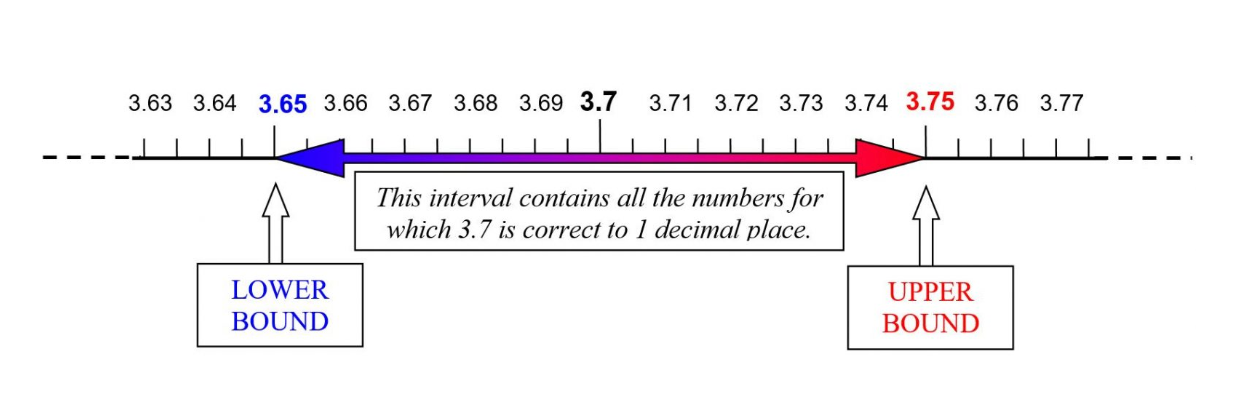
Lower bound \( = \) stated value \( – 0.5 \)
Upper bound \( = \) stated value \( + 0.5 \)
Example:
\( 12 \text{ cm to the nearest cm} \Rightarrow 11.5 \leq L < 12.5 \)
Area and Bounds
For a rectangle:
\( \mathrm{Area} = \mathrm{length} \times \mathrm{width} \)
The smallest area uses both lower bounds.
The largest area uses both upper bounds.
Example 1:
The dimensions of a rectangle are 12 cm and 8 cm to the nearest cm. Calculate, to 3 significant figures, the smallest possible area as a percentage of the largest possible area.
▶️ Answer/Explanation
Step 1: Find bounds
Length: \( 11.5 \leq L < 12.5 \)
Width: \( 7.5 \leq W < 8.5 \)
Step 2: Smallest area
\( A_{\min}=11.5\times7.5=86.25\text{ cm}^2 \)
Step 3: Largest area
\( A_{\max}=12.5\times8.5=106.25\text{ cm}^2 \)
Step 4: Percentage
\( \dfrac{86.25}{106.25}\times100 \)
\( =81.176\ldots\% \)
To 3 significant figures: \( 81.2\% \)
Conclusion: \( 81.2\% \).
Example 2:
A metal rod has length \( 25 \) cm correct to the nearest cm. Find the minimum and maximum possible lengths.
▶️ Answer/Explanation
Since it is measured to the nearest cm:
Lower bound \( =25-0.5=24.5\text{ cm} \)
Upper bound \( =25+0.5=25.5\text{ cm} \)
\( 24.5 \leq L < 25.5 \)
Conclusion: The length lies between \( 24.5\text{ cm} \) and \( 25.5\text{ cm} \).
Example 3:
A square has side \( 6 \) m correct to the nearest metre. Find the largest possible perimeter.
▶️ Answer/Explanation
Side bounds:
\( 5.5 \leq s < 6.5 \)
Largest side \( =6.5\text{ m} \)
Perimeter of a square:
\( P=4s \)
\( P_{\max}=4\times6.5=26\text{ m} \)
Conclusion: The largest possible perimeter is \( 26\text{ m} \).