
Expanding Linear Expressions
Expanding means multiplying brackets to remove them and simplify the expression.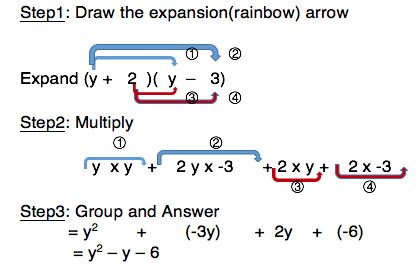
We use the distributive law:
\( a(b+c)=ab+ac \)
Two Brackets
Multiply every term in the first bracket by every term in the second bracket.
\( (a+b)(c+d)=ac+ad+bc+bd \)
After expanding, always collect like terms.
Key Idea
Each term multiplies every term in the other bracket.
Example 1:
Expand \( (x+3)(x+5) \).
▶️ Answer/Explanation
\( x(x+5)+3(x+5) \)
\( =x^2+5x+3x+15 \)
\( =x^2+8x+15 \)
Conclusion: \( x^2+8x+15 \).
Example 2:
Expand and simplify \( (2x+1)(x+4) \).
▶️ Answer/Explanation
\( 2x(x+4)+1(x+4) \)
\( =2x^2+8x+x+4 \)
\( =2x^2+9x+4 \)
Conclusion: \( 2x^2+9x+4 \).
Example 3:
Expand and simplify \( (x+y)(x+1) \).
▶️ Answer/Explanation
Multiply each term:
\( x(x+1)+y(x+1) \)
\( =x^2+x+xy+y \)
Conclusion: \( x^2+xy+x+y \).
Quadratic Expressions and Factorisation
A quadratic expression is an algebraic expression where the highest power of \( x \) is 2.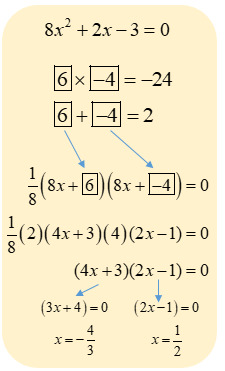
\( ax^2+bx+c \)
Examples:
\( x^2+5x+6 \)
\( 3x^2-2x+1 \)
Factorising a Quadratic
Factorising means writing the quadratic as a product of two brackets.
\( ax^2+bx+c=(px+q)(rx+s) \)
Method (AC Method)
1. Multiply \( a \times c \).
2. Find two numbers that multiply to this value and add to \( b \).
3. Split the middle term.
4. Factorise by grouping.
Example 1:
Factorise \( x^2+7x+10 \).
▶️ Answer/Explanation
Numbers that multiply to 10 and add to 7 are 5 and 2.
\( (x+5)(x+2) \)
Conclusion: \( (x+5)(x+2) \).
Example 2:
Factorise \( 2x^2+9x+4 \).
▶️ Answer/Explanation
\( a\times c=2\times4=8 \)
Numbers: 8 and 1 (sum 9)
\( 2x^2+8x+x+4 \)
\( 2x(x+4)+1(x+4) \)
\( (2x+1)(x+4) \)
Conclusion: \( (2x+1)(x+4) \).
Example 3:
Factorise \( 6x^2-5x-6 \).
▶️ Answer/Explanation
\( a\times c=6\times(-6)=-36 \)
Numbers: -9 and 4 (sum -5)
\( 6x^2-9x+4x-6 \)
\( 3x(2x-3)+2(2x-3) \)
\( (3x+2)(2x-3) \)
Conclusion: \( (3x+2)(2x-3) \).
Completing the Square
Completing the square is a method used to rewrite a quadratic expression in the form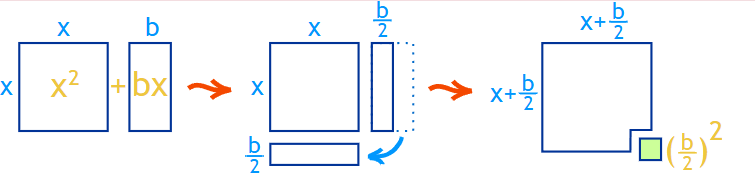
\( a(x+b)^2+c \)
This form is useful for solving equations and identifying turning points of graphs.
Steps
1. Factorise the coefficient of \( x^2 \) from the first two terms.
2. Take half of the coefficient of \( x \).
3. Square it and add inside the bracket.
4. Adjust the constant outside the bracket.
Key Idea
\( x^2+2bx+b^2=(x+b)^2 \)
Example 1:
Write \( x^2+6x+5 \) in the form \( (x+b)^2+c \).
▶️ Answer/Explanation
Half of 6 is 3.
\( (x+3)^2=x^2+6x+9 \)
\( x^2+6x+5=(x+3)^2-4 \)
Conclusion: \( (x+3)^2-4 \).
Example 2:
Write \( x^2-4x+1 \) in the form \( (x+b)^2+c \).
▶️ Answer/Explanation
Half of −4 is −2.
\( (x-2)^2=x^2-4x+4 \)
\( x^2-4x+1=(x-2)^2-3 \)
Conclusion: \( (x-2)^2-3 \).
Example 3:
Write \( 2x^2+6x-1 \) in the form \( a(x+b)^2+c \).
▶️ Answer/Explanation
Factorise 2 from first two terms:
\( 2(x^2+3x)-1 \)
Half of 3 is \( \dfrac{3}{2} \), square it:
\( \left(\dfrac{3}{2}\right)^2=\dfrac{9}{4} \)
\( 2\left(x^2+3x+\dfrac{9}{4}\right)-2\cdot\dfrac{9}{4}-1 \)
\( 2\left(x+\dfrac{3}{2}\right)^2-\dfrac{9}{2}-1 \)
\( 2\left(x+\dfrac{3}{2}\right)^2-\dfrac{11}{2} \)
Conclusion: \( 2\left(x+\dfrac{3}{2}\right)^2-\dfrac{11}{2} \).