
Solving Quadratic Equations by Factorisation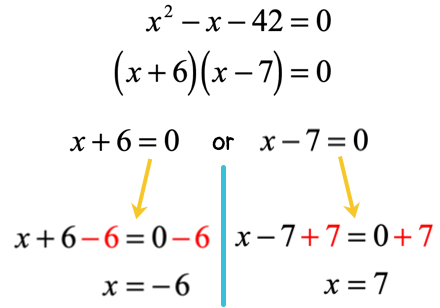
A quadratic equation is an equation that contains \( x^2 \) as the highest power.
\( ax^2+bx+c=0 \)
To solve it by factorisation, we write the quadratic as two brackets and use the zero product rule.
If \( AB=0 \), then \( A=0 \) or \( B=0 \).
Steps
1. Rearrange the equation so one side equals 0.
2. Factorise the quadratic.
3. Set each bracket equal to 0.
4. Solve for \( x \).
Example 1:
Solve \( 2x^2-3x+1=0 \).
▶️ Answer/Explanation
Factorise:
\( (2x-1)(x-1)=0 \)
Set each bracket to zero:
\( 2x-1=0 \Rightarrow x=\dfrac{1}{2} \)
\( x-1=0 \Rightarrow x=1 \)
Conclusion: \( x=\dfrac{1}{2},\;1 \).
Example 2:
Solve \( x(3x-2)=5 \).
▶️ Answer/Explanation
First rearrange:
\( 3x^2-2x-5=0 \)
Factorise:
\( (3x-5)(x+1)=0 \)
Solve:
\( 3x-5=0 \Rightarrow x=\dfrac{5}{3} \)
\( x+1=0 \Rightarrow x=-1 \)
Conclusion: \( x=\dfrac{5}{3},\;-1 \).
Example 3:
Solve \( x^2-9=0 \).
▶️ Answer/Explanation
Difference of squares:
\( (x-3)(x+3)=0 \)
\( x=3 \) or \( x=-3 \)
Conclusion: \( x=3,\;-3 \).
Solving Quadratic Equations Using the Quadratic Formula and Completing the Square
Some quadratic equations cannot be factorised easily. In these cases we solve them using either the quadratic formula or completing the square.
The Quadratic Formula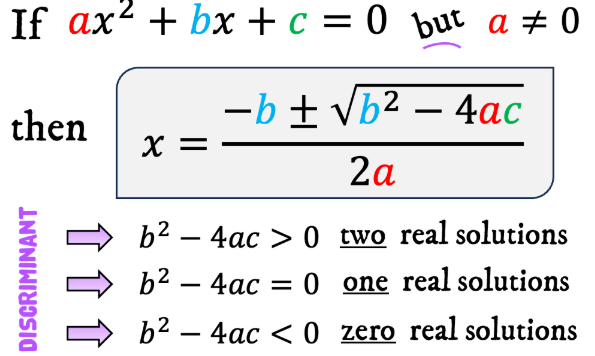
For the equation
\( ax^2+bx+c=0 \)
the solutions are
\( x=\dfrac{-b\pm\sqrt{b^2-4ac}}{2a} \)
The value inside the square root \( b^2-4ac \) is called the discriminant.
Completing the Square
We rewrite the quadratic into a squared bracket and then solve.
\( (x+b)^2=k \Rightarrow x=-b\pm\sqrt{k} \)
Example 1:
Solve \( x^2-5x+6=0 \).
▶️ Answer/Explanation
Here \( a=1,\;b=-5,\;c=6 \).
\( x=\dfrac{-(-5)\pm\sqrt{(-5)^2-4(1)(6)}}{2(1)} \)
\( x=\dfrac{5\pm\sqrt{25-24}}{2} \)
\( x=\dfrac{5\pm1}{2} \)
\( x=3 \) or \( x=2 \)
Conclusion: \( x=2,\;3 \).
Example 2 :
Solve \( 2x^2+3x-2=0 \).
▶️ Answer/Explanation
\( a=2,\;b=3,\;c=-2 \)
\( x=\dfrac{-3\pm\sqrt{3^2-4(2)(-2)}}{4} \)
\( x=\dfrac{-3\pm\sqrt{9+16}}{4} \)
\( x=\dfrac{-3\pm5}{4} \)
\( x=\dfrac{1}{2} \) or \( x=-2 \)
Conclusion: \( x=\dfrac{1}{2},\;-2 \).
Example 3:
Solve \( x^2+4x+1=0 \) by completing the square.
▶️ Answer/Explanation
Complete the square:
\( x^2+4x+1=0 \)
\( (x+2)^2-4+1=0 \)
\( (x+2)^2-3=0 \)
\( (x+2)^2=3 \)
\( x+2=\pm\sqrt{3} \)
\( x=-2\pm\sqrt{3} \)
Conclusion: \( x=-2\pm\sqrt{3} \).