
Recognising and Drawing Graphs (Cubic, Reciprocal and Trigonometric)
You should be able to recognise the shape of a graph from its equation and sketch it using key features such as intercepts, turning points and asymptotes.
1. Cubic Graphs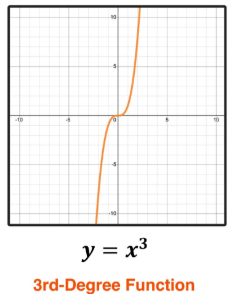
General form:
\( y=Ax^3+Bx^2+Cx+D \)
Key features:
- S-shaped curve
- Always continuous
- May cross the x-axis up to three times
- Positive \( A \): rises left to right
- Negative \( A \): falls left to right
Examples:
\( y=x^3 \)
\( y=3x^3-2x^2+5x-4 \)
\( y=2x^3-6x+2 \)
2. Reciprocal Graphs
Basic reciprocal function: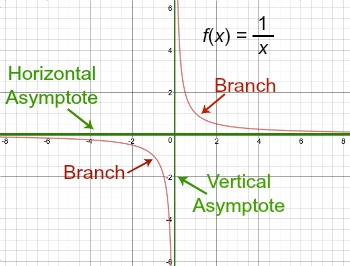
\( y=\dfrac{1}{x},\;x\neq0 \)
Key features:
- Two separate curves
- Never touches axes
- Vertical asymptote \( x=0 \)
- Horizontal asymptote \( y=0 \)
More complicated forms:
\( y=\dfrac{2x^2+3x}{x} \)
\( y=\dfrac{1}{x}(3x^2-5),\;x\neq0 \)
\( w=\dfrac{5}{d^2},\;d\neq0 \)
3. Trigonometric Graphs (Degrees)
You must recognise the graphs of: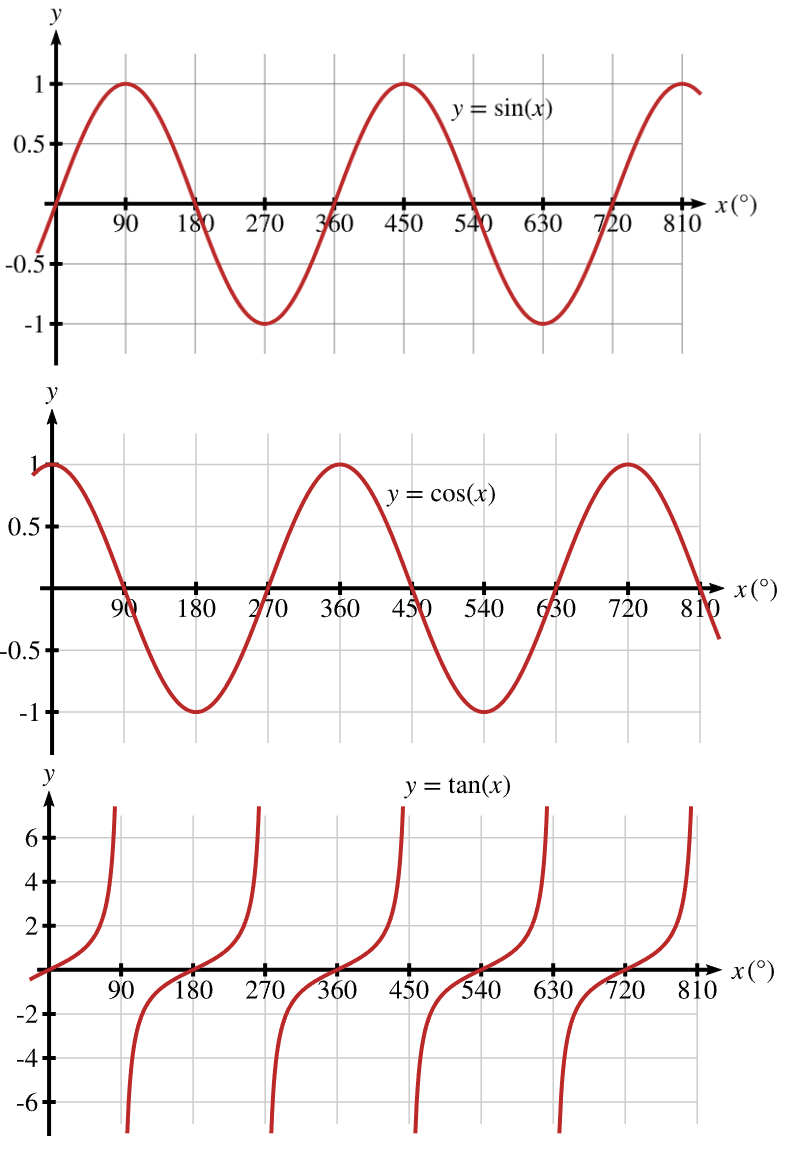
\( y=\sin x \)
\( y=\cos x \)
\( y=\tan x \)
Sine Graph
- Smooth wave
- Period \( 360^\circ \)
- Maximum 1, minimum −1
Cosine Graph
- Same shape as sine but starts at 1
- Period \( 360^\circ \)
Tangent Graph
- Repeating curve
- Vertical asymptotes at \( 90^\circ,270^\circ,\dots \)
- Period \( 180^\circ \)
Example 1:
State the shape of the graph \( y=x^3 \).
▶️ Answer/Explanation
It is a cubic S-shaped curve passing through the origin.
Conclusion: Cubic graph.
Example 2:
Identify the asymptotes of \( y=\dfrac{1}{x} \).
▶️ Answer/Explanation
Vertical asymptote: \( x=0 \)
Horizontal asymptote: \( y=0 \)
Conclusion: \( x=0,\;y=0 \).
Example 3:
State the period of \( y=\tan x \).
▶️ Answer/Explanation
The tangent graph repeats every \( 180^\circ \).
Conclusion: \( 180^\circ \).
Gradient and Equation of a Straight Line
The gradient (slope) of a straight line measures how steep the line is.
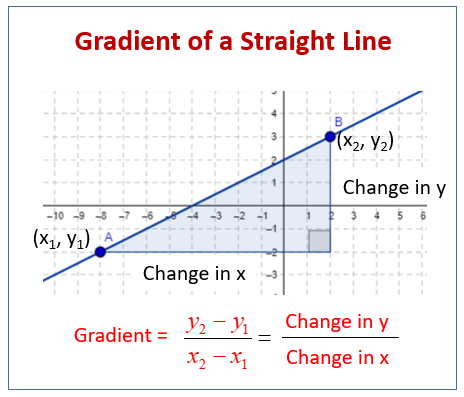
For two points \( (x_1,y_1) \) and \( (x_2,y_2) \):
\( m=\dfrac{y_2-y_1}{x_2-x_1} \)
Equation of a Line
The equation of a straight line is written as:
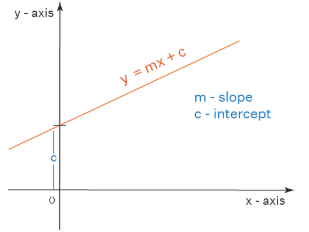
\( y=mx+c \)
where \( m \) is the gradient and \( c \) is the y-intercept.
After finding \( m \), substitute one point into the equation to find \( c \).
Example 1:
Find the gradient of the line through \( (3,2) \) and \( (7,10) \).
▶️ Answer/Explanation
\( m=\dfrac{10-2}{7-3}=\dfrac{8}{4}=2 \)
Conclusion: Gradient \( =2 \).
Example 2:
Find the equation of the straight line through \( (1,7) \) and \( (2,9) \).
▶️ Answer/Explanation
Step 1: Gradient
\( m=\dfrac{9-7}{2-1}=2 \)
Step 2: Find \( c \)
Use point \( (1,7) \) in \( y=mx+c \).
\( 7=2(1)+c \)
\( 7=2+c \)
\( c=5 \)
Final Equation
\( y=2x+5 \)
Conclusion: \( y=2x+5 \).
Example 3:
Check that the point \( (3,11) \) lies on the line \( y=2x+5 \).
▶️ Answer/Explanation
Substitute \( x=3 \):
\( y=2(3)+5=6+5=11 \)
Conclusion: The point lies on the line.
Parallel and Perpendicular Lines
Parallel Lines
Parallel lines have the same gradient.
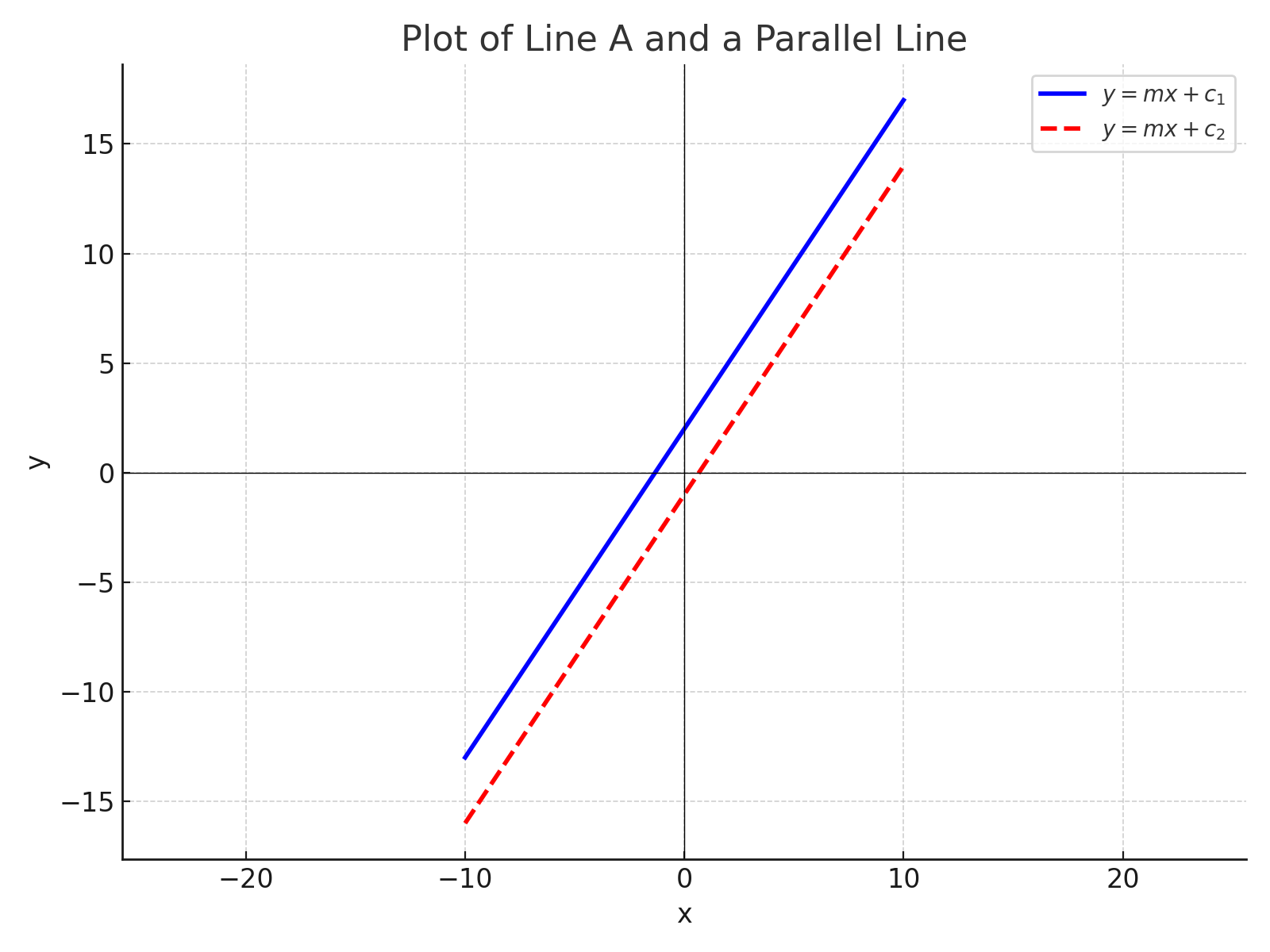
If \( y=mx+c \), any parallel line has gradient \( m \).
Perpendicular Lines
Perpendicular lines meet at \( 90^\circ \).
Their gradients are negative reciprocals.
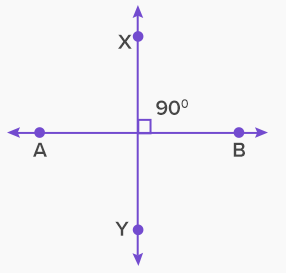
If gradient is \( m \), perpendicular gradient \( =-\dfrac{1}{m} \)
Example:
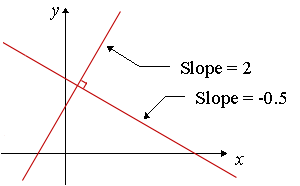
Line with gradient \( 2 \Rightarrow \) perpendicular gradient \( -\dfrac{1}{2} \)
Finding the Equation
1. Find the gradient.
2. Use a given point to find \( c \).
3. Write in \( y=mx+c \) form.
Example 1:
Find the equation of the line perpendicular to \( y=2x+5 \) through \( (3,7) \).
▶️ Answer/Explanation
Step 1: Gradient
Original gradient \( =2 \)
Perpendicular gradient \( =-\dfrac{1}{2} \)
Step 2: Substitute point
Use \( y=mx+c \) and point \( (3,7) \).
\( 7=-\dfrac{1}{2}(3)+c \)
\( 7=-\dfrac{3}{2}+c \)
\( c=\dfrac{17}{2} \)
Final Equation
\( y=-\dfrac{1}{2}x+\dfrac{17}{2} \)
Conclusion: \( y=-\dfrac{1}{2}x+\dfrac{17}{2} \).
Example 2:
Find a line parallel to \( y=3x-4 \) passing through \( (2,5) \).
▶️ Answer/Explanation
Parallel gradient \( =3 \).
\( 5=3(2)+c \)
\( 5=6+c \)
\( c=-1 \)
\( y=3x-1 \)
Conclusion: \( y=3x-1 \).
Example 3:
Determine whether the lines \( y=\dfrac{1}{2}x+1 \) and \( y=-2x+3 \) are perpendicular.
▶️ Answer/Explanation
Gradients: \( \dfrac{1}{2} \) and \( -2 \).
\( \dfrac{1}{2}\times(-2)=-1 \)
Conclusion: The lines are perpendicular.