
Geometrical Reasoning (Giving Reasons for Angles)
In geometry you must not only find angles, but also justify each step using standard geometrical facts.
Common Angle Facts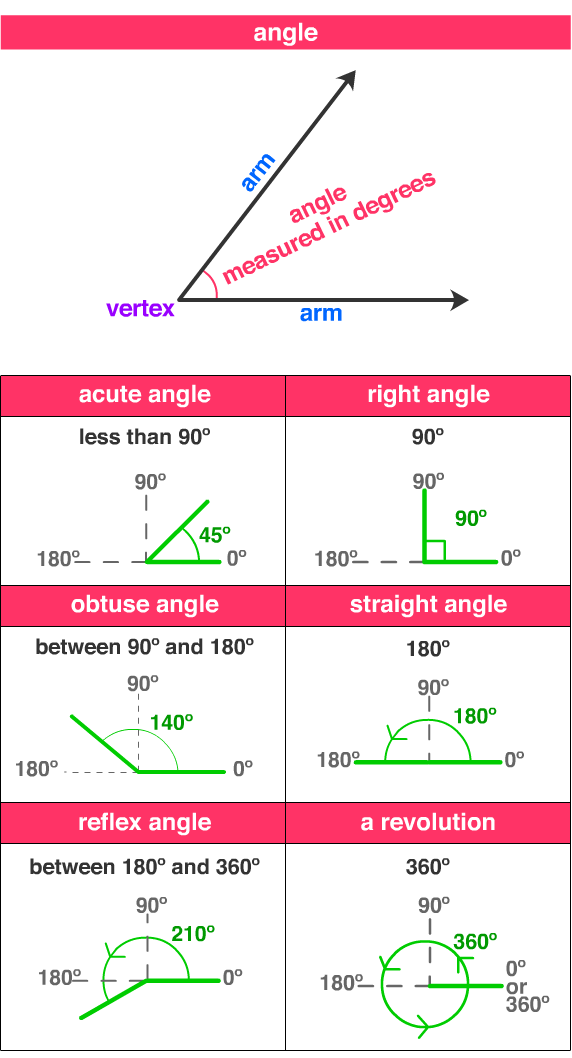
Angles in Lines
- Angles on a straight line sum to \( 180^\circ \)
- Vertically opposite angles are equal
Parallel Lines
- Corresponding angles are equal
- Alternate angles are equal
- Co-interior angles sum to \( 180^\circ \)
Triangles
- Angles in a triangle sum to \( 180^\circ \)
- Isosceles triangle base angles are equal
- Exterior angle equals sum of opposite interior angles
Polygons
Sum of interior angles \( =(n-2)\times180^\circ \)
Circle Theorems
- Angle in a semicircle is \( 90^\circ \)
- Angles in the same segment are equal
- Angle at centre is twice angle at circumference
- Opposite angles in a cyclic quadrilateral sum to \( 180^\circ \)
- Radius is perpendicular to tangent
Example 1:
Two angles on a straight line are \( 3x \) and \( 60^\circ \). Find \( x \).
▶️ Answer/Explanation
Angles on a straight line sum to \( 180^\circ \).
\( 3x+60=180 \)
\( 3x=120 \)
\( x=40^\circ \)
Conclusion: \( x=40^\circ \).
Example 2:
The angles of a triangle are \( x \), \( x+20 \), and \( x+40 \). Find \( x \).
▶️ Answer/Explanation
Angles in a triangle sum to \( 180^\circ \).
\( x+(x+20)+(x+40)=180 \)
\( 3x+60=180 \)
\( 3x=120 \)
\( x=40^\circ \)
Conclusion: \( x=40^\circ \).
Example 3:
Opposite angles of a cyclic quadrilateral are \( 2x+10 \) and \( 3x-20 \). Find \( x \).
▶️ Answer/Explanation
Opposite angles in a cyclic quadrilateral sum to \( 180^\circ \).
\( (2x+10)+(3x-20)=180 \)
\( 5x-10=180 \)
\( 5x=190 \)
\( x=38^\circ \)
Conclusion: \( x=38^\circ \).