
Trigonometric Ratios for Obtuse Angles
An obtuse angle is an angle greater than \( 90^\circ \) but less than \( 180^\circ \).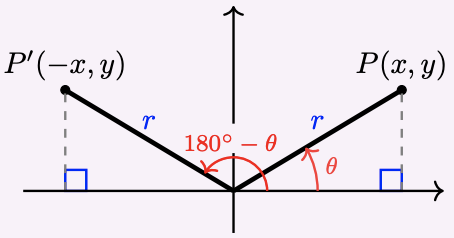
\( 90^\circ<\theta<180^\circ \)
Sine, cosine and tangent can still be used for these angles.
Important Idea
Obtuse angles lie in the second quadrant.
Signs of trig ratios:
- \( \sin\theta \) is positive
- \( \cos\theta \) is negative
- \( \tan\theta \) is negative
Related Acute Angle
For an obtuse angle:
\( \theta=180^\circ-\alpha \)
where \( \alpha \) is the related acute angle.
Therefore:
\( \sin(180^\circ-\alpha)=\sin\alpha \)
\( \cos(180^\circ-\alpha)=-\cos\alpha \)
\( \tan(180^\circ-\alpha)=-\tan\alpha \)
Example 1:
Find \( \sin120^\circ \).
▶️ Answer/Explanation
\( 120^\circ=180^\circ-60^\circ \)
\( \sin120^\circ=\sin60^\circ \)
\( \sin60^\circ=\dfrac{\sqrt{3}}{2} \)
Conclusion: \( \dfrac{\sqrt{3}}{2} \).
Example 2:
Find \( \cos150^\circ \).
▶️ Answer/Explanation
\( 150^\circ=180^\circ-30^\circ \)
\( \cos150^\circ=-\cos30^\circ \)
\( \cos30^\circ=\dfrac{\sqrt{3}}{2} \)
\( \cos150^\circ=-\dfrac{\sqrt{3}}{2} \)
Conclusion: \( -\dfrac{\sqrt{3}}{2} \).
Example 3:
Find \( \tan135^\circ \).
▶️ Answer/Explanation
\( 135^\circ=180^\circ-45^\circ \)
\( \tan135^\circ=-\tan45^\circ \)
\( \tan45^\circ=1 \)
\( \tan135^\circ=-1 \)
Conclusion: \( -1 \).
Angles of Elevation and Depression
These problems involve looking upwards or downwards and using right-angled triangle trigonometry.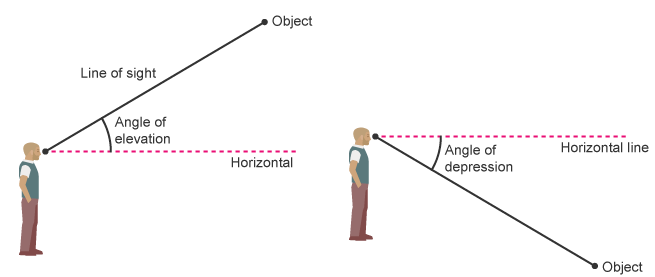
Angle of Elevation
The angle between the horizontal and the line of sight when looking up at an object.
Angle of Depression
The angle between the horizontal and the line of sight when looking down at an object.
Important Fact
The angle of elevation equals the angle of depression because they are alternate angles between parallel horizontal lines.
Using Trigonometry
For a right-angled triangle:
\( \sin\theta=\dfrac{\mathrm{opposite}}{\mathrm{hypotenuse}} \)
\( \cos\theta=\dfrac{\mathrm{adjacent}}{\mathrm{hypotenuse}} \)
\( \tan\theta=\dfrac{\mathrm{opposite}}{\mathrm{adjacent}} \)
Most elevation and depression questions use:
\( \tan\theta=\dfrac{\mathrm{height}}{\mathrm{horizontal\ distance}} \)
Example 1:
A tree is \( 8 \) m high. A person stands \( 10 \) m away. Find the angle of elevation to the top of the tree.
▶️ Answer/Explanation
\( \tan\theta=\dfrac{8}{10}=0.8 \)
\( \theta=\tan^{-1}(0.8) \approx 38.7^\circ \)
Conclusion: \( 38.7^\circ \).
Example 2:
From the top of a \( 20 \) m building, the angle of depression to a car is \( 25^\circ \). Find the horizontal distance to the car.
▶️ Answer/Explanation
Angle of elevation from the car is also \( 25^\circ \).
\( \tan25^\circ=\dfrac{20}{d} \)
\( d=\dfrac{20}{\tan25^\circ} \approx 42.9\text{ m} \)
Conclusion: \( 42.9\text{ m} \).
Example 3:
A ladder \( 6 \) m long leans against a wall. The base is \( 2 \) m from the wall. Find the angle between the ladder and the ground.
▶️ Answer/Explanation
\( \cos\theta=\dfrac{2}{6}=\dfrac{1}{3} \)
\( \theta=\cos^{-1}\left(\dfrac{1}{3}\right)\approx70.5^\circ \)
Conclusion: \( 70.5^\circ \).
Sine Rule and Cosine Rule
For any triangle (not necessarily right-angled), we use the sine rule or cosine rule to find missing sides or angles.
Labelling a Triangle
The sides \( a,b,c \) are opposite angles \( A,B,C \) respectively.
The Sine Rule
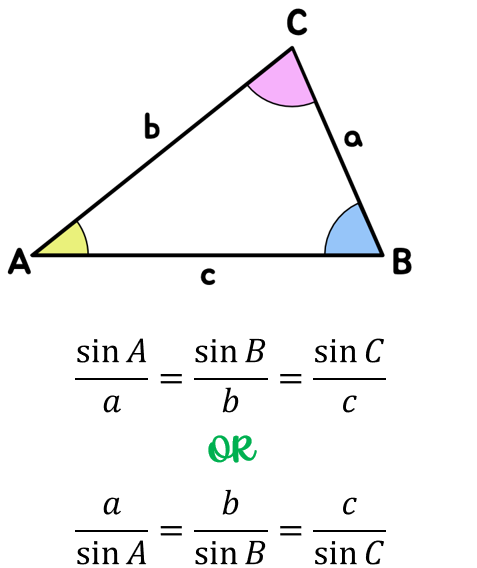
\( \dfrac{a}{\sin A}=\dfrac{b}{\sin B}=\dfrac{c}{\sin C} \)
Use when:
- Two angles and one side are known
- Two sides and a non-included angle are known
The Cosine Rule
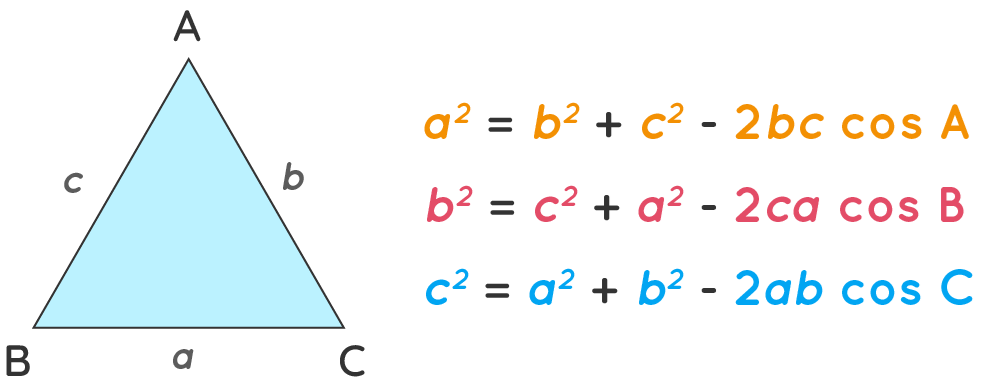
\( a^2=b^2+c^2-2bc\cos A \)
Use when:
- Two sides and the included angle are known
- All three sides are known (to find an angle)
Example 1:
In a triangle, \( A=40^\circ \), \( B=65^\circ \) and side \( a=8\text{ cm} \). Find side \( b \).
▶️ Answer/Explanation
\( \dfrac{a}{\sin A}=\dfrac{b}{\sin B} \)
\( \dfrac{8}{\sin40^\circ}=\dfrac{b}{\sin65^\circ} \)
\( b=\dfrac{8\sin65^\circ}{\sin40^\circ}\approx11.3\text{ cm} \)
Conclusion: \( b\approx11.3\text{ cm} \).
Example 2:
Two sides of a triangle are \( 7\text{ cm} \) and \( 10\text{ cm} \) with included angle \( 60^\circ \). Find the third side.
▶️ Answer/Explanation
\( a^2=7^2+10^2-2(7)(10)\cos60^\circ \)
\( a^2=49+100-140\cdot\dfrac{1}{2} \)
\( a^2=149-70=79 \)
\( a=\sqrt{79}\approx8.89\text{ cm} \)
Conclusion: \( \approx8.89\text{ cm} \).
Example 3:
A triangle has sides \( 5\text{ cm}, 6\text{ cm}, 7\text{ cm} \). Find the angle opposite the side \( 7\text{ cm} \).
▶️ Answer/Explanation
Use cosine rule:
\( 7^2=5^2+6^2-2(5)(6)\cos C \)
\( 49=25+36-60\cos C \)
\( 49=61-60\cos C \)
\( 60\cos C=12 \)
\( \cos C=0.2 \)
\( C=\cos^{-1}(0.2)\approx78.5^\circ \)
Conclusion: \( \approx78.5^\circ \).
Pythagoras’ Theorem in Three Dimensions
Pythagoras’ theorem can be extended to 3D shapes such as cuboids, pyramids and prisms.
In 2D:
\( c^2=a^2+b^2 \)
In 3D, we apply Pythagoras twice.
Space Diagonal of a Cuboid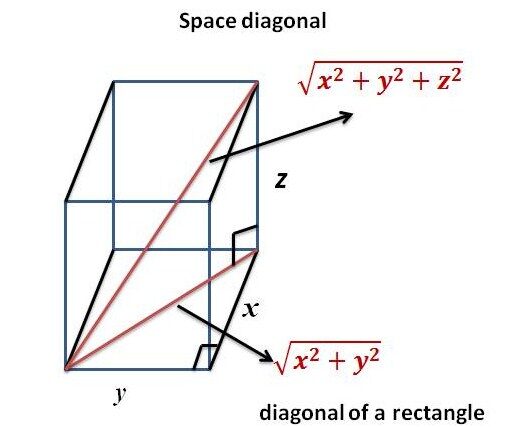
For a cuboid with length \( l \), width \( w \), height \( h \):
\( d=\sqrt{l^2+w^2+h^2} \)
This gives the distance between opposite corners.
Method
1. Find the diagonal of the base rectangle.
2. Use Pythagoras again with the height.
Example 1:
A cuboid has dimensions \( 3\text{ cm},4\text{ cm},12\text{ cm} \). Find the space diagonal.
▶️ Answer/Explanation
\( d=\sqrt{3^2+4^2+12^2} \)
\( d=\sqrt{9+16+144}=\sqrt{169}=13\text{ cm} \)
Conclusion: \( 13\text{ cm} \).
Example 2:
A box measures \( 5\text{ cm} \times 12\text{ cm} \times 9\text{ cm} \). Find the distance between opposite corners.
▶️ Answer/Explanation
\( d=\sqrt{5^2+12^2+9^2} \)
\( d=\sqrt{25+144+81}=\sqrt{250} \)
\( d\approx15.8\text{ cm} \)
Conclusion: \( 15.8\text{ cm} \).
Example 3:
A vertical pole \( 10\text{ m} \) high stands on a square base of side \( 6\text{ m} \). Find the distance from the top of the pole to a corner of the base.
▶️ Answer/Explanation
First find base diagonal:
\( \sqrt{6^2+6^2}=\sqrt{72} \)
Now use height:
\( d=\sqrt{72+10^2}=\sqrt{72+100}=\sqrt{172} \)
\( d\approx13.1\text{ m} \)
Conclusion: \( 13.1\text{ m} \).
Area of a Triangle Using \( \dfrac{1}{2}ab\sin C \)
For any triangle (not necessarily right-angled), the area can be found using:
\( \mathrm{Area}=\dfrac{1}{2}ab\sin C \)
where \( a \) and \( b \) are two sides and \( C \) is the included angle between them.
Important
- The angle must be between the two known sides
- Angles are measured in degrees
This formula works for any triangle.
Example 1:
Two sides of a triangle are \( 6\text{ cm} \) and \( 8\text{ cm} \) with included angle \( 30^\circ \). Find the area.
▶️ Answer/Explanation
\( \mathrm{Area}=\dfrac{1}{2}\times6\times8\times\sin30^\circ \)
\( =24\times\dfrac{1}{2}=12\text{ cm}^2 \)
Conclusion: \( 12\text{ cm}^2 \).
Example 2:
Find the area of a triangle with sides \( 7\text{ cm} \) and \( 9\text{ cm} \) and included angle \( 50^\circ \).
▶️ Answer/Explanation
\( \mathrm{Area}=\dfrac{1}{2}\times7\times9\times\sin50^\circ \)
\( =31.5\times\sin50^\circ \)
\( \approx31.5\times0.766=24.1\text{ cm}^2 \)
Conclusion: \( \approx24.1\text{ cm}^2 \).
Example 3:
A triangle has sides \( 10\text{ m} \) and \( 13\text{ m} \) with included angle \( 120^\circ \). Find the area.
▶️ Answer/Explanation
\( \mathrm{Area}=\dfrac{1}{2}\times10\times13\times\sin120^\circ \)
\( =65\times\sin120^\circ \)
\( \sin120^\circ=\sin60^\circ=\dfrac{\sqrt{3}}{2} \)
\( \mathrm{Area}=65\times\dfrac{\sqrt{3}}{2}\approx56.3\text{ m}^2 \)
Conclusion: \( \approx56.3\text{ m}^2 \).
Trigonometry in Three Dimensions
In 3D problems we combine Pythagoras and trigonometry to find distances and angles inside solid shapes such as cuboids and pyramids.
Angle Between a Line and a Plane
The angle between a line and a plane is the angle between the line and its projection onto the plane.
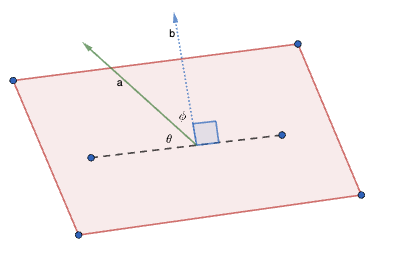
This always forms a right-angled triangle.
We commonly use:
\( \sin\theta=\dfrac{\mathrm{vertical\ height}}{\mathrm{sloping\ edge}} \)
\( \tan\theta=\dfrac{\mathrm{vertical\ height}}{\mathrm{horizontal\ distance}} \)
Method
1. Draw the triangle inside the 3D shape.
2. Use Pythagoras to find missing sides.
3. Apply sine, cosine or tangent.
Example 1:
A cuboid has base \( 6\text{ m} \) by \( 8\text{ m} \) and height \( 5\text{ m} \). Find the angle between the diagonal and the base.
▶️ Answer/Explanation
Base diagonal:
\( \sqrt{6^2+8^2}=10 \)
Now use tangent:
\( \tan\theta=\dfrac{5}{10}=0.5 \)
\( \theta=\tan^{-1}(0.5)\approx26.6^\circ \)
Conclusion: \( 26.6^\circ \).
Example 2:
A vertical tower \( 12\text{ m} \) stands at the centre of a square base of side \( 10\text{ m} \). Find the angle between the sloping edge from the top to a corner and the ground.
▶️ Answer/Explanation
Half the diagonal of base:
\( \sqrt{5^2+5^2}=\sqrt{50} \)
Use tangent:
\( \tan\theta=\dfrac{12}{\sqrt{50}} \)
\( \theta\approx59.7^\circ \)
Conclusion: \( 59.7^\circ \).
Example 3:
A ladder reaches a point \( 4\text{ m} \) up a wall and its foot is \( 3\text{ m} \) away from the wall. Find the angle between the ladder and the wall.
▶️ Answer/Explanation
Length of ladder:
\( \sqrt{4^2+3^2}=5 \)
Angle with wall uses cosine:
\( \cos\theta=\dfrac{4}{5} \)
\( \theta=\cos^{-1}(0.8)\approx36.9^\circ \)
Conclusion: \( 36.9^\circ \).