
Tree Diagrams
A tree diagram is used to show all possible outcomes of events that happen one after another.

Each branch represents an outcome and is labelled with its probability.
Key Rules
- Probabilities on branches from the same point add to \( 1 \)
- To find the probability of a path, multiply along the branches
- To combine different paths, add the probabilities
Method
1. Draw the first set of branches.
2. From each branch, draw the second set of outcomes.
3. Multiply probabilities along a branch.
4. Add probabilities if more than one path gives the required result.
Example 1:
A coin is tossed twice. Find the probability of getting two heads.
▶️ Answer/Explanation
Each toss:
\( P(H)=\dfrac{1}{2},\;P(T)=\dfrac{1}{2} \)
Multiply along the HH path:
\( \dfrac{1}{2}\times\dfrac{1}{2}=\dfrac{1}{4} \)

Conclusion: \( \dfrac{1}{4} \).
Example 2:
A bag contains 3 red and 2 blue balls. One ball is chosen and replaced, then another is chosen. Find the probability of two red balls.
▶️ Answer/Explanation
Total balls \( = 5 \)
\( P(R)=\dfrac{3}{5} \)
Replacement means probabilities stay the same.
\( P(RR)=\dfrac{3}{5}\times\dfrac{3}{5}=\dfrac{9}{25} \)
Conclusion: \( \dfrac{9}{25} \).
Example 3:
A spinner has three equal sections numbered 1, 2 and 3. It is spun twice. Find the probability of getting a total of 4.
▶️ Answer/Explanation
Each number has probability \( \dfrac{1}{3} \).
Ways to total 4:
\( (1,3),(3,1),(2,2) \)
Each path:
\( \dfrac{1}{3}\times\dfrac{1}{3}=\dfrac{1}{9} \)
Add probabilities:
\( 3\times\dfrac{1}{9}=\dfrac{1}{3} \)
Conclusion: \( \dfrac{1}{3} \).
Independent Events
Two events are independent if one event does not affect the probability of the other.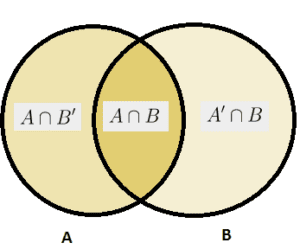
Examples:
- Tossing a coin repeatedly
- Rolling a dice several times
- Choosing with replacement
Key Rule
To find the probability that independent events both occur, multiply the probabilities.
\( P(A\ \text{and}\ B)=P(A)\times P(B) \)
For more than two events:
\( P(A\cap B\cap C)=P(A)\times P(B)\times P(C) \)
Example 1:
A fair coin is tossed and a fair dice is rolled. Find the probability of getting a head and a 6.
▶️ Answer/Explanation
\( P(H)=\dfrac{1}{2} \)
\( P(6)=\dfrac{1}{6} \)
\( P(H\text{ and }6)=\dfrac{1}{2}\times\dfrac{1}{6}=\dfrac{1}{12} \)
Conclusion: \( \dfrac{1}{12} \).
Example 2:
A dice is rolled twice. Find the probability of getting two 4s.
▶️ Answer/Explanation
\( P(4)=\dfrac{1}{6} \)
\( P(4\text{ and }4)=\dfrac{1}{6}\times\dfrac{1}{6}=\dfrac{1}{36} \)
Conclusion: \( \dfrac{1}{36} \).
Example 3:
A spinner gives red with probability \( \dfrac{2}{5} \). It is spun three times. Find the probability of getting red each time.
▶️ Answer/Explanation
\( P(RRR)=\dfrac{2}{5}\times\dfrac{2}{5}\times\dfrac{2}{5} \)
\( =\dfrac{8}{125} \)
Conclusion: \( \dfrac{8}{125} \).
Conditional Probability (Without Replacement)
Conditional probability occurs when the probability of the second event depends on the first event.

This usually happens when objects are chosen without replacement.
Because the first item is not put back, the total number of items changes.
Key Idea
We still multiply probabilities along a branch, but the second probability is different.
\( P(A\text{ then }B)=P(A)\times P(B\mid A) \)
Here \( P(B\mid A) \) means “probability of \( B \) given \( A \) has already happened”.
Example 1:
A bag contains 4 red and 3 blue balls. Two balls are picked one after the other without replacement. Find the probability of two red balls.
▶️ Answer/Explanation
Total balls \( =7 \)
First red \( =\dfrac{4}{7} \)
After removing one red:
3 red left out of 6 balls
Second red \( =\dfrac{3}{6}=\dfrac{1}{2} \)
\( P(RR)=\dfrac{4}{7}\times\dfrac{1}{2}=\dfrac{2}{7} \)
Conclusion: \( \dfrac{2}{7} \).
Example 2:
A box contains 5 green and 2 yellow counters. Two counters are drawn without replacement. Find the probability of one green then one yellow.
▶️ Answer/Explanation
First green \( =\dfrac{5}{7} \)
After removal:
2 yellow out of 6
Second yellow \( =\dfrac{2}{6}=\dfrac{1}{3} \)
\( P(GY)=\dfrac{5}{7}\times\dfrac{1}{3}=\dfrac{5}{21} \)
Conclusion: \( \dfrac{5}{21} \).
Example 3:
A bag has 3 white and 4 black balls. Two balls are drawn without replacement. Find the probability that the balls are different colours.
▶️ Answer/Explanation
Two possible paths:
White then black
Black then white
White then black:
\( \dfrac{3}{7}\times\dfrac{4}{6}=\dfrac{12}{42}=\dfrac{2}{7} \)
Black then white:
\( \dfrac{4}{7}\times\dfrac{3}{6}=\dfrac{12}{42}=\dfrac{2}{7} \)
Add:
\( \dfrac{2}{7}+\dfrac{2}{7}=\dfrac{4}{7} \)
Conclusion: \( \dfrac{4}{7} \).
Applying Probability to Problems
Probability is used to predict how likely an event is to happen in real situations.
The probability of an event:
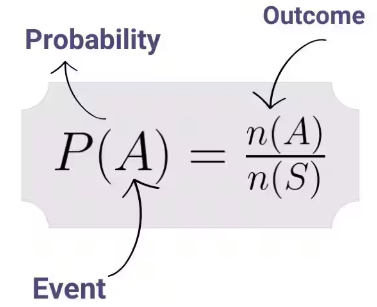
\( \mathrm{Probability}=\dfrac{\mathrm{number\ of\ favourable\ outcomes}}{\mathrm{total\ number\ of\ possible\ outcomes}} \)
Probability values lie between:
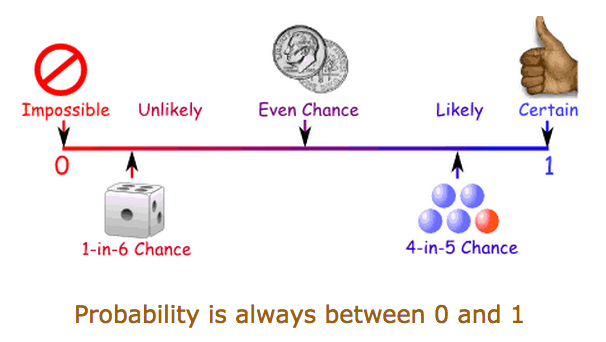
\( 0\leq P\leq1 \)
- \( 0 \) means impossible
- \( 1 \) means certain
Complementary Events
The probability an event does not happen:
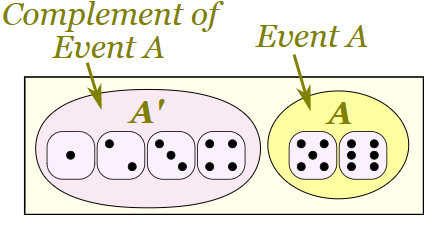
\( P(\mathrm{not}\ A)=1-P(A) \)
Example 1:
A bag contains 5 red, 3 blue and 2 green balls. One ball is chosen at random. Find the probability it is blue.
▶️ Answer/Explanation
Total balls \( =10 \)
Blue balls \( =3 \)
\( P(\mathrm{blue})=\dfrac{3}{10} \)
Conclusion: \( \dfrac{3}{10} \).
Example 2:
A fair dice is rolled. Find the probability of not getting a 6.
▶️ Answer/Explanation
\( P(6)=\dfrac{1}{6} \)
\( P(\mathrm{not\ }6)=1-\dfrac{1}{6}=\dfrac{5}{6} \)
Conclusion: \( \dfrac{5}{6} \).
Example 3:
The probability of rain tomorrow is \( 0.35 \). Find the probability that it does not rain.
▶️ Answer/Explanation
\( P(\mathrm{no\ rain})=1-0.35=0.65 \)
Conclusion: \( 0.65 \).