
Algebraic Proof
An algebraic proof shows that a statement is always true using algebra, not numbers.
Instead of testing examples, we let a number be a variable such as \( n \) and prove the result works for all values.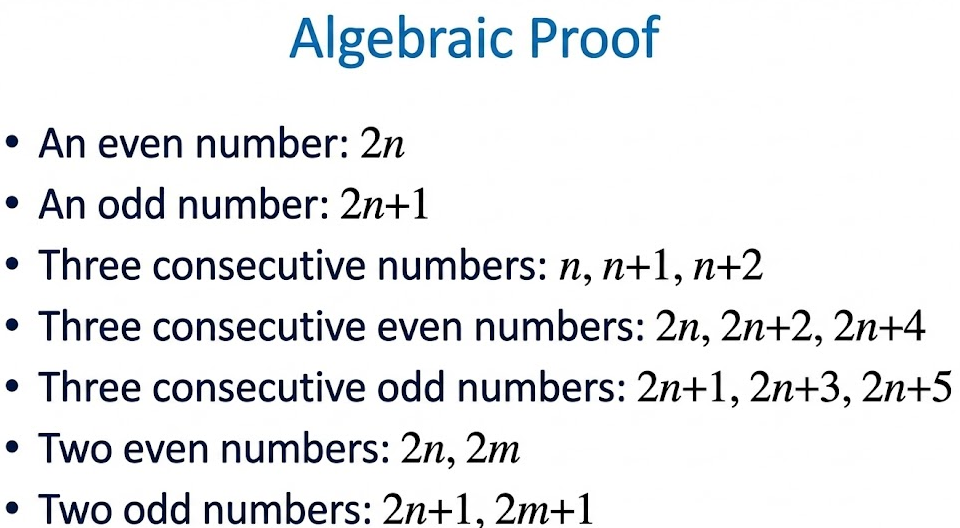
Useful Ideas
- An even number can be written as \( 2n \)
- An odd number can be written as \( 2n+1 \)
- Consecutive integers: \( n,\;n+1,\;n+2 \)
Method
1. Let the number be \( n \).
2. Form an expression.
3. Simplify algebraically.
4. Show it matches the required form.
Example 1:
Prove that the sum of two even numbers is even.
▶️ Answer/Explanation
Let the numbers be \( 2n \) and \( 2m \).
Sum \( =2n+2m \)
\( =2(n+m) \)
This is a multiple of 2, therefore even.
Conclusion: Always even.
Example 2:
Prove that the square of an odd number is odd.
▶️ Answer/Explanation
Let the odd number be \( 2n+1 \).
\( (2n+1)^2 \)
\( =4n^2+4n+1 \)
\( =2(2n^2+2n)+1 \)
This is of the form \( 2k+1 \), so it is odd.
Conclusion: Always odd.
Example 3:
Prove that the sum of three consecutive integers is divisible by 3.
▶️ Answer/Explanation
Let the integers be \( n,\;n+1,\;n+2 \).
Sum \( =n+(n+1)+(n+2) \)
\( =3n+3 \)
\( =3(n+1) \)
This is a multiple of 3.
Conclusion: Divisible by 3.