
Changing the Subject of a Formula
Very often in mathematics and science we need to rearrange a formula so that a different variable becomes the subject.
The subject of a formula is the letter that stands alone on one side of the equation.
For example:
In \( A=\pi r^2 \), the subject is \( A \).
If we are asked to make \( r \) the subject, we must rearrange the equation so that \( r \) is alone.
Key Principle
An equation is like a balance. Whatever operation you do to one side, you must do to the other side.
You should always undo operations in the reverse order (this is called working with inverse operations):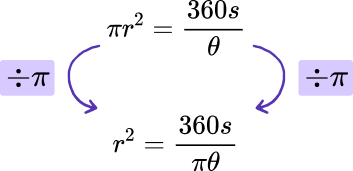
- Undo addition by subtraction
- Undo subtraction by addition
- Undo multiplication by division
- Undo division by multiplication
- Undo squares using square roots
- Undo cubes using cube roots
Recommended Order
When rearranging:
1. Remove brackets
2. Remove fractions
3. Move terms containing the subject to one side
4. Factorise if the subject appears more than once
5. Undo powers or roots last
Important Situations
You must be especially careful when:
- The subject appears twice
- The subject is inside a bracket
- The subject is squared or cubed
- The subject is inside a square root
Example 1:
Make \( r \) the subject of \( V=\dfrac{4}{3}\pi r^3 \).
▶️ Answer/Explanation
Step 1: Remove the fraction by multiplying both sides by \( \dfrac{3}{4\pi} \).
\( r^3=\dfrac{3V}{4\pi} \)
Step 2: Undo the cube using a cube root.
\( r=\sqrt[3]{\dfrac{3V}{4\pi}} \)
Conclusion: \( r=\sqrt[3]{\dfrac{3V}{4\pi}} \).
Example 2:
Make \( x \) the subject of \( y=3x+5x^2 \).
▶️ Answer/Explanation
Rearrange into quadratic form:
\( 5x^2+3x-y=0 \)
Now solve using the quadratic formula:
\( x=\dfrac{-3\pm\sqrt{3^2-4(5)(-y)}}{2(5)} \)
\( x=\dfrac{-3\pm\sqrt{9+20y}}{10} \)
Conclusion: \( x=\dfrac{-3\pm\sqrt{9+20y}}{10} \).
Example 3:
Make \( l \) the subject of \( T=2\pi\sqrt{\dfrac{l}{g}} \).
▶️ Answer/Explanation
Step 1: Divide both sides by \( 2\pi \).
\( \dfrac{T}{2\pi}=\sqrt{\dfrac{l}{g}} \)
Step 2: Square both sides.
\( \dfrac{T^2}{4\pi^2}=\dfrac{l}{g} \)
Step 3: Multiply by \( g \).
\( l=\dfrac{gT^2}{4\pi^2} \)
Conclusion: \( l=\dfrac{gT^2}{4\pi^2} \).