
Simultaneous Linear Equations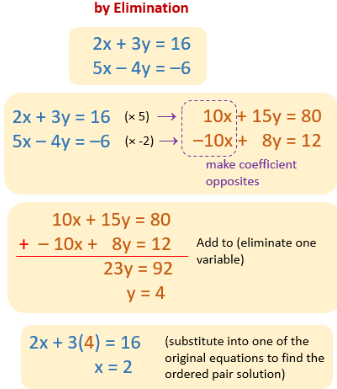
Simultaneous equations are two equations that contain the same unknowns.
The solution is the pair of values that satisfies both equations at the same time.
For example, we want values of \( x \) and \( y \) that make both equations true.
Methods
The most important GCSE method is the elimination method.
Elimination Method Steps
1. Make the coefficients of one variable equal.
2. Add or subtract the equations to eliminate one variable.
3. Solve for the remaining variable.
4. Substitute back to find the other variable.
Example 1:
Solve
\( 2x+3y=17 \)
\( 3x-5y=35 \)
▶️ Answer/Explanation
Make the \( y \) coefficients equal.
Multiply first equation by 5:
\( 10x+15y=85 \)
Multiply second equation by 3:
\( 9x-15y=105 \)
Add equations:
\( 19x=190 \)
\( x=10 \)
Substitute into \( 2x+3y=17 \):
\( 20+3y=17 \)
\( 3y=-3 \)
\( y=-1 \)
Conclusion: \( x=10,\;y=-1 \).
Example 2:
Solve
\( x+y=11 \)
\( x-y=3 \)
▶️ Answer/Explanation
Add the equations:
\( 2x=14 \Rightarrow x=7 \)
Substitute:
\( 7+y=11 \Rightarrow y=4 \)
Conclusion: \( (7,4) \).
Example 3:
Solve
\( 4x+2y=18 \)
\( 2x+y=9 \)
▶️ Answer/Explanation
Notice:
First equation is \( 2\times \) second equation.
The equations represent the same line.
Conclusion: Infinitely many solutions.
Simultaneous Equations as Graphs
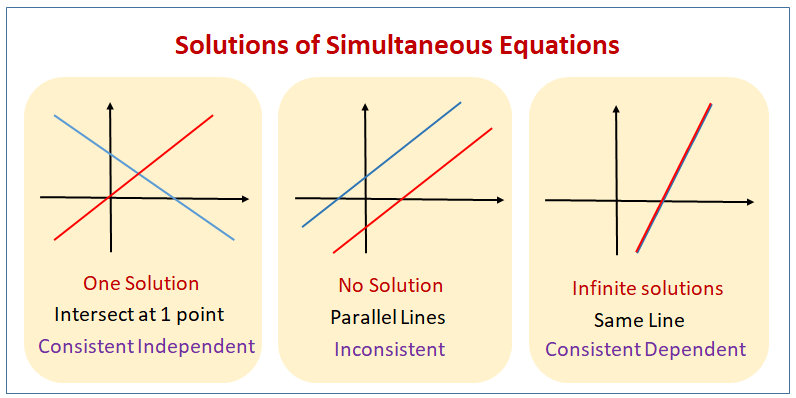
Every linear equation in two variables represents a straight line when drawn on a graph. When we solve simultaneous equations, we are actually finding the point where the two lines meet.
This point is called the point of intersection.
Important Meaning
The coordinates of the intersection give the values of \( x \) and \( y \) that satisfy both equations at the same time.
Possible Cases
- Lines intersect once → one solution
- Lines are parallel → no solution
- Lines coincide (same line) → infinitely many solutions
How to Interpret Graphically
1. Rearrange each equation into \( y=mx+c \).
2. Plot both lines.
3. Read the coordinates of the intersection.
Example 1:
Interpret the solution of
\( 2x+3y=17 \)
\( 3x-5y=35 \)
▶️ Answer/Explanation
From algebraic solution:
\( x=10,\;y=-1 \)
This means the two lines meet at:
\( (10,-1) \)
Conclusion: The intersection point is \( (10,-1) \).
Example 2:
Explain what happens for
\( y=2x+1 \)
\( y=2x-3 \)
▶️ Answer/Explanation
Both lines have gradient 2.
They are parallel and never meet.
Conclusion: No solution.
Example 3:
Explain the solution of
\( 4x+2y=18 \)
\( 2x+y=9 \)
▶️ Answer/Explanation
First equation is twice the second.
They are the same line.
Conclusion: Infinite solutions.