
Simultaneous Equations (Linear and Quadratic)
Sometimes we solve two equations where:
- one equation is linear (a straight line)
- the other equation is quadratic (a curve)
The solution represents the points of intersection between the line and the curve.
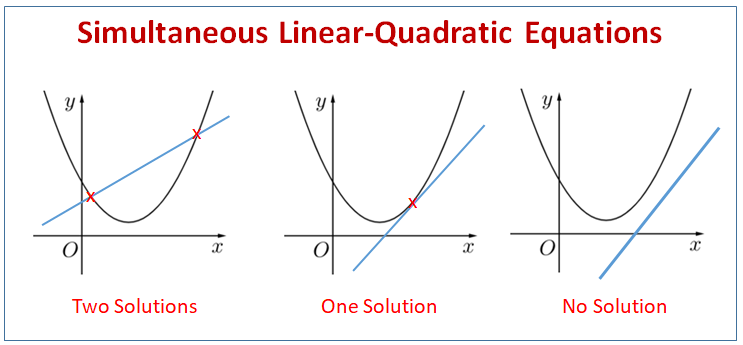
Method (Substitution)
1. Rearrange the linear equation to make \( y \) or \( x \) the subject.
2. Substitute into the quadratic equation.
3. Solve the quadratic equation.
4. Substitute back to find the corresponding value of the other variable.
Example 1:
Solve
\( y=2x-11 \)
\( x^2+y^2=25 \)
▶️ Answer/Explanation
Substitute \( y=2x-11 \) into the circle equation:
\( x^2+(2x-11)^2=25 \)
\( x^2+4x^2-44x+121=25 \)
\( 5x^2-44x+96=0 \)
Factorise:
\( (5x-24)(x-4)=0 \)
\( x=\dfrac{24}{5} \) or \( x=4 \)
Find \( y \):
For \( x=4 \): \( y=8-11=-3 \)
For \( x=\dfrac{24}{5} \): \( y=\dfrac{48}{5}-11=-\dfrac{7}{5} \)
Conclusion: \( (4,-3) \) and \( \left(\dfrac{24}{5},-\dfrac{7}{5}\right) \).
Example 2:
Solve
\( y=11x-2 \)
\( y=5x^2 \)
▶️ Answer/Explanation
Since both equal \( y \), equate them:
\( 5x^2=11x-2 \)
\( 5x^2-11x+2=0 \)
Factorise:
\( (5x-1)(x-2)=0 \)
\( x=\dfrac{1}{5} \) or \( x=2 \)
Find \( y \):
If \( x=2 \), \( y=5(2)^2=20 \)
If \( x=\dfrac{1}{5} \), \( y=5\left(\dfrac{1}{5}\right)^2=\dfrac{1}{5} \)
Conclusion: \( (2,20) \) and \( \left(\dfrac{1}{5},\dfrac{1}{5}\right) \).
Example 3:
Explain the number of solutions graphically.
▶️ Answer/Explanation
A line and a curve can:
- touch once (tangent) → 1 solution
- cut twice → 2 solutions
- not meet → 0 solutions
Conclusion: Number of intersection points equals number of solutions.