
Arithmetic Sequences: First Term and Common Difference
An arithmetic sequence is a sequence of numbers where the same number is added each time.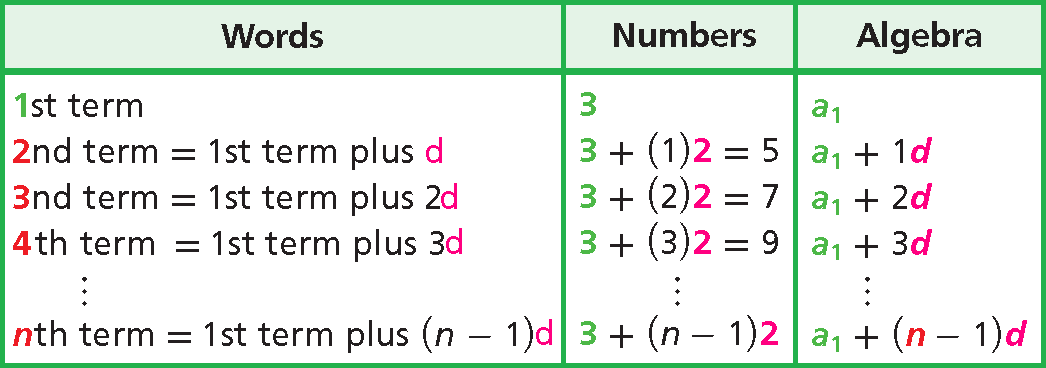
Example:
\( 3,\;7,\;11,\;15,\;19,\dots \)
The number being added each time is called the common difference.
Common difference \( =4 \)
Key Terms
- First term (a) → the first number in the sequence
- Common difference (d) → amount added each step
If the sequence increases, \( d \) is positive. If it decreases, \( d \) is negative.
Finding the Common Difference
Subtract consecutive terms:
\( d=\text{next term} – \text{previous term} \)
When Given Specific Terms
We label terms:
1st term \( =a \)
2nd term \( =a+d \)
3rd term \( =a+2d \)
4th term \( =a+3d \)
5th term \( =a+4d \)
So the \( n \)th term is built from repeated addition of \( d \).
Example 1:
The 2nd term of an arithmetic sequence is 7 and the 5th term is 19. Find \( a \) and \( d \).
▶️ Answer/Explanation
2nd term:
\( a+d=7 \) (1)
5th term:
\( a+4d=19 \) (2)
Subtract (1) from (2):
\( 3d=12 \Rightarrow d=4 \)
Substitute into (1):
\( a+4=7 \Rightarrow a=3 \)
Conclusion: \( a=3,\;d=4 \).
Example 2:
Find the first term and common difference of the sequence
\( 10,\;6,\;2,\;-2,\dots \)
▶️ Answer/Explanation
\( d=6-10=-4 \)
First term \( a=10 \)
Conclusion: \( a=10,\;d=-4 \).
Example 3:
The 3rd term of a sequence is 11 and the 6th term is 23. Find \( a \) and \( d \).
▶️ Answer/Explanation
3rd term:
\( a+2d=11 \) (1)
6th term:
\( a+5d=23 \) (2)
Subtract:
\( 3d=12 \Rightarrow d=4 \)
Substitute into (1):
\( a+8=11 \Rightarrow a=3 \)
Conclusion: \( a=3,\;d=4 \).
The nth Term of an Arithmetic Sequence
In an arithmetic sequence we often want a formula to calculate any term without writing the whole sequence.
This formula is called the nth term.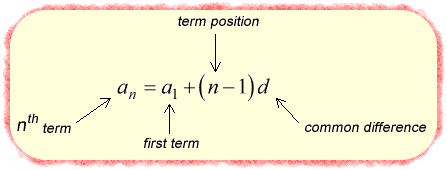
nth Term Formula
\( T_n=a+(n-1)d \)
where:
- \( a \) = first term
- \( d \) = common difference
- \( n \) = term number
Why it Works
- To reach the 2nd term we add \( d \) once.
- To reach the 3rd term we add \( d \) twice.
- To reach the \( n \)th term we add \( d \) exactly \( (n-1) \) times.
Important Note
The nth term gives a formula for the sequence and allows us to:
- find any term
- check if a number belongs to the sequence
- find missing terms
Example 1:
Find the nth term of the sequence
\( 4,\;7,\;10,\;13,\dots \)
▶️ Answer/Explanation
First term \( a=4 \)
Common difference \( d=3 \)
\( T_n=4+(n-1)3 \)
\( T_n=4+3n-3=3n+1 \)
Conclusion: \( T_n=3n+1 \).
Example 2:
Find the 20th term of the sequence with \( a=5 \) and \( d=2 \).
▶️ Answer/Explanation
\( T_{20}=5+(20-1)2 \)
\( =5+38=43 \)
Conclusion: 43.
Example 3:
Determine whether 101 is a term of the sequence \( 3n+1 \).
▶️ Answer/Explanation
Set \( 3n+1=101 \)
\( 3n=100 \)
\( n=\dfrac{100}{3} \)
Not an integer.
Conclusion: 101 is not in the sequence.
Sum of an Arithmetic Series
When we add the terms of an arithmetic sequence, the result is called an arithmetic series.
Example:
\( 4+7+10+13+\dots \)
Instead of adding many numbers one by one, we use a formula.
Sum Formula
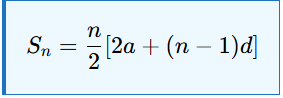
where:
- \( S_n \) = sum of the first \( n \) terms
- \( a \) = first term
- \( d \) = common difference
- \( n \) = number of terms
Alternative Formula
If the last term \( l \) is known:
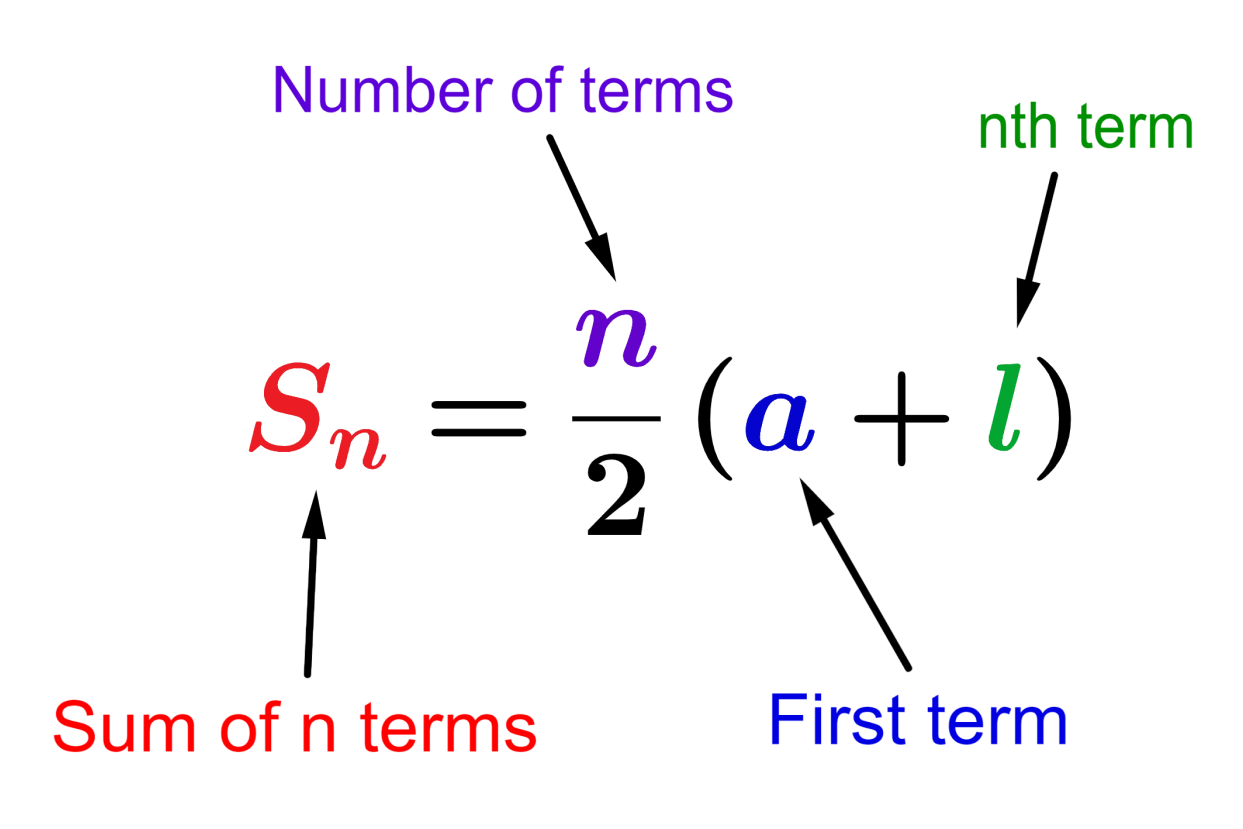
Important Idea
The first and last terms pair to give the same total:
\( 4+13=17 \)
\( 7+10=17 \)
This is why the formula works.
Example 1:
Find the sum of the first 50 terms of
\( 4+7+10+13+\dots \)
▶️ Answer/Explanation
First term \( a=4 \)
Common difference \( d=3 \)
Number of terms \( n=50 \)
\( S_{50}=\dfrac{50}{2}(2(4)+(50-1)3) \)
\( =25(8+147) \)
\( =25(155)=3875 \)
Conclusion: \( 3875 \).
Example 2:
Find the sum of the first 20 terms of the sequence
\( 5,\;8,\;11,\;14,\dots \)
▶️ Answer/Explanation
\( a=5,\; d=3,\; n=20 \)
\( S_{20}=\dfrac{20}{2}(2(5)+(20-1)3) \)
\( =10(10+57)=10(67)=670 \)
Conclusion: 670.
Example 3:
The first term of a sequence is 2 and the common difference is 5. Find the sum of the first 30 terms.
▶️ Answer/Explanation
\( a=2,\; d=5,\; n=30 \)
\( S_{30}=\dfrac{30}{2}(2(2)+(30-1)5) \)
\( =15(4+145)=15(149)=2235 \)
Conclusion: 2235.