
Functions as Mappings
A function is a rule that links each input value to exactly one output value.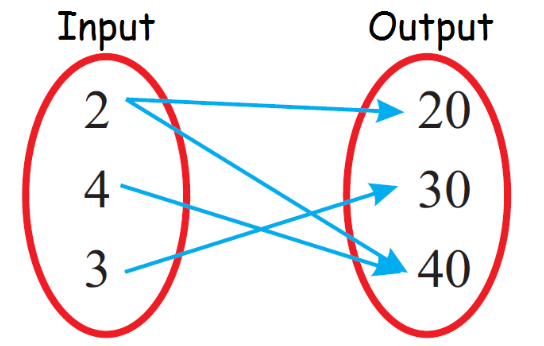
We usually think of a function as a machine:
Input \( \rightarrow \) rule \( \rightarrow \) output
The input values come from one set and the outputs form another set.
Therefore, a function is a mapping between two sets.
Key Property of a Function
Each input must give only one output.
If an input produces two different outputs, it is not a function.
Mapping Description
If we square numbers:
\( 1\mapsto1 \)
\( 2\mapsto4 \)
\( 3\mapsto9 \)
Every number has exactly one image, so this is a function.
Important Terms
- Input (independent variable)
- Output (dependent variable)
- Mapping (the rule connecting them)
A function guarantees predictability: once the input is known, the output is fixed.
Example 1:
The rule is “multiply by 3”. Is this a function?
▶️ Answer/Explanation
\( 2\mapsto6 \)
\( 5\mapsto15 \)
\( 10\mapsto30 \)
Each input gives one output.
Conclusion: It is a function.
Example 2:
The rule is “square root”. Does it define a function over real numbers?
▶️ Answer/Explanation
\( 9\mapsto3 \)
Only the positive square root is taken.
So each input has one output.
Conclusion: Yes, it is a function.
Example 3:
The rule is “\( y^2=x \)”. Is this a function?
▶️ Answer/Explanation
If \( x=4 \):
\( y=2 \) or \( y=-2 \)
One input gives two outputs.
Conclusion: Not a function.
Function Notation
Instead of writing equations only as \( y= \dots \), functions are written using function notation.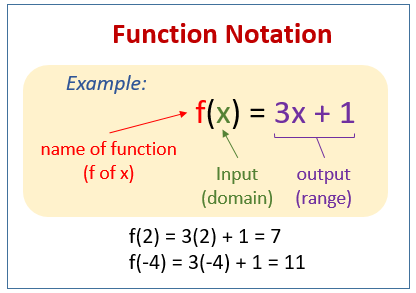
The most common form is:
\( f(x)=\dots \)
This does not mean \( f\times x \). It means “the value of the function \( f \) when the input is \( x \)”.
How to Read It
\( f(3) \) means the output when \( x=3 \).
So we substitute 3 into the rule.
Mapping Notation
Functions can also be written as a mapping:
\( f:x\mapsto \text{rule} \)
Example:
\( f:x\mapsto 2x+1 \)
This means “take a number \( x \), multiply by 2, then add 1”.
Important Idea
\( f(x) \) represents the output value. \( x \) is the input.
Different functions can be used:
\( g(x),\; h(x),\; p(x) \)
They are just names of different rules.
Example 1:
Given \( f(x)=3x+4 \), find \( f(5) \).
▶️ Answer/Explanation
\( f(5)=3(5)+4 \)
\( =15+4=19 \)
Conclusion: 19.
Example 2:
If \( g(x)=x^2-1 \), find \( g(-3) \).
▶️ Answer/Explanation
\( g(-3)=(-3)^2-1 \)
\( =9-1=8 \)
Conclusion: 8.
Example 3:
Write the rule “multiply by 4 then subtract 7” in function notation.
▶️ Answer/Explanation
\( f(x)=4x-7 \)
Mapping form: \( f:x\mapsto4x-7 \)
Conclusion: \( f(x)=4x-7 \).
Domain and Range of a Function
Every function has a set of allowed input values and a set of possible output values.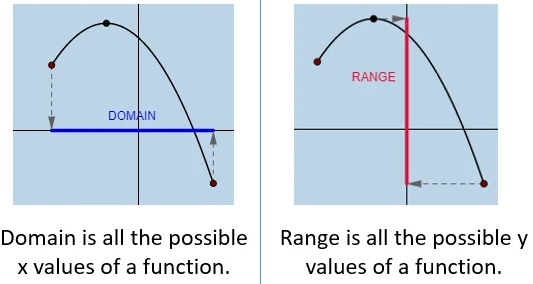
Domain
The domain is the set of all values of \( x \) that we are allowed to substitute into the function.
Range
The range is the set of values that the function can produce as outputs.
Important Idea
Some values must be excluded from the domain because they make the function impossible to calculate.
Most Common Restriction
You cannot divide by zero.
So any value that makes the denominator equal to zero must be excluded.
Example function:
\( f(x)=\dfrac{1}{x-2} \)
The denominator becomes zero when:
\( x-2=0 \Rightarrow x=2 \)
Therefore \( x=2 \) must be excluded from the domain.
Range Explanation
Because the numerator is 1, the function can never equal 0.
So the range excludes \( y=0 \).
Summary
- Domain: allowed inputs
- Range: possible outputs
Example 1:
Find the value excluded from the domain of \( f(x)=\dfrac{1}{x-2} \).
▶️ Answer/Explanation
\( x-2=0 \)
\( x=2 \)
Conclusion: Exclude \( x=2 \).
Example 2:
State the domain of \( g(x)=\dfrac{5}{x+3} \).
▶️ Answer/Explanation
\( x+3=0 \Rightarrow x=-3 \)
Conclusion: Domain is all real numbers except \( x=-3 \).
Example 3:
Explain why \( y=\dfrac{2}{x} \) can never equal 0.
▶️ Answer/Explanation
A fraction equals 0 only if the numerator is 0.
The numerator is 2, which is never 0.
Conclusion: Range excludes \( y=0 \).
Composite Functions and Inverse Functions
Composite Functions
A composite function means applying one function and then another.
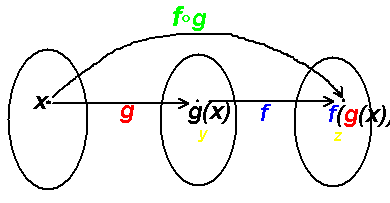
If we have two functions:
\( f(x) \) and \( g(x) \)
The composite function is written:
\( fg(x)=f(g(x)) \)
This means:
First apply \( g \), then apply \( f \).
Inverse Functions
An inverse function reverses the effect of a function.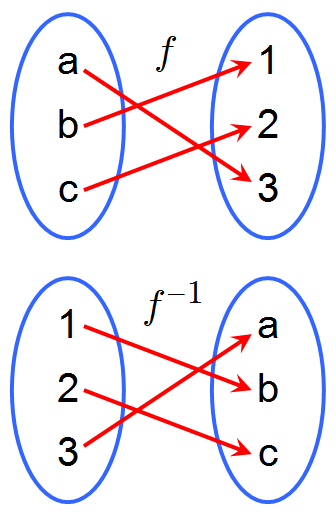
It is written:
\( f^{-1}(x) \)
If:
\( f(3)=10 \)
then:
\( f^{-1}(10)=3 \)
How to Find an Inverse
1. Write \( y=f(x) \)
2. Swap \( x \) and \( y \)
3. Rearrange to make \( y \) the subject
4. Replace \( y \) with \( f^{-1}(x) \)
Example 1:
\( f(x)=2x+1 \), \( g(x)=x^2 \). Find \( fg(x) \).
▶️ Answer/Explanation
First apply \( g \):
\( g(x)=x^2 \)
Now apply \( f \):
\( f(g(x))=f(x^2)=2x^2+1 \)
Conclusion: \( fg(x)=2x^2+1 \).
Example 2:
Find the inverse of \( f(x)=3x-5 \).
▶️ Answer/Explanation
\( y=3x-5 \)
Swap \( x \) and \( y \):
\( x=3y-5 \)
Rearrange:
\( x+5=3y \)
\( y=\dfrac{x+5}{3} \)
Conclusion: \( f^{-1}(x)=\dfrac{x+5}{3} \).
Example 3:
\( f(x)=2x+3 \), \( g(x)=x-4 \). Find \( f^{-1}(g(x)) \).
▶️ Answer/Explanation
First find inverse of \( f \):
\( y=2x+3 \)
\( x=2y+3 \)
\( y=\dfrac{x-3}{2} \)
So \( f^{-1}(x)=\dfrac{x-3}{2} \).
Now apply \( g(x) \):
\( g(x)=x-4 \)
Substitute into inverse:
\( f^{-1}(g(x))=\dfrac{(x-4)-3}{2}=\dfrac{x-7}{2} \)
Conclusion: \( \dfrac{x-7}{2} \).