
Transformations of Graphs
A transformation changes the position or shape of a graph without changing the basic function.
We start with a graph:
\( y=f(x) \)
Then we apply changes to create a new graph.
1. Vertical Translation
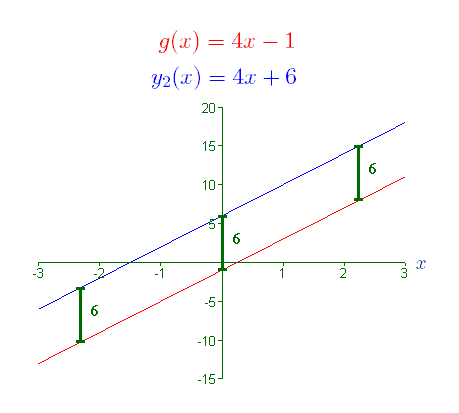
\( y=f(x)+a \)
Moves the graph up or down.
- \( a>0 \) move up
- \( a<0 \) move down
2. Horizontal Translation
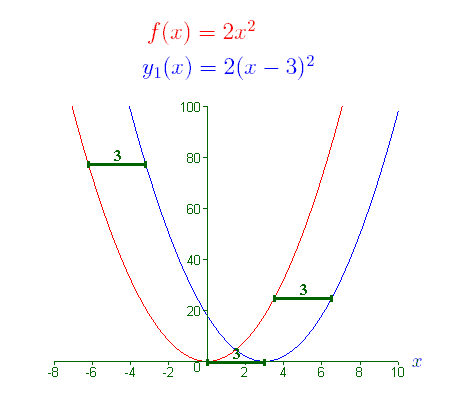
\( y=f(x+a) \)
Moves the graph left or right.
- \( a>0 \) move left
- \( a<0 \) move right
3. Vertical Stretch
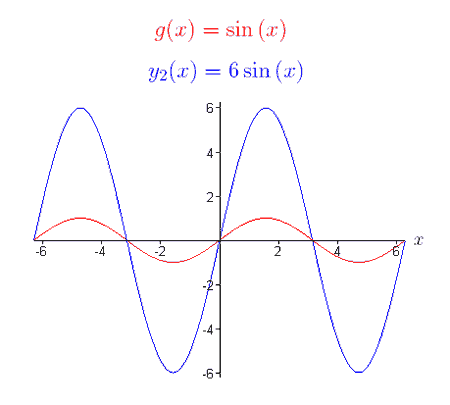
\( y=af(x) \)
- \( a>1 \) stretch
- \( 0<a<1 \) compression
4. Horizontal Stretch
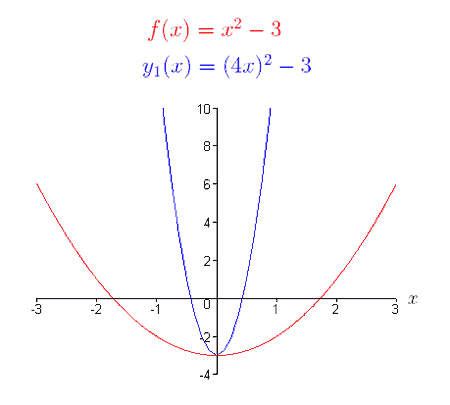
\( y=f(ax) \)
- \( a>1 \) compress horizontally
- \( 0<a<1 \) stretch horizontally
Works for Many Functions
These transformations apply to:
- Linear graphs \( y=x \)
- Quadratic graphs \( y=x^2 \)
- Sine graphs \( y=\sin x \)
- Cosine graphs \( y=\cos x \)
Important Memory Rule
- Changes outside the function affect vertical movement.
- Changes inside the brackets affect horizontal movement.
| Transformation Rules for Functions | ||
|---|---|---|
| Function Notation | Type of Transformation | Change to Coordinate Point |
| f(x) + d | Vertical translation up d units | (x, y) → (x, y + d) |
| f(x) − d | Vertical translation down d units | (x, y) → (x, y − d) |
| f(x + c) | Horizontal translation left c units | (x, y) → (x − c, y) |
| f(x − c) | Horizontal translation right c units | (x, y) → (x + c, y) |
| −f(x) | Reflection over x-axis | (x, y) → (x, −y) |
| f(−x) | Reflection over y-axis | (x, y) → (−x, y) |
| af(x) | Vertical stretch for |a| > 1 | (x, y) → (x, ay) |
| Vertical compression for 0 < |a| < 1 | ||
| f(bx) | Horizontal compression for |b| > 1 | (x, y) → (x/b, y) |
| Horizontal stretch for 0 < |b| < 1 | ||
Example 1:
Describe the transformation from \( y=x^2 \) to \( y=x^2+3 \).
▶️ Answer/Explanation
The +3 is outside the function.
So the graph moves vertically upward.
Conclusion: Translation up 3 units.
Example 2:
Describe the transformation from \( y=\sin x \) to \( y=\sin(x-2) \).
▶️ Answer/Explanation
The change is inside the bracket.
\( x-2 \) shifts the graph right.
Conclusion: Translation 2 units to the right.
Example 3:
Describe the transformation from \( y=x \) to \( y=3x \).
▶️ Answer/Explanation
The function is multiplied by 3.
All y-values triple.
Conclusion: Vertical stretch by scale factor 3.
Interpreting Transformations Algebraically
Instead of being told the transformation, sometimes we are given a graph or a new function and must work out how it has been changed.
We compare the new function with the original function: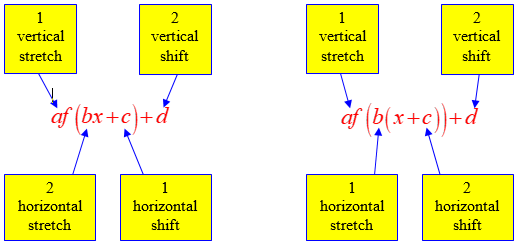
Original: \( y=f(x) \)
and identify what has happened to it.
Key Recognition Rules
- \( y=f(x)+a \) → vertical shift
- \( y=f(x+a) \) → horizontal shift
- \( y=af(x) \) → vertical stretch/compression
- \( y=f(ax) \) → horizontal stretch/compression
Important Reminder
Inside the bracket affects the x-direction. Outside the bracket affects the y-direction.
The horizontal change is always the opposite direction to what you might expect:
- \( f(x+3) \) → move left 3
- \( f(x-3) \) → move right 3
Writing the Function from a Transformation
If you know the original graph and the transformation, you can construct the new function.
Example starting graph:
\( y=x^2 \)
Move right 4 → replace \( x \) with \( x-4 \)
\( y=(x-4)^2 \)
Example 1:
Describe the transformation from \( y=x^2 \) to \( y=(x-3)^2 \).
▶️ Answer/Explanation
The change is inside the bracket.
\( x-3 \) shifts the graph right.
Conclusion: Translation 3 units to the right.
Example 2:
Describe the transformation from \( y=\cos x \) to \( y=2\cos x \).
▶️ Answer/Explanation
The function is multiplied by 2.
All y-values double.
Conclusion: Vertical stretch with scale factor 2.
Example 3:
Write the equation of the graph obtained by moving \( y=x^2 \) up 5 units.
▶️ Answer/Explanation
Vertical shift upward adds 5.
\( y=x^2+5 \)
Conclusion: \( y=x^2+5 \).
Gradients of Non-Linear Graphs (Tangents)
For a straight line, the gradient is the same everywhere.
But a curve (non-linear graph) is constantly changing direction, so its gradient changes at every point.
Therefore a curve does not have one single gradient. Instead, we find the gradient at a particular point.
Tangent
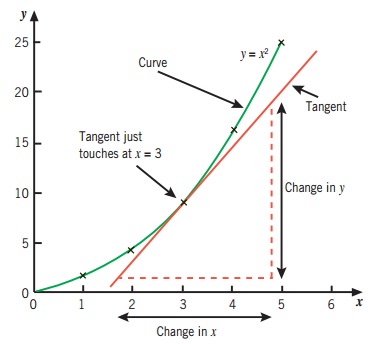
The gradient of a curve at a point is found by drawing a tangent.
A tangent is a straight line that touches the curve at exactly one point and has the same direction as the curve at that point.
Method
1. Draw the tangent line at the required point.
2. Choose two clear points on the tangent.
3. Use the gradient formula:
\( \text{gradient}=\dfrac{\text{change in }y}{\text{change in }x} \)
This gradient is called the instantaneous rate of change.
Important Notes
- Steep upward tangent → positive gradient
- Steep downward tangent → negative gradient
- Horizontal tangent → gradient 0
Example 1:
A tangent at a point on a curve passes through \( (2,3) \) and \( (6,11) \). Find the gradient.
▶️ Answer/Explanation
\( \text{gradient}=\dfrac{11-3}{6-2} \)
\( =\dfrac{8}{4}=2 \)
Conclusion: Gradient = 2.
Example 2:
The tangent line at a point is horizontal. What is the gradient?
▶️ Answer/Explanation
Horizontal line means no change in \( y \).
\( \text{gradient}=0 \)
Conclusion: Gradient 0.
Example 3:
A tangent passes through \( (1,5) \) and \( (4,-1) \). Find the gradient and state the direction of the curve.
▶️ Answer/Explanation
\( \text{gradient}=\dfrac{-1-5}{4-1}=\dfrac{-6}{3}=-2 \)
Negative gradient means the curve is decreasing at that point.
Conclusion: Gradient = −2 and curve slopes downward.
Intersection of Two Graphs
When two graphs cross each other, the point where they meet is called the point of intersection.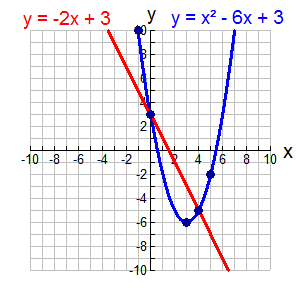
At the intersection, both graphs have the same \( x \) value and the same \( y \) value.
Therefore, to find the intersection points, we set the equations equal to each other.
Key Idea
If:
\( y_1=y_2 \)
then:
\( y_2-y_1=0 \)
The solutions of this equation give the x-coordinates of the intersection points.
After finding \( x \), substitute back into either equation to find \( y \).
Important
A linear and a non-linear graph can:
- not meet
- touch once
- intersect twice
Example 1:
Find the intersection of
\( y=2x+1 \)
\( y=x^2+3x-2 \)
▶️ Answer/Explanation
Set equal:
\( 2x+1=x^2+3x-2 \)
\( x^2+x-3=0 \)
Solve quadratic:
\( x=\dfrac{-1\pm\sqrt{13}}{2} \)
Substitute into \( y=2x+1 \):
\( y=2\left(\dfrac{-1\pm\sqrt{13}}{2}\right)+1=-1\pm\sqrt{13}+1=\pm\sqrt{13} \)
Conclusion: \( \left(\dfrac{-1+\sqrt{13}}{2},\sqrt{13}\right) \) and \( \left(\dfrac{-1-\sqrt{13}}{2},-\sqrt{13}\right) \).
Example 2:
Find the intersection of
\( y=5 \)
\( y=x^3-3x^2+7 \)
▶️ Answer/Explanation
Set equal:
\( 5=x^3-3x^2+7 \)
\( x^3-3x^2+2=0 \)
Try integer roots:
\( x=1 \Rightarrow 1-3+2=0 \)
So \( x=1 \) is a solution.
Find \( y \):
\( y=5 \)
Conclusion: Intersection point \( (1,5) \).
Example 3:
Explain why solving \( y_2-y_1=0 \) finds intersection points.
▶️ Answer/Explanation
At an intersection both graphs have the same y-value.
So their difference is zero.
Therefore solving \( y_2-y_1=0 \) gives the x-values of intersection.
Conclusion: Intersection occurs when the two equations are equal.