
Variable Rate of Change
In many real situations a quantity does not change at a constant speed.
For example, a car does not usually move at one steady speed. It accelerates, slows down, and stops. This means the rate of change is not fixed.
This is called a variable rate of change.
Constant Rate of Change
A straight line graph has a constant gradient. So the rate of change is the same everywhere.
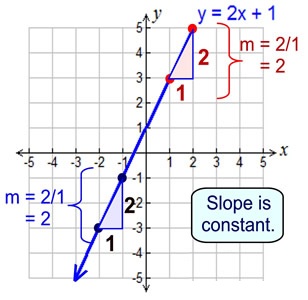
Example: \( y=3x \)
Every increase of 1 in \( x \) increases \( y \) by 3.
Variable Rate of Change
A curved graph does not have a constant gradient. The steepness changes at different points.
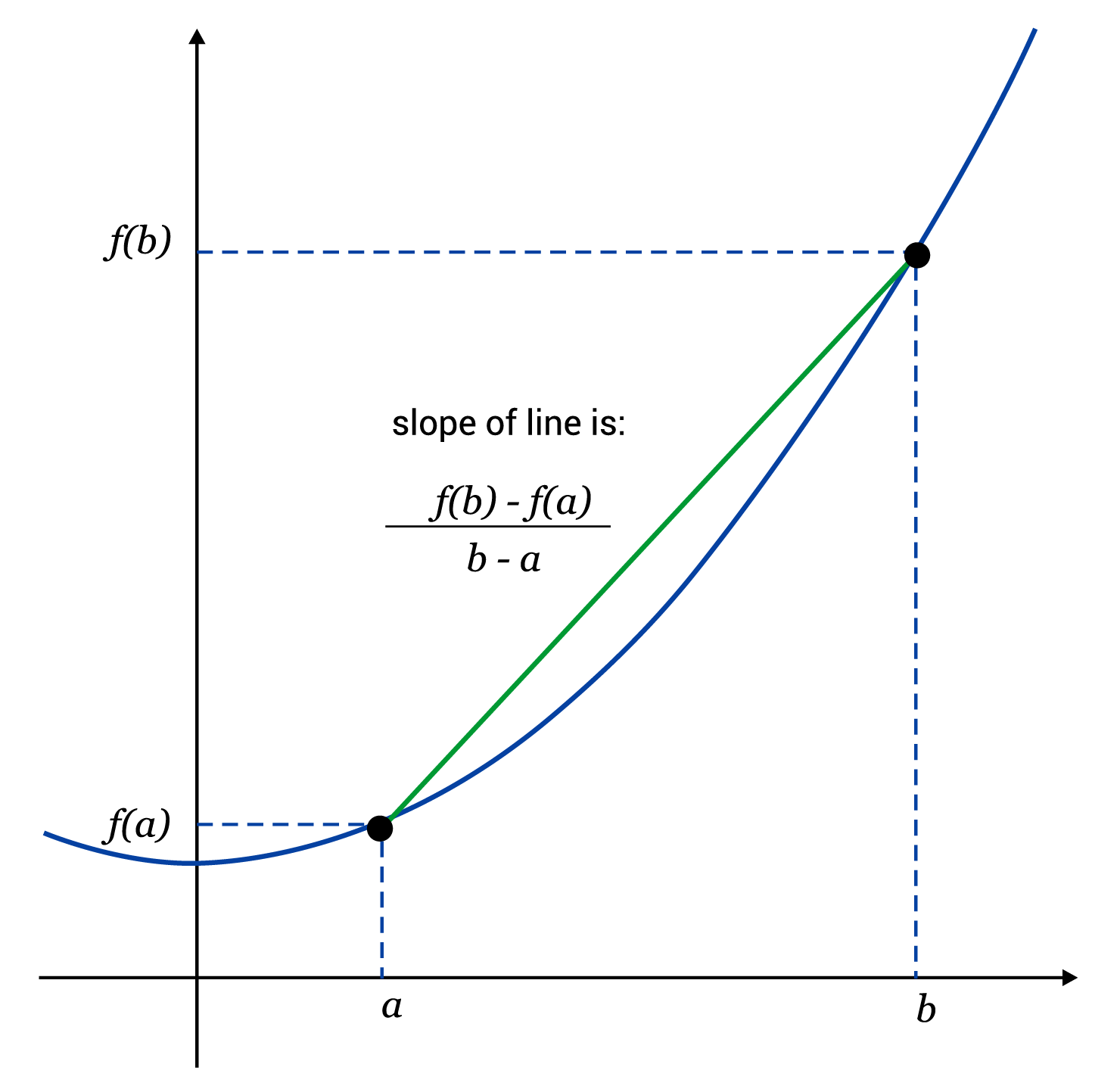
Example: \( y=x^2 \)
Near \( x=0 \) the graph is almost flat. For larger values of \( x \) the graph becomes steeper.
Instantaneous Rate of Change
The rate of change at a single point is called the instantaneous rate of change.
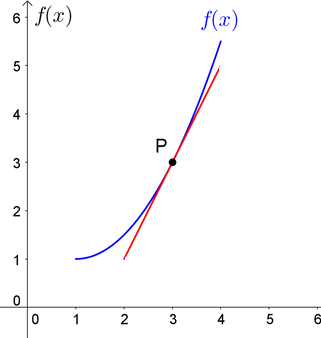
In calculus this is found using the gradient of the tangent to the curve at that point.
So:
Gradient of tangent = rate of change
Physical Meaning
- Gradient of displacement–time graph → velocity
- Gradient of velocity–time graph → acceleration
This idea is the starting point of calculus and differentiation.
Example 1:
State whether the rate of change of \( y=5x+2 \) is constant or variable.
▶️ Answer/Explanation
This is a straight line.
Gradient is always 5.
Conclusion: Constant rate of change.
Example 2:
Explain why \( y=x^2 \) has a variable rate of change.
▶️ Answer/Explanation
The graph is curved.
Its gradient increases as \( x \) increases.
Conclusion: Variable rate of change.
Example 3:
A displacement–time graph is curved. What does this say about the motion?
▶️ Answer/Explanation
The gradient is changing.
So the velocity is changing.
Conclusion: The object is accelerating.
Differentiating Integer Powers of \( x \)
Differentiation is the process used in calculus to find the rate of change of a function.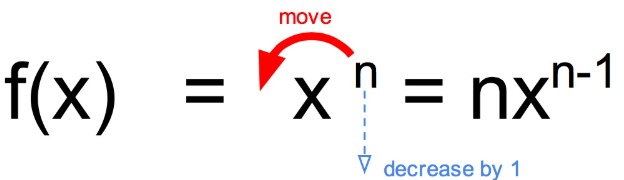
It tells us how quickly \( y \) changes when \( x \) changes.
The derivative is written as:
\( \dfrac{dy}{dx} \)
This means “rate of change of \( y \) with respect to \( x \)”.
The Power Rule
For integer powers of \( x \):
If \( y=x^n \), then \( \dfrac{dy}{dx}=nx^{n-1} \)
This rule works for any positive or negative integer power.
Special Cases
- Derivative of a constant is 0
- Derivative of \( x \) is 1
Examples:
\( \dfrac{d}{dx}(x^5)=5x^4 \)
\( \dfrac{d}{dx}(x^2)=2x \)
\( \dfrac{d}{dx}(x)=1 \)
\( \dfrac{d}{dx}(7)=0 \)
Polynomials
Differentiate each term separately.
\( \dfrac{d}{dx}(ax^n)=anx^{n-1} \)
Example 1:
Differentiate \( y=x^4 \).
▶️ Answer/Explanation
\( \dfrac{dy}{dx}=4x^3 \)
Conclusion: \( 4x^3 \).
Example 2:
Differentiate \( y=5x^3-2x^2+7x-9 \).
▶️ Answer/Explanation
\( \dfrac{dy}{dx}=15x^2-4x+7 \)
Conclusion: \( 15x^2-4x+7 \).
Example 3:
Differentiate \( y=6x^{-2} \).
▶️ Answer/Explanation
\( \dfrac{dy}{dx}=6(-2)x^{-3}=-12x^{-3} \)
Conclusion: \( -12x^{-3} \).
Stationary Points, Gradients and Turning Points
Differentiation allows us to find the gradient of a curve at any point.
The gradient function is found by differentiating \( y=f(x) \).
\( \dfrac{dy}{dx} \)
Stationary Points
A stationary point occurs when the gradient is zero.
\( \dfrac{dy}{dx}=0 \)
At this point the tangent to the curve is horizontal.
Stationary points are also called turning points.
Types of Turning Points
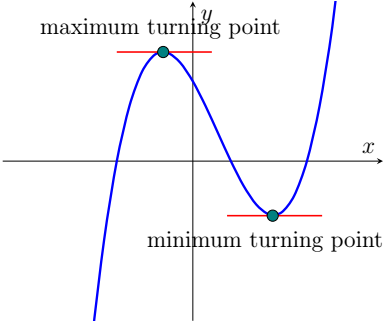
- Maximum point (highest point locally)
- Minimum point (lowest point locally)
Method to Find Turning Points
1. Differentiate the function
2. Set \( \dfrac{dy}{dx}=0 \)
3. Solve for \( x \)
4. Substitute into the original equation to find \( y \)
The coordinates found are the stationary points.
Example 1:
Find the stationary point of \( y=x^2-4x+1 \).
▶️ Answer/Explanation
Differentiate:
\( \dfrac{dy}{dx}=2x-4 \)
Set equal to zero:
\( 2x-4=0 \Rightarrow x=2 \)
Substitute into original equation:
\( y=2^2-4(2)+1=4-8+1=-3 \)
Conclusion: Stationary point \( (2,-3) \).
Example 2:
Find the turning points of \( y=x^3-3x^2 \).
▶️ Answer/Explanation
Differentiate:
\( \dfrac{dy}{dx}=3x^2-6x \)
Set equal to zero:
\( 3x^2-6x=0 \)
\( 3x(x-2)=0 \)
\( x=0 \) or \( x=2 \)
Find y-values:
\( y(0)=0 \)
\( y(2)=8-12=-4 \)
Conclusion: Turning points at \( (0,0) \) and \( (2,-4) \).
Example 3:
Find the stationary point of \( y=2x^2+8x+5 \).
▶️ Answer/Explanation
Differentiate:
\( \dfrac{dy}{dx}=4x+8 \)
Set equal to zero:
\( 4x+8=0 \Rightarrow x=-2 \)
Substitute into original equation:
\( y=2(-2)^2+8(-2)+5=8-16+5=-3 \)
Conclusion: Stationary point \( (-2,-3) \).
Distinguishing Between Maxima and Minima (Using Graph Shape)
After finding a stationary point, we need to decide whether it is a maximum or a minimum.
In GCSE Mathematics this can be done simply by looking at the shape of the graph.
Maximum Point
A maximum point is the highest point of the curve in that region.
The graph:
- goes up before the point
- goes down after the point
So the curve looks like an upside-down U shape.
Minimum Point
A minimum point is the lowest point of the curve in that region.
The graph:
- goes down before the point
- goes up after the point
So the curve looks like a U shape.
Key Idea
We only look at how the curve behaves around the stationary point.
- Increasing then decreasing → Maximum
- Decreasing then increasing → Minimum
A cubic graph may also flatten without turning. This is not a maximum or minimum.
Example 1:
The graph of \( y=-x^2+4x \) has a stationary point. Is it a maximum or minimum?
▶️ Answer/Explanation
The coefficient of \( x^2 \) is negative.
The parabola opens downward.
Conclusion: Maximum point.
Example 2:
The graph of \( y=x^2+6x+5 \) has a turning point. Identify its type.
▶️ Answer/Explanation
The coefficient of \( x^2 \) is positive.
The parabola opens upward.
Conclusion: Minimum point.
Example 3:
The curve increases before a stationary point and continues increasing after it. What type of point is this?
▶️ Answer/Explanation
The graph does not turn.
It only flattens briefly.
Conclusion: Neither maximum nor minimum (point of inflection).
Calculus in Kinematics and Practical Problems
Calculus is widely used to describe motion.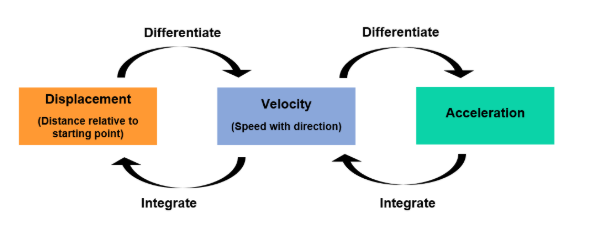
If the displacement of a particle from a fixed point is known, we can find how fast it moves and how its speed changes.
Key Relationships
- Displacement \( s \) → position of the object
- Velocity \( v \) → rate of change of displacement
- Acceleration \( a \) → rate of change of velocity
Mathematically:
\( v=\dfrac{ds}{dt} \)
\( a=\dfrac{dv}{dt}=\dfrac{d^2s}{dt^2} \)
So:
- Differentiate displacement → velocity
- Differentiate velocity → acceleration
Example 1:
The displacement of a particle is \( s=24t^2-t^3 \), \( 0\le t\le20 \). Find expressions for velocity and acceleration.
▶️ Answer/Explanation
Velocity:
\( v=\dfrac{ds}{dt} \)
\( s=24t^2-t^3 \)
\( v=48t-3t^2 \)
Acceleration:
\( a=\dfrac{dv}{dt} \)
\( a=48-6t \)
Conclusion: \( v=48t-3t^2 \) and \( a=48-6t \).
Example 2:
Given \( s=t^3+2t^2 \), find the velocity when \( t=2 \).
▶️ Answer/Explanation
Velocity:
\( v=\dfrac{ds}{dt}=3t^2+4t \)
Substitute \( t=2 \):
\( v=3(4)+8=12+8=20 \)
Conclusion: Velocity \( =20 \text{ m/s} \).
Example 3:
For \( s=5t^2 \), find the acceleration.
▶️ Answer/Explanation
First velocity:
\( v=\dfrac{ds}{dt}=10t \)
Acceleration:
\( a=\dfrac{dv}{dt}=10 \)
Conclusion: Constant acceleration \( 10\text{ m/s}^2 \).