
Areas of Similar Figures
Two shapes are similar if they have the same shape but different size.
Their corresponding angles are equal and their corresponding sides are in the same ratio.
If the scale factor between two similar shapes is \( k \), then every length in the larger shape is \( k \) times the smaller shape.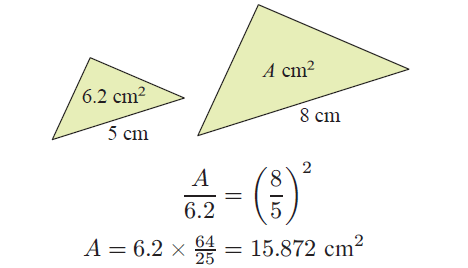
Key Rule for Area
The ratio of the areas of two similar figures equals the square of the ratio of their corresponding sides.
If side ratio \( =a:b \)
Area ratio \( =a^2:b^2 \)
This happens because area depends on two dimensions (length × width).
Example of Scale Factor
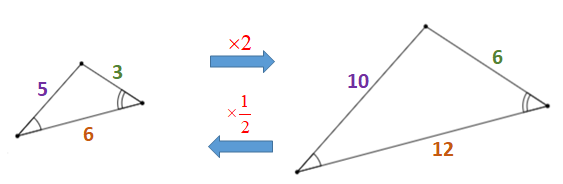
If a triangle is enlarged with scale factor 3:
- All sides triple
- Area becomes \( 3^2=9 \) times larger
Important Idea
Do not multiply areas directly by the side ratio. You must square the ratio first.
Example 1:
Two similar squares have side lengths 2 cm and 6 cm. Find the ratio of their areas.
▶️ Answer/Explanation
Side ratio:
\( 2:6=1:3 \)
Area ratio:
\( 1^2:3^2=1:9 \)
Conclusion: \( 1:9 \).
Example 2:
Two similar triangles have corresponding sides in the ratio \( 3:5 \). Find the ratio of their areas.
▶️ Answer/Explanation
Area ratio \( =3^2:5^2=9:25 \)
Conclusion: \( 9:25 \).
Example 3:
A rectangle is enlarged by scale factor 4. By what factor does its area increase?
▶️ Answer/Explanation
Area factor \( =4^2=16 \)
Conclusion: Area becomes 16 times larger.
Volumes of Similar Figures
When 3D shapes are similar, they have the same shape but different size.
Their corresponding lengths are in a constant ratio called the scale factor.
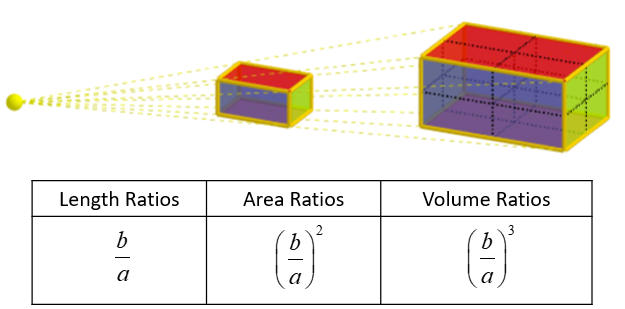
If the scale factor between two similar solids is \( k \):
- All lengths multiply by \( k \)
- Areas multiply by \( k^2 \)
- Volumes multiply by \( k^3 \)
Key Rule for Volume
The ratio of the volumes of similar solids equals the cube of the ratio of corresponding sides.
If side ratio \( =a:b \)
Volume ratio \( =a^3:b^3 \)
This happens because volume depends on three dimensions: length, width and height.
Important Reminder
Students often square the ratio by mistake. For volume you must cube the ratio.
Example 1:
Two similar cubes have side lengths 2 cm and 6 cm. Find the ratio of their volumes.
▶️ Answer/Explanation
Side ratio:
\( 2:6=1:3 \)
Volume ratio:
\( 1^3:3^3=1:27 \)
Conclusion: \( 1:27 \).
Example 2:
Two similar cones have radii in the ratio \( 3:5 \). Find the ratio of their volumes.
▶️ Answer/Explanation
Volume ratio \( =3^3:5^3=27:125 \)
Conclusion: \( 27:125 \).
Example 3:
A solid is enlarged with scale factor 4. By what factor does the volume increase?
▶️ Answer/Explanation
Volume factor \( =4^3=64 \)
Conclusion: Volume becomes 64 times larger.