
Intersecting Chord Properties
A chord is a straight line joining two points on the circumference of a circle.
Sometimes two chords meet (intersect) inside or outside a circle. These situations follow special multiplication rules.
Internal Intersecting Chords
When two chords cross inside a circle, the products of the segments are equal.
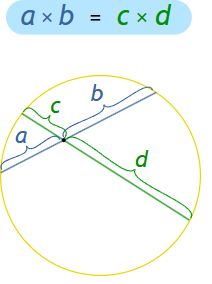
\( (\text{first segment})(\text{second segment})=(\text{third segment})(\text{fourth segment}) \)
If the chord segments are \( a \) and \( b \), and the other chord segments are \( c \) and \( d \):
\( ab=cd \)
External Intersecting Chords
When two lines from a point outside the circle meet the circle, the rule changes slightly.
We multiply the whole line length by the external part.
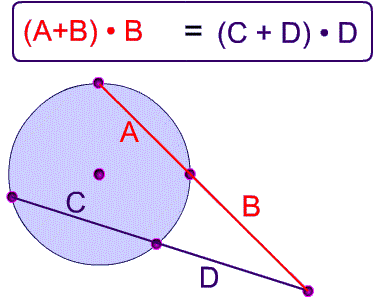
\( (\text{whole})(\text{external})=(\text{whole})(\text{external}) \)
If one line has outside part \( p \) and total length \( p+q \), and the other has outside part \( r \) and total length \( r+s \):
\( p(p+q)=r(r+s) \)
Important Idea
These rules allow missing lengths in a circle to be calculated using algebra.
Example 1:
Two chords intersect inside a circle. The segments are 3 cm and 8 cm on one chord, and 4 cm and \( x \) cm on the other. Find \( x \).
▶️ Answer/Explanation
\( 3\times8=4x \)
\( 24=4x \)
\( x=6 \)
Conclusion: \( x=6\text{ cm} \).
Example 2:
From a point outside a circle, one secant has external length 5 cm and internal length 7 cm. Another has external length 4 cm and internal length \( x \) cm. Find \( x \).
▶️ Answer/Explanation
Whole length first line:
\( 5+7=12 \)
Whole length second line:
\( 4+x \)
\( 5(12)=4(4+x) \)
\( 60=16+4x \)
\( 4x=44 \)
\( x=11 \)
Conclusion: \( x=11\text{ cm} \).
Example 3:
One chord has segments 6 cm and 2 cm. Another has segments 3 cm and \( y \) cm. Find \( y \).
▶️ Answer/Explanation
\( 6\times2=3y \)
\( 12=3y \)
\( y=4 \)
Conclusion: \( y=4\text{ cm} \).
Cyclic Quadrilaterals
A quadrilateral is a four-sided shape.
A cyclic quadrilateral is a quadrilateral whose four vertices all lie on the circumference of the same circle.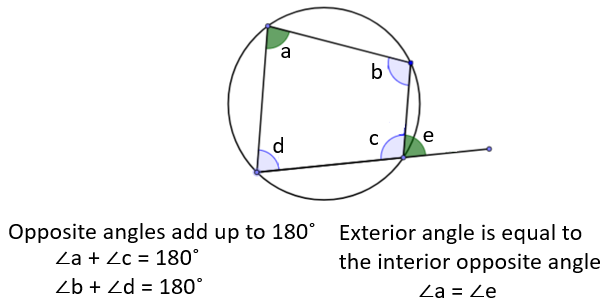
In other words, you can draw one circle that passes through all four corners of the shape.
Key Idea
If every vertex of the quadrilateral touches the circle, then the quadrilateral is cyclic.
This idea is very important because cyclic quadrilaterals have special angle properties (which you will use in circle geometry questions).
How to Recognise One
- All four points lie on the circle
- The sides form chords of the circle
The circle is called the circumcircle.
Later you will learn that opposite angles in a cyclic quadrilateral always add to \( 180^\circ \).
Example 1:
A quadrilateral has all four corners on a circle. What type of quadrilateral is it?
▶️ Answer/Explanation
By definition, all vertices lie on a circle.
Conclusion: It is a cyclic quadrilateral.
Example 2:
A quadrilateral has three vertices on a circle but one vertex outside the circle. Is it cyclic?
▶️ Answer/Explanation
All four vertices must lie on the circle.
Here one point is outside.
Conclusion: Not a cyclic quadrilateral.
Example 3:
Explain why the sides of a cyclic quadrilateral are chords of a circle.
▶️ Answer/Explanation
Each side joins two points on the circumference.
A line joining two points on a circle is a chord.
Conclusion: All sides are chords.
Angle Properties of Circles
Circles contain several important angle theorems. You are not required to prove them, but you must recognise and apply them to find unknown angles.
(i) Angle at the Centre is Twice the Angle at the Circumference
The angle subtended by the same arc at the centre of a circle is double the angle at the circumference.
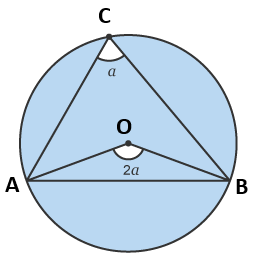
\( \text{Angle at centre}=2\times\text{angle at circumference} \)
Both angles must stand on the same arc.
(ii) Angle in a Semicircle
The angle subtended by a diameter at the circumference is a right angle.
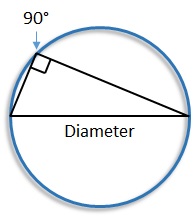
\( 90^\circ \)
(iii) Angles in the Same Segment
Angles standing on the same chord in the same segment are equal.
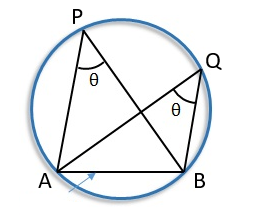
So if two angles look at the same arc, they are equal.
(iv) Opposite Angles in a Cyclic Quadrilateral
If a quadrilateral is cyclic:
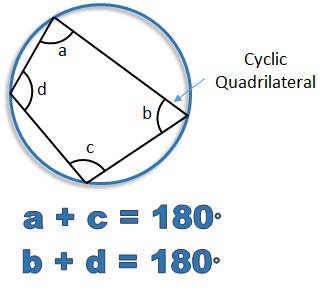
Opposite angles add to \( 180^\circ \)
(v) Alternate Segment Theorem
The angle between a tangent and a chord equals the angle in the opposite segment of the circle.
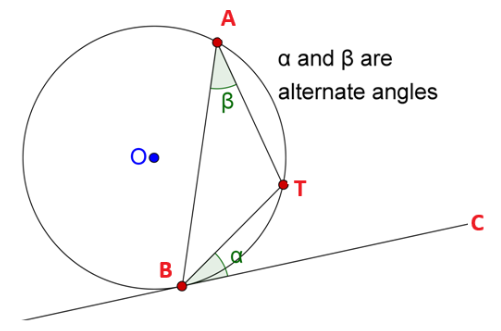
This is commonly used when a tangent touches the circle.
Example 1:
An angle at the circumference is \( 35^\circ \). Find the angle at the centre standing on the same arc.
▶️ Answer/Explanation
Centre angle \( =2\times35^\circ=70^\circ \)
Conclusion: \( 70^\circ \).
Example 2:
A triangle is drawn in a semicircle using the diameter. Find the angle at the circumference.
▶️ Answer/Explanation
Angle in a semicircle is always a right angle.
Conclusion: \( 90^\circ \).
Example 3:
In a cyclic quadrilateral one angle is \( 112^\circ \). Find the opposite angle.
▶️ Answer/Explanation
Opposite angles sum to \( 180^\circ \)
\( 180^\circ-112^\circ=68^\circ \)
Conclusion: \( 68^\circ \).