
Vectors: Magnitude and Direction
A vector is a quantity that has both size and direction.
This makes it different from a scalar quantity, which has size only.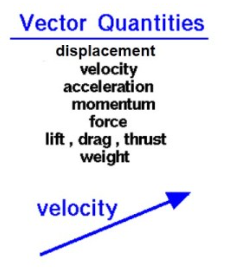
Examples
- Distance → scalar (only length)
- Displacement → vector (length and direction)
- Speed → scalar
- Velocity → vector
- Force → vector
Magnitude
The magnitude of a vector is its size or length.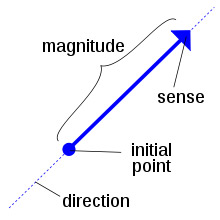
It tells how large the vector is.
Direction
The direction shows where the vector points.
Two vectors are equal only if:
- They have the same magnitude
- They have the same direction
Representing a Vector
Vectors are drawn as arrows:
- Length of arrow → magnitude
- Arrowhead → direction
The starting point is called the tail and the end point is the head.
This idea is used in geometry, mechanics and physics.
Example 1:
Explain why velocity is a vector quantity.
▶️ Answer/Explanation
Velocity has speed and direction.
For example: 20 m/s east is different from 20 m/s west.
Conclusion: Velocity is a vector.
Example 2:
Is distance a vector?
▶️ Answer/Explanation
Distance has magnitude only.
It has no direction.
Conclusion: Distance is a scalar.
Example 3:
Two forces act in opposite directions but have equal size. Are they equal vectors?
▶️ Answer/Explanation
Their magnitudes are equal but directions are opposite.
Conclusion: They are not equal vectors.
Vector Notation and Column Vectors
Vectors can be written in several standard mathematical forms.
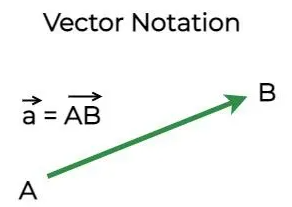
A vector from point \( O \) to point \( A \) is written as:
\( \overrightarrow{OA} \)
Sometimes this vector is also labelled using a lowercase letter:
\( \mathbf{a} \)
So:
\( \overrightarrow{OA}=\mathbf{a} \)
Column Vectors
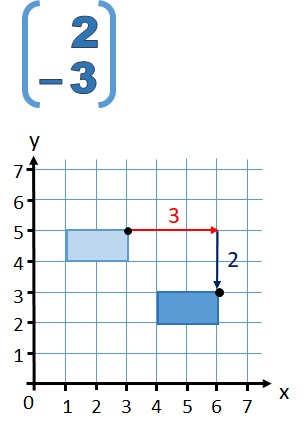
A vector can also be written as a column vector:
\( \begin{pmatrix} x \\ y \end{pmatrix} \)
This tells us how far to move:
- \( x \) units horizontally
- \( y \) units vertically
For example:
\( \begin{pmatrix} 4 \\ 2 \end{pmatrix} \)
means move 4 units right and 2 units up.
Position Vectors
If the vector starts at the origin \( (0,0) \), it is called a position vector.
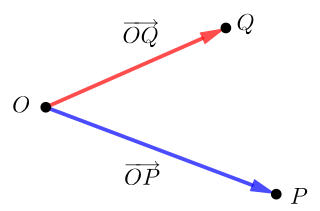
So the coordinates of point \( A(4,2) \) are the same as the vector:
\( \overrightarrow{OA}= \begin{pmatrix} 4 \\ 2 \end{pmatrix} \)
Negative Vectors
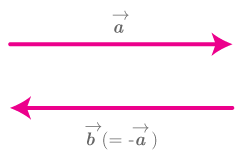
A negative vector points in the opposite direction.
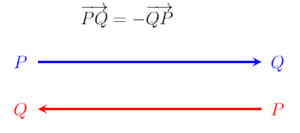
\( -\mathbf{a} \) is the same length as \( \mathbf{a} \) but reversed.
Example 1:
Write the vector from \( O(0,0) \) to \( A(5,-3) \) as a column vector.
▶️ Answer/Explanation
\( \overrightarrow{OA}= \begin{pmatrix} 5 \\ -3 \end{pmatrix} \)
Conclusion: Column vector \( \begin{pmatrix}5\\-3\end{pmatrix} \).
Example 2:
Point \( B \) has position vector \( \begin{pmatrix}2\\7\end{pmatrix} \). Write its coordinates.
▶️ Answer/Explanation
Coordinates are the same as the vector components.
Conclusion: \( (2,7) \).
Example 3:
If \( \overrightarrow{OA}=\mathbf{a} \), what does \( -\mathbf{a} \) represent?
▶️ Answer/Explanation
Same magnitude, opposite direction.
Conclusion: Vector from \( A \) back to \( O \).
Multiplying a Vector by a Scalar
A scalar is an ordinary number (for example 2, 3, −1, 0.5).
When a vector is multiplied by a scalar, its length changes but its direction may stay the same or reverse.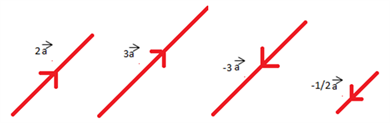
If:
\( \mathbf{a}=\begin{pmatrix}x\\y\end{pmatrix} \)
then multiplying by a scalar \( k \) gives:
\( k\mathbf{a}=\begin{pmatrix}kx\\ky\end{pmatrix} \)
Effect of the Scalar
- \( k>1 \) → vector becomes longer
- \( 0<k<1 \) → vector becomes shorter
- \( k<0 \) → vector reverses direction
- \( k=0 \) → zero vector (no movement)
Important Idea
Scalar multiplication stretches or shrinks a vector. It does not change the angle unless the scalar is negative (which flips direction).
Example 1:
Given \( \mathbf{a}=\begin{pmatrix}3\\2\end{pmatrix} \), find \( 2\mathbf{a} \).
▶️ Answer/Explanation
\( 2\mathbf{a}=\begin{pmatrix}2\times3\\2\times2\end{pmatrix} =\begin{pmatrix}6\\4\end{pmatrix} \)
Conclusion: \( \begin{pmatrix}6\\4\end{pmatrix} \).
Example 2:
If \( \mathbf{b}=\begin{pmatrix}-4\\5\end{pmatrix} \), find \( -\mathbf{b} \).
▶️ Answer/Explanation
\( -\mathbf{b}=\begin{pmatrix}4\\-5\end{pmatrix} \)
Conclusion: Same magnitude, opposite direction.
Example 3:
Given \( \mathbf{c}=\begin{pmatrix}8\\-6\end{pmatrix} \), find \( \dfrac{1}{2}\mathbf{c} \).
▶️ Answer/Explanation
\( \dfrac{1}{2}\mathbf{c}= \begin{pmatrix}4\\-3\end{pmatrix} \)
Conclusion: \( \begin{pmatrix}4\\-3\end{pmatrix} \).
Adding and Subtracting Vectors
Vectors can be combined by addition and subtraction.
We add or subtract vectors by working with their components.
If
\( \mathbf{a}=\begin{pmatrix}x_1\\y_1\end{pmatrix} \), \( \mathbf{b}=\begin{pmatrix}x_2\\y_2\end{pmatrix} \)
Vector Addition
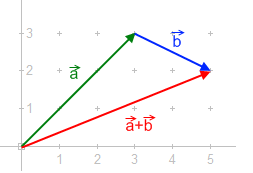
\( \mathbf{a}+\mathbf{b}=\begin{pmatrix}x_1+x_2\\y_1+y_2\end{pmatrix} \)
So we simply add corresponding components.
Vector Subtraction
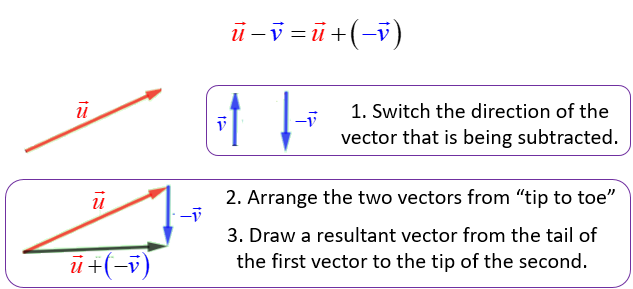
\( \mathbf{a}-\mathbf{b}=\begin{pmatrix}x_1-x_2\\y_1-y_2\end{pmatrix} \)
Subtracting a vector is the same as adding its negative:
\( \mathbf{a}-\mathbf{b}=\mathbf{a}+(-\mathbf{b}) \)
Geometric Meaning
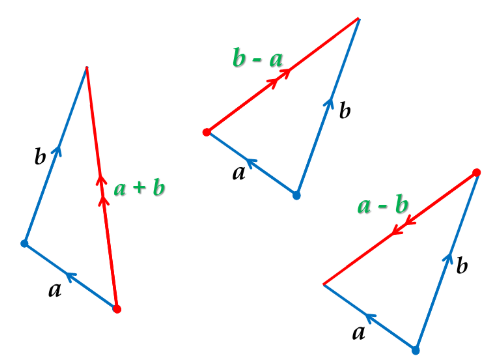
- Addition: place vectors head to tail
- Result is the vector from the start of the first to the end of the last
This is often called the triangle rule or parallelogram rule.
Example 1:
Find \( \mathbf{a}+\mathbf{b} \) if \( \mathbf{a}=\begin{pmatrix}2\\5\end{pmatrix} \), \( \mathbf{b}=\begin{pmatrix}4\\-3\end{pmatrix} \).
▶️ Answer/Explanation
\( \mathbf{a}+\mathbf{b}= \begin{pmatrix}2+4\\5-3\end{pmatrix} = \begin{pmatrix}6\\2\end{pmatrix} \)
Conclusion: \( \begin{pmatrix}6\\2\end{pmatrix} \).
Example 2:
Find \( \mathbf{a}-\mathbf{b} \) if \( \mathbf{a}=\begin{pmatrix}7\\1\end{pmatrix} \), \( \mathbf{b}=\begin{pmatrix}3\\4\end{pmatrix} \).
▶️ Answer/Explanation
\( \mathbf{a}-\mathbf{b}= \begin{pmatrix}7-3\\1-4\end{pmatrix} = \begin{pmatrix}4\\-3\end{pmatrix} \)
Conclusion: \( \begin{pmatrix}4\\-3\end{pmatrix} \).
Example 3:
Given \( \overrightarrow{AB}=\begin{pmatrix}3\\2\end{pmatrix} \) and \( \overrightarrow{BC}=\begin{pmatrix}5\\1\end{pmatrix} \), find \( \overrightarrow{AC} \).
▶️ Answer/Explanation
Use head-to-tail rule:
\( \overrightarrow{AC}=\overrightarrow{AB}+\overrightarrow{BC} \)
\( \overrightarrow{AC}= \begin{pmatrix}3+5\\2+1\end{pmatrix} = \begin{pmatrix}8\\3\end{pmatrix} \)
Conclusion: \( \begin{pmatrix}8\\3\end{pmatrix} \).
Magnitude (Modulus) of a Vector
The magnitude (or modulus) of a vector is its length.
It tells us how large the vector is, regardless of its direction.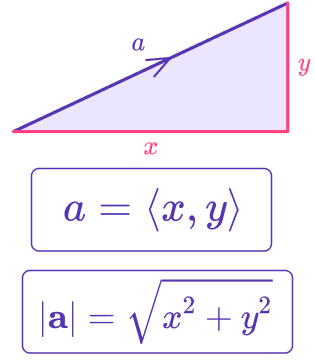
If a vector is written as a column vector:
\( \mathbf{v}= \begin{pmatrix} x\\ y \end{pmatrix} \)
its magnitude is found using Pythagoras’ theorem.
\( |\mathbf{v}|=\sqrt{x^2+y^2} \)
We are finding the distance from the origin \( (0,0) \) to the point \( (x,y) \).
Important Notes
- Magnitude is always positive
- It is written using vertical bars \( |\mathbf{v}| \)
Example 1:
Find the magnitude of \( \begin{pmatrix}5\\-3\end{pmatrix} \).
▶️ Answer/Explanation
\( |\mathbf{v}|=\sqrt{5^2+(-3)^2} \)
\( =\sqrt{25+9}=\sqrt{34} \)
Conclusion: \( \sqrt{34} \).
Example 2:
Find the magnitude of \( \begin{pmatrix}6\\8\end{pmatrix} \).
▶️ Answer/Explanation
\( |\mathbf{v}|=\sqrt{6^2+8^2} \)
\( =\sqrt{36+64}=\sqrt{100}=10 \)
Conclusion: \( 10 \).
Example 3:
A vector has magnitude 13 and horizontal component 5. Find the vertical component.
▶️ Answer/Explanation
Use Pythagoras:
\( 13^2=5^2+y^2 \)
\( 169=25+y^2 \)
\( y^2=144 \Rightarrow y=12 \)
Conclusion: Vertical component \( 12 \).
Resultant of Two or More Vectors
The resultant vector is the single vector that has the same overall effect as several vectors acting together.
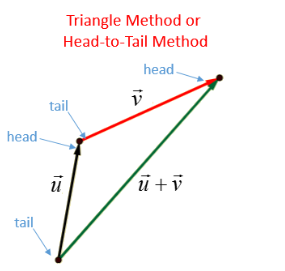
To find the resultant, we add the vectors.
Head-to-Tail Rule
Place each vector so the head of one meets the tail of the next. The resultant is drawn from the start of the first vector to the end of the last vector.
Using Vector Notation
If
\( \overrightarrow{OA}=3\mathbf{a} \)
\( \overrightarrow{AB}=2\mathbf{b} \)
\( \overrightarrow{BC}=\mathbf{c} \)
Then travelling from \( O \) to \( C \):
\( \overrightarrow{OC}=\overrightarrow{OA}+\overrightarrow{AB}+\overrightarrow{BC} \)
\( \overrightarrow{OC}=3\mathbf{a}+2\mathbf{b}+\mathbf{c} \)
Reverse Direction
If you travel backwards, the vector becomes negative.
For example:
\( \overrightarrow{CA}=-\overrightarrow{AC} \)
Using the path \( C \to B \to A \):
\( \overrightarrow{CA}=-\mathbf{c}-2\mathbf{b} \)
Important Idea
Vectors describe movement along a path. Adding them is equivalent to walking step by step along the route.
Example 1:
Given \( \overrightarrow{AB}=\mathbf{a} \) and \( \overrightarrow{BC}=\mathbf{b} \), find \( \overrightarrow{AC} \).
▶️ Answer/Explanation
\( \overrightarrow{AC}=\overrightarrow{AB}+\overrightarrow{BC} \)
\( \overrightarrow{AC}=\mathbf{a}+\mathbf{b} \)
Conclusion: \( \mathbf{a}+\mathbf{b} \).
Example 2:
Given \( \overrightarrow{OA}=2\mathbf{a} \) and \( \overrightarrow{AB}=5\mathbf{a} \), find \( \overrightarrow{OB} \).
▶️ Answer/Explanation
\( \overrightarrow{OB}=\overrightarrow{OA}+\overrightarrow{AB} \)
\( \overrightarrow{OB}=2\mathbf{a}+5\mathbf{a}=7\mathbf{a} \)
Conclusion: \( 7\mathbf{a} \).
Example 3:
If \( \overrightarrow{AB}=\mathbf{p} \) and \( \overrightarrow{AC}=\mathbf{q} \), express \( \overrightarrow{BC} \) in terms of \( \mathbf{p} \) and \( \mathbf{q} \).
▶️ Answer/Explanation
Use triangle rule:
\( \overrightarrow{AC}=\overrightarrow{AB}+\overrightarrow{BC} \)
\( \mathbf{q}=\mathbf{p}+\overrightarrow{BC} \)
\( \overrightarrow{BC}=\mathbf{q}-\mathbf{p} \)
Conclusion: \( \mathbf{q}-\mathbf{p} \).
Using Vectors in Geometrical Proofs
Vectors can be used to prove geometrical results without measuring angles or lengths.
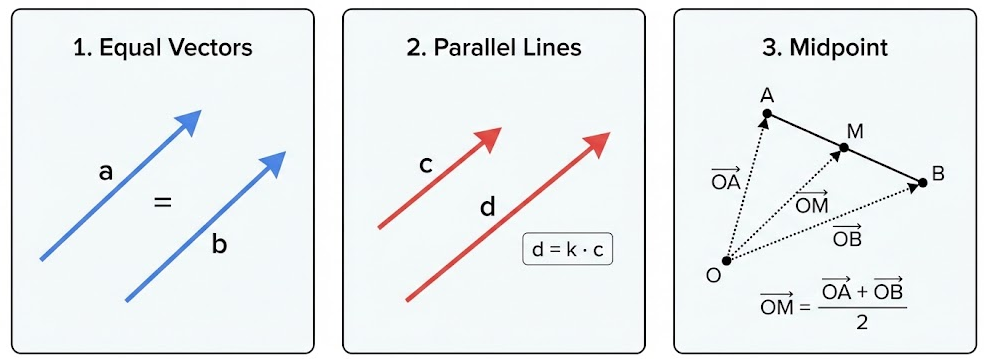
Instead, we show two vectors are equal or parallel.
Key Ideas
- Equal vectors → same length and same direction
- Parallel lines → one vector is a scalar multiple of another
- Midpoint → position vector is the average of endpoints
Midpoint Formula Using Vectors
If \( A \) has position vector \( \mathbf{a} \) and \( B \) has position vector \( \mathbf{b} \), the midpoint \( M \) has position vector:
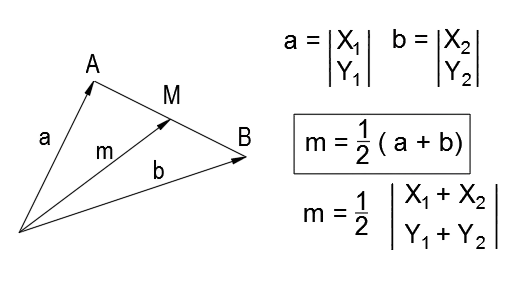
\( \mathbf{m}=\dfrac{\mathbf{a}+\mathbf{b}}{2} \)
Showing a Quadrilateral is a Parallelogram
A quadrilateral is a parallelogram if:
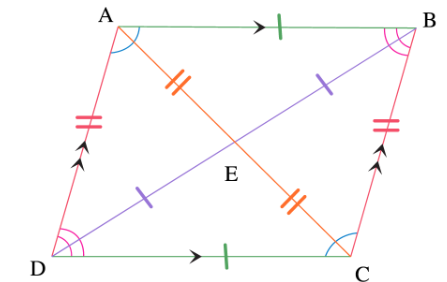
- Opposite sides are equal vectors
- Or diagonals bisect each other
So we prove:
\( \overrightarrow{AB}=\overrightarrow{DC} \) or \( \overrightarrow{AD}=\overrightarrow{BC} \)
Alternatively we show the midpoints of both diagonals are equal.
Example 1:
Points \( A \) and \( B \) have position vectors \( \mathbf{a} \) and \( \mathbf{b} \). Find the position vector of the midpoint of \( AB \).
▶️ Answer/Explanation
\( \mathbf{m}=\dfrac{\mathbf{a}+\mathbf{b}}{2} \)
Conclusion: Midpoint vector \( \dfrac{\mathbf{a}+\mathbf{b}}{2} \).
Example 2:
If \( \overrightarrow{AB}=\overrightarrow{DC} \), what can you say about quadrilateral \( ABCD \)?
▶️ Answer/Explanation
Opposite sides are equal and parallel.
Conclusion: \( ABCD \) is a parallelogram.
Example 3:
Show that two vectors \( \mathbf{p} \) and \( 2\mathbf{p} \) are parallel.
▶️ Answer/Explanation
One vector is a scalar multiple of the other.
Scalar multiple ⇒ same direction.
Conclusion: The vectors are parallel.