
Unbalanced Force, Mass and Acceleration
When forces act on an object, they may be balanced or unbalanced. An unbalanced force causes a change in motion, such as a change in speed or direction.
The relationship between force, mass, and acceleration is described by Newton’s Second Law of Motion.
Balanced and Unbalanced Forces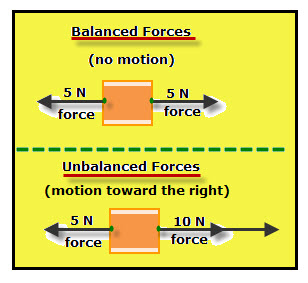
- Balanced forces result in no change in velocity.
- Unbalanced forces cause acceleration.
- Acceleration may be speeding up, slowing down, or changing direction.
Key Relationship
The relationship between unbalanced force, mass, and acceleration is:
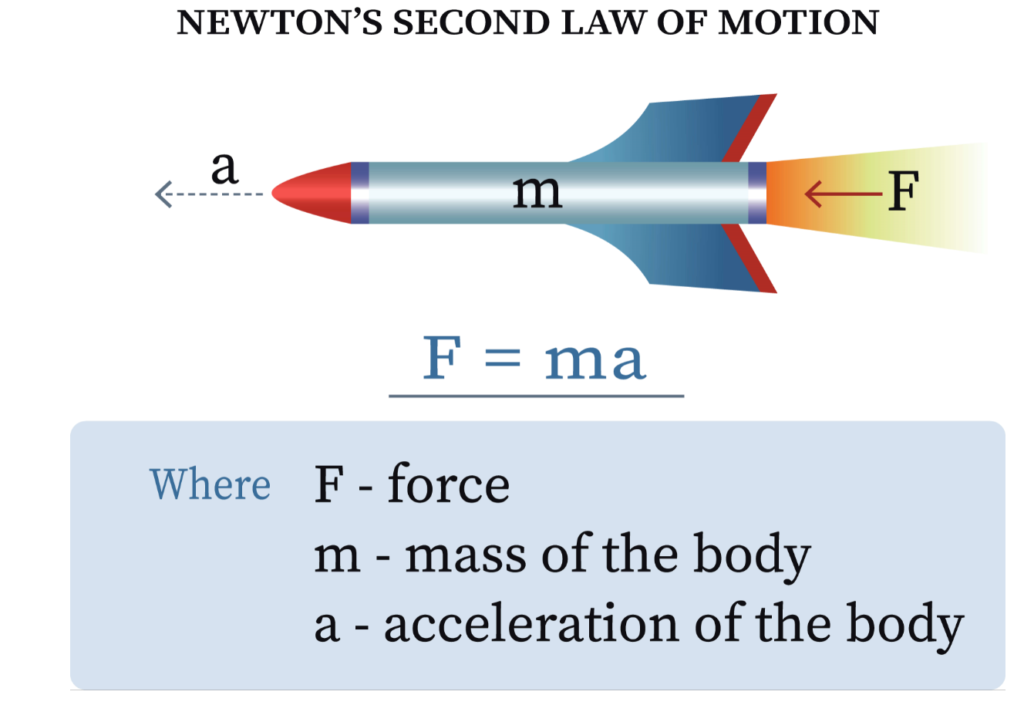
\( \mathrm{force = mass \times acceleration} \)
\( \mathrm{F = ma} \)
- \( \mathrm{F} \) = resultant (unbalanced) force (N)
- \( \mathrm{m} \) = mass (kg)
- \( \mathrm{a} \) = acceleration (m/s²)
Understanding the Equation
- A larger force produces a larger acceleration.
- A larger mass results in a smaller acceleration for the same force.
- Acceleration is always in the direction of the unbalanced force.
Rearranging the Equation
The equation can be rearranged to find mass or acceleration:
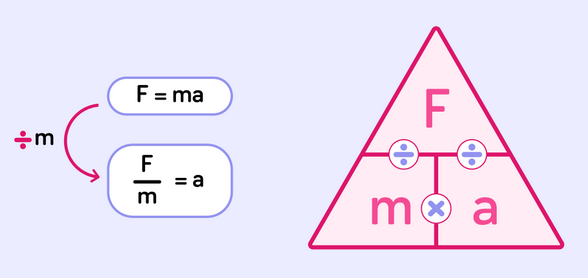
- Acceleration: \( \mathrm{a = \dfrac{F}{m}} \)
- Mass: \( \mathrm{m = \dfrac{F}{a}} \)
Units
- Force → newton (N)
- Mass → kilogram (kg)
- Acceleration → metre per second squared (m/s²)
Key Idea
- Only unbalanced forces cause acceleration.
- Balanced forces do not change motion.
- The direction of acceleration is the same as the direction of the force.
Important Points to Remember
- Always use the resultant force, not individual forces.
- Convert all quantities to SI units.
- Include correct units in final answers.
Example
A force of \( \mathrm{20\ N} \) acts on a mass of \( \mathrm{5\ kg} \). Calculate the acceleration of the object.
▶️ Answer / Explanation
Use: \( \mathrm{F = ma} \)
\( \mathrm{a = \dfrac{F}{m}} \)
\( \mathrm{a = \dfrac{20}{5}} \)
\( \mathrm{a = 4\ m/s^2} \)
Example
A trolley accelerates at \( \mathrm{2\ m/s^2} \) when a force of \( \mathrm{10\ N} \) acts on it. Calculate the mass of the trolley.
▶️ Answer / Explanation
Use: \( \mathrm{F = ma} \)
\( \mathrm{m = \dfrac{F}{a}} \)
\( \mathrm{m = \dfrac{10}{2}} \)
\( \mathrm{m = 5\ kg} \)
Weight, Mass and Gravitational Field Strength
Weight is the force acting on an object due to gravity. It depends on both the mass of the object and the strength of the gravitational field it is in.
Because gravity varies from place to place, an object’s weight can change, even though its mass stays the same.
Mass
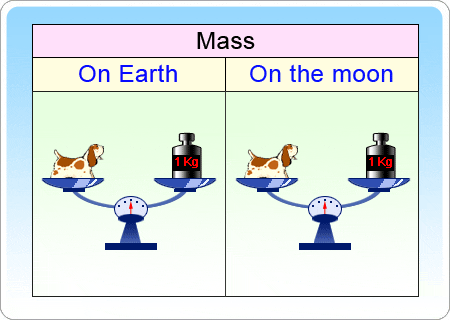
- Mass is the amount of matter in an object.
- Mass is measured in kilograms (kg).
- Mass does not change with location.
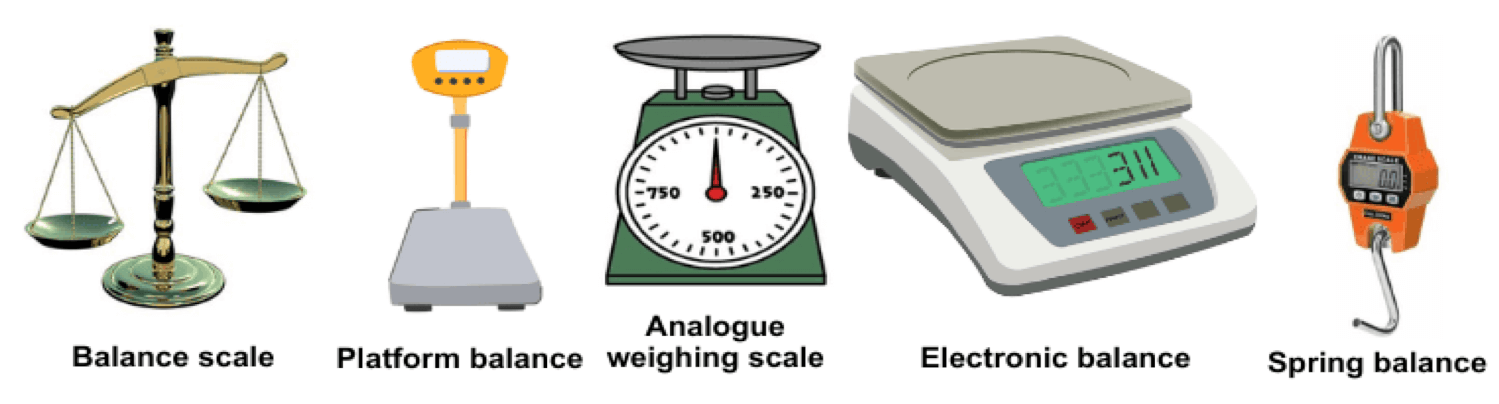
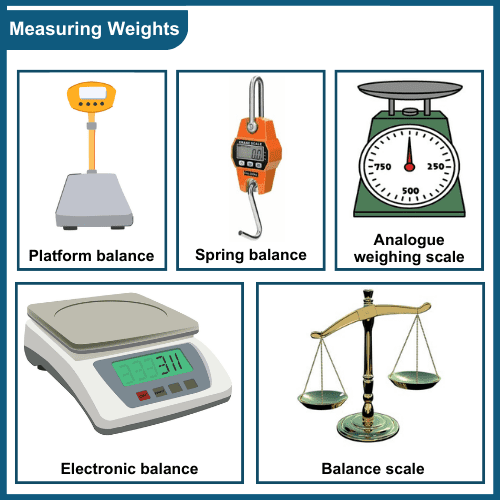
Instruments Used: Mass is measured using a beam balance or electronic balance.
Weight
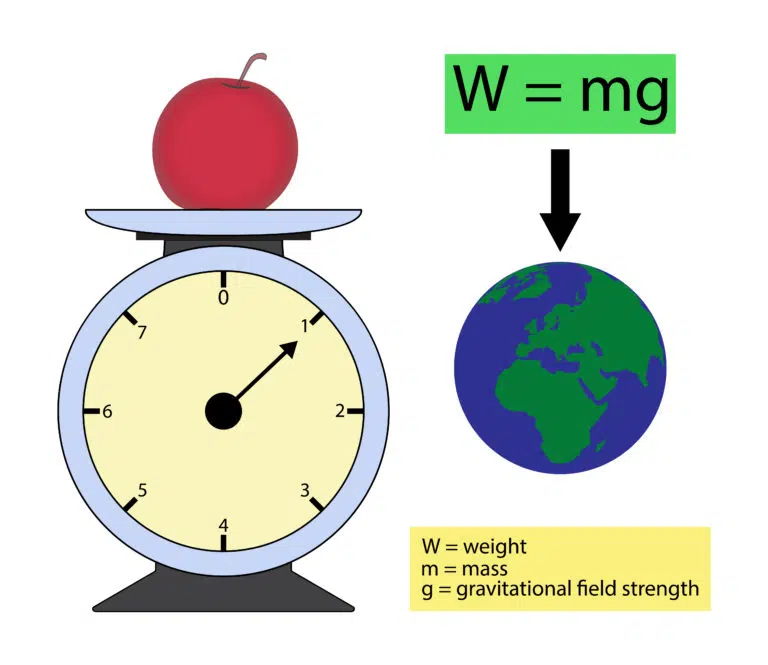
- Weight is a force caused by gravity.
- Weight is measured in newtons (N).
- Weight depends on the gravitational field strength.
Instruments Used: Weight is measured using a spring balance or a newton meter.
Gravitational Field Strength
Gravitational field strength tells us how strong gravity is at a particular place.
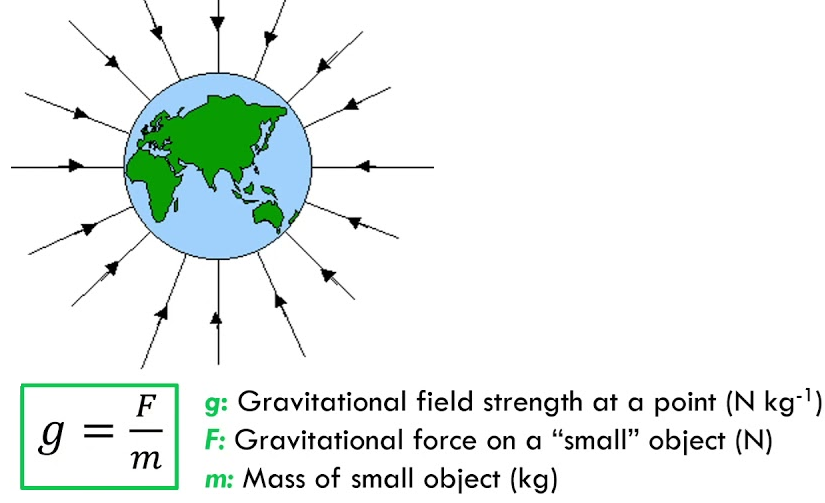
- Measured in newtons per kilogram (N/kg).
- Represents the force acting on 1 kg of mass.
- On Earth, gravitational field strength is approximately \( \mathrm{9.8\ N/kg} \).
Key Relationship
The relationship between weight, mass and gravitational field strength is:
\( \mathrm{weight = mass \times gravitational\ field\ strength} \)
\( \mathrm{W = mg} \)
- \( \mathrm{W} \) = weight (N)
- \( \mathrm{m} \) = mass (kg)
- \( \mathrm{g} \) = gravitational field strength (N/kg)
Understanding the Equation
- A larger mass produces a larger weight.
- A stronger gravitational field produces a larger weight.
- If \( \mathrm{g} \) decreases, weight decreases but mass stays constant.
Rearranging the Equation
The equation can be rearranged to find mass or gravitational field strength:
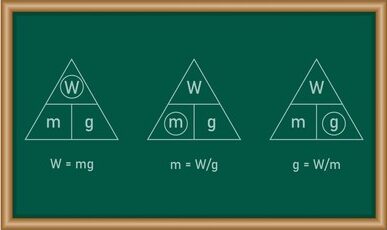
- Mass: \( \mathrm{m = \dfrac{W}{g}} \)
- Gravitational field strength: \( \mathrm{g = \dfrac{W}{m}} \)
Key Idea
- Weight is a force caused by gravity.
- Mass is constant, but weight can change.
- Gravitational field strength links mass to weight.
Important Points to Remember
- Always use the correct units.
- Weight acts vertically downwards.
- Do not confuse mass with weight.
Example
An object has a mass of \( \mathrm{6\ kg} \). Calculate its weight on Earth. (Take \( \mathrm{g = 9.8\ N/kg} \))
▶️ Answer / Explanation
Use: \( \mathrm{W = mg} \)
\( \mathrm{W = 6 \times 9.8} \)
\( \mathrm{W = 58.8\ N} \)
Example
An object has a weight of \( \mathrm{20\ N} \) on a planet where the gravitational field strength is \( \mathrm{5\ N/kg} \). Calculate the mass of the object.
▶️ Answer / Explanation
Use: \( \mathrm{W = mg} \)
\( \mathrm{m = \dfrac{W}{g}} \)
\( \mathrm{m = \dfrac{20}{5}} \)
\( \mathrm{m = 4\ kg} \)