
Stopping Distance of a Vehicle
The stopping distance of a vehicle is the total distance travelled from the moment a driver notices a hazard to the moment the vehicle comes to a complete stop.
Stopping distance is important for road safety because it determines how much space a vehicle needs to stop safely.
Components of Stopping Distance
The stopping distance is made up of two parts:
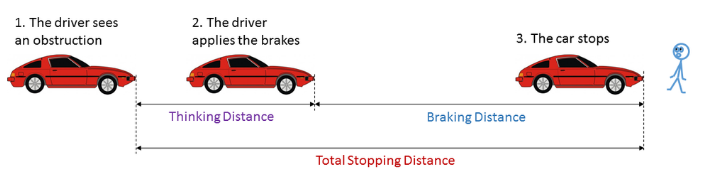
- Thinking distance
- Braking distance
Thinking Distance
Thinking distance is the distance travelled while the driver is reacting to a hazard before the brakes are applied.
- Depends on the driver’s reaction time.
- Increases with speed.
- Affected by tiredness, alcohol, drugs, and distractions.
Formula for thinking distance:
\( \mathrm{thinking\ distance = speed \times reaction\ time} \)
Braking Distance
Braking distance is the distance travelled after the brakes are applied until the vehicle stops.
- Depends on the vehicle’s speed.
- Affected by road conditions, tyre condition, and braking force.
- Increases rapidly with speed.
Key Relationship
The relationship between stopping distance, thinking distance and braking distance is:
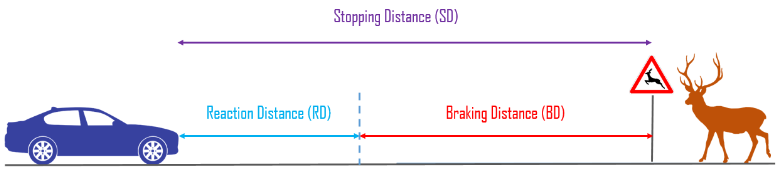
\( \mathrm{stopping\ distance = thinking\ distance + braking\ distance} \)
Understanding the Relationship
- Even with good brakes, stopping distance can be large due to thinking distance.
- Higher speed increases both thinking and braking distances.
- Poor conditions mainly increase braking distance.
Key Idea
- Stopping distance is not just braking distance.
- Driver reaction time is always involved.
- Reducing speed greatly reduces stopping distance.
Important Points to Remember
- Stopping distance is measured in metres (m).
- Thinking distance depends on the driver.
- Braking distance depends on the vehicle and road.
Example
A car has a thinking distance of \( \mathrm{12\ m} \) and a braking distance of \( \mathrm{28\ m} \). Calculate the stopping distance.
▶️ Answer / Explanation
Use: \( \mathrm{stopping\ distance = thinking\ distance + braking\ distance} \)
\( \mathrm{stopping\ distance = 12 + 28} \)
\( \mathrm{stopping\ distance = 40\ m} \)
Example
A driver is travelling at \( \mathrm{20\ m/s} \) and has a reaction time of \( \mathrm{0.8\ s} \). Calculate the thinking distance.
▶️ Answer / Explanation
Use: \( \mathrm{thinking\ distance = speed \times reaction\ time} \)
\( \mathrm{thinking\ distance = 20 \times 0.8} \)
\( \mathrm{thinking\ distance = 16\ m} \)
Factors Affecting Vehicle Stopping Distance
The stopping distance of a vehicle is the total distance travelled from when a driver first notices a hazard to when the vehicle comes to a complete stop.
Stopping distance depends on both the driver and the vehicle, as well as external conditions such as the road surface.
Key Relationship
The stopping distance is given by:
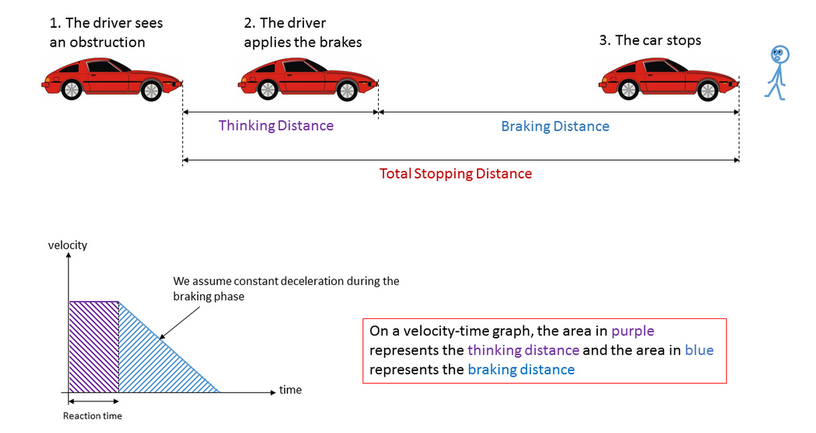
\( \mathrm{stopping\ distance = thinking\ distance + braking\ distance} \)
Main Factors Affecting Stopping Distance
The main factors are:
- Speed of the vehicle
- Reaction time of the driver
- Mass of the vehicle
- Road conditions
1. Speed
Speed has the greatest effect on stopping distance.
- Higher speed increases thinking distance.
- Higher speed also increases braking distance.
- Braking distance increases rapidly as speed increases.
Doubling the speed more than doubles the stopping distance.
2. Reaction Time
Reaction time affects only the thinking distance.
Thinking distance formula:
\( \mathrm{thinking\ distance = speed \times reaction\ time} \)
- Longer reaction time increases stopping distance.
- Reaction time increases due to tiredness, alcohol, drugs, and distractions.
3. Mass of the Vehicle
The mass of a vehicle mainly affects the braking distance.
- A larger mass means more momentum.
- More force is required to stop the vehicle.
- This results in a longer braking distance.
Heavy vehicles such as trucks take longer distances to stop.
4. Road Conditions
Road conditions affect the amount of friction between the tyres and the road.
- Wet or icy roads reduce friction.
- Reduced friction increases braking distance.
- Loose surfaces (gravel) also reduce grip.
Good road conditions provide more friction and shorter braking distances.
Key Idea
- Stopping distance depends on both thinking and braking distances.
- Some factors affect the driver, others affect the vehicle.
- Reducing speed greatly reduces stopping distance.
Important Points to Remember
- Reaction time affects only thinking distance.
- Road and vehicle factors mainly affect braking distance.
- Stopping distance is always measured in metres (m).
Example
A driver increases speed from \( \mathrm{15\ m/s} \) to \( \mathrm{25\ m/s} \). State two reasons why the stopping distance increases.
▶️ Answer / Explanation
Thinking distance increases because the car travels further during the reaction time.
Braking distance increases because the car has more kinetic energy to lose.
Example
A car is travelling on an icy road. Explain why its stopping distance is longer than on a dry road.
▶️ Answer / Explanation
The icy road reduces friction between the tyres and the road.
Reduced friction increases braking distance, so the total stopping distance is larger.