
Forces on Falling Objects and Terminal Velocity
When an object falls through the air, it experiences forces that affect its motion. These forces determine how the object accelerates and explain why it eventually reaches a constant maximum speed called terminal velocity.
Forces Acting on a Falling Object
Two main forces act on a falling object:

- Weight (gravitational force)
- Air resistance (drag)
1. Weight
Weight is the force pulling the object downward due to gravity.
Formula for weight:
\( \mathrm{W = mg} \)
- Acts vertically downward.
- Constant for a given mass near Earth’s surface.
- Measured in newtons (N).
2. Air Resistance
Air resistance is a frictional force that opposes motion through air.
- Acts upward on a falling object.
- Acts opposite to the direction of motion.
- Increases as the object’s speed increases.
Motion of a Falling Object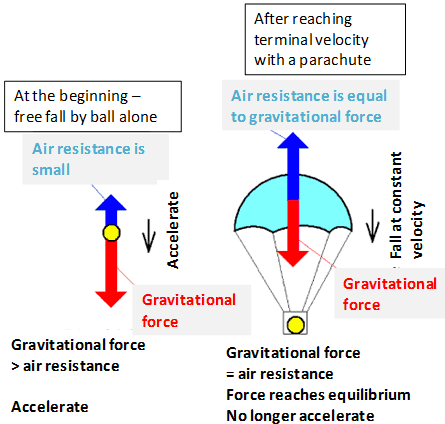
Just after release:
- Weight is much larger than air resistance.
- The resultant force is downward.
- The object accelerates downward.
As speed increases:
- Air resistance increases.
- The resultant force decreases.
- The acceleration decreases.
Terminal Velocity
Terminal velocity is the constant maximum speed reached by a falling object when forces become balanced.

- Air resistance equals weight.
- The resultant force is zero.
- Acceleration becomes zero.
- The object continues to fall at constant speed.
Condition at terminal velocity:
\( \mathrm{air\ resistance = weight} \)
Why Terminal Velocity Occurs
- Air resistance increases with speed.
- Eventually, it becomes equal to the weight.
- No unbalanced force remains to cause acceleration.
Different objects have different terminal velocities depending on their shape, surface area, and mass.
Key Idea
- Falling objects experience both weight and air resistance.
- Acceleration decreases as air resistance increases.
- Terminal velocity occurs when forces are balanced.
Important Points to Remember
- Terminal velocity does not mean the object stops.
- Heavier or more streamlined objects usually have higher terminal velocities.
- In a vacuum, all objects fall at the same rate.
Example
State the forces acting on a ball falling through the air.
▶️ Answer / Explanation
The ball experiences weight acting downward and air resistance acting upward.
Example
A skydiver reaches terminal velocity while falling. Explain why the skydiver no longer accelerates.
▶️ Answer / Explanation
At terminal velocity, air resistance equals the weight of the skydiver.
The forces are balanced, so the resultant force is zero.
With no resultant force, there is no acceleration.