
Practical: Extension and Applied Force
This practical investigates how the extension of different materials changes when an applied force is increased. The materials studied include helical springs, metal wires, and rubber bands.
The investigation helps to understand elastic behaviour and the limits of materials.
Aim
To investigate the relationship between applied force and extension for a helical spring, a metal wire, and a rubber band.
Apparatus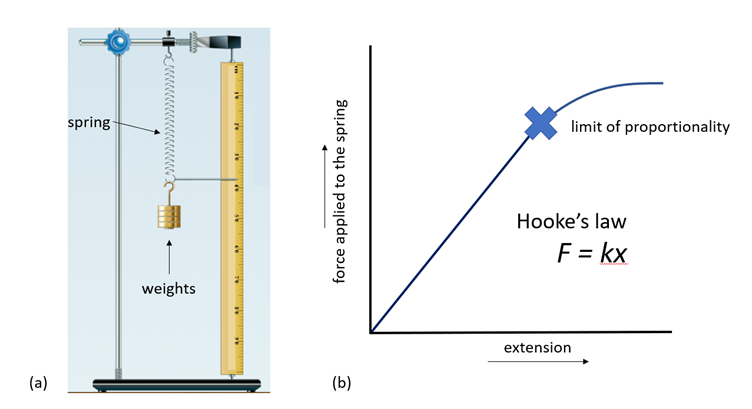
- Helical spring, metal wire, rubber band
- Clamp stand and boss
- Mass hanger and slotted masses
- Metre ruler
- Pointer (optional)
Key Formula
For elastic materials that obey Hooke’s law:
\( \mathrm{force = spring\ constant \times extension} \)
\( \mathrm{F = kx} \)
- \( \mathrm{F} \) = applied force (N)
- \( \mathrm{k} \) = spring constant (N/m)
- \( \mathrm{x} \) = extension (m)
Method
- Secure the spring (or wire or rubber band) vertically to a clamp stand.
- Measure and record its original length.
- Add a known mass to apply a force.
- Measure the new length and calculate the extension.
- Increase the mass in equal steps and repeat measurements.
- Repeat the experiment for the metal wire and rubber band.
Measurements
- Force calculated using: \( \mathrm{F = mg} \)
- Extension calculated using: \( \mathrm{extension = final\ length – original\ length} \)
Expected Results
- Helical spring: Extension is directly proportional to force (straight-line graph).
- Metal wire: Very small extension, proportional at low forces.
- Rubber band: Non-linear relationship; does not obey Hooke’s law.
Force–Extension Graph
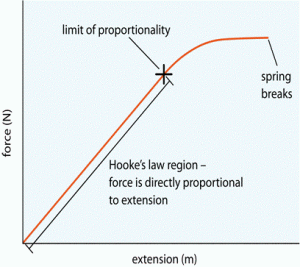
- A straight line through the origin shows Hooke’s law is obeyed.
- The gradient gives the spring constant \( \mathrm{k} \).
- A curved graph shows non-elastic behaviour.
Elastic Limit
The elastic limit is the point beyond which the material does not return to its original length when the force is removed.
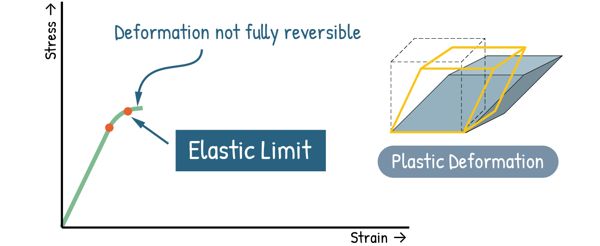
- Below elastic limit → elastic deformation.
- Beyond elastic limit → permanent deformation.
Safety and Accuracy
- Add masses gently.
- Do not exceed the elastic limit.
- Read the ruler at eye level to avoid parallax error.
- Use small force intervals for accuracy.
Key Idea
- Some materials obey Hooke’s law.
- Others show non-linear extension.
- Graphs help identify elastic behaviour.
Example
A force of \( \mathrm{6\ N} \) produces an extension of \( \mathrm{0.03\ m} \) in a spring. Calculate the spring constant.
▶️ Answer / Explanation
Use: \( \mathrm{F = kx} \)
\( \mathrm{k = \dfrac{F}{x}} \)
\( \mathrm{k = \dfrac{6}{0.03}} \)
\( \mathrm{k = 200\ N/m} \)
Example
A rubber band is stretched using increasing force. Explain why the force–extension graph is not a straight line.
▶️ Answer / Explanation
Rubber bands do not obey Hooke’s law.
Their extension is not proportional to the applied force.