
Hooke’s Law and the Force–Extension Graph
A force–extension graph shows how the extension of a material changes when a force is applied. The initial linear region of this graph is associated with Hooke’s law.
This region represents elastic behaviour where the material returns to its original length when the force is removed.
Hooke’s Law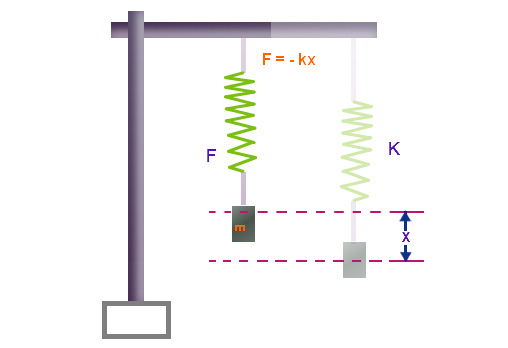
Hooke’s law states that:
\( \mathrm{force \propto extension} \)
Or in equation form:
\( \mathrm{F = kx} \)
- \( \mathrm{F} \) = applied force (N)
- \( \mathrm{k} \) = spring constant (N/m)
- \( \mathrm{x} \) = extension (m)
Initial Linear Region
The initial linear region of a force–extension graph is the straight-line part at the start of the graph.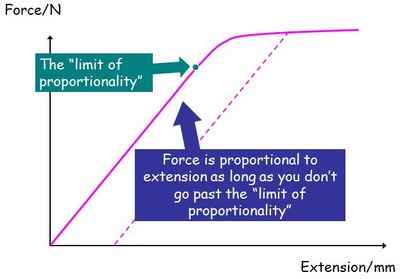
- Force and extension are directly proportional.
- The graph is a straight line through the origin.
- The material obeys Hooke’s law in this region.
The gradient of this straight line represents the spring constant.
Beyond the Linear Region
After the initial linear region:
- The graph becomes curved.
- Extension is no longer proportional to force.
- Hooke’s law no longer applies.
This occurs when the elastic limit is reached.
Elastic Behaviour
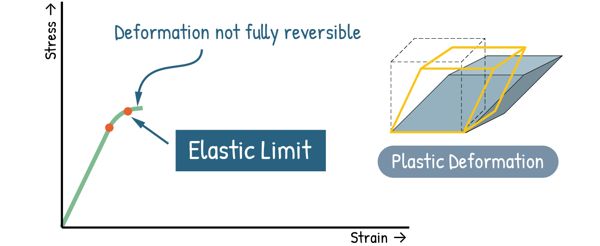
- Below the elastic limit, the material returns to its original length.
- Energy is stored as elastic potential energy.
- No permanent deformation occurs.
Key Idea
- The straight-line region shows Hooke’s law.
- The gradient gives the spring constant.
- Only the initial region is used for calculations.
Important Points to Remember
- Hooke’s law applies only up to the elastic limit.
- Not all materials have a clear linear region.
- Rubber bands usually do not obey Hooke’s law.
Example
A spring has a straight-line force–extension graph for small forces. State what this shows about the behaviour of the spring.
▶️ Answer / Explanation
The spring obeys Hooke’s law in this region.
Force is directly proportional to extension.
Example
The gradient of the linear region of a force–extension graph is \( \mathrm{400\ N/m} \). Calculate the extension produced by a force of \( \mathrm{8\ N} \).
▶️ Answer / Explanation
Use: \( \mathrm{F = kx} \)
\( \mathrm{x = \dfrac{F}{k}} \)
\( \mathrm{x = \dfrac{8}{400}} \)
\( \mathrm{x = 0.02\ m} \)
Elastic Behaviour of Materials
Elastic behaviour is the ability of a material to return to its original shape and size after the forces causing deformation have been removed.
Materials that show elastic behaviour store energy when they are deformed and release this energy when the force is removed.
Elastic Deformation
Elastic deformation occurs when a material changes shape under a force but returns to its original shape once the force is removed.
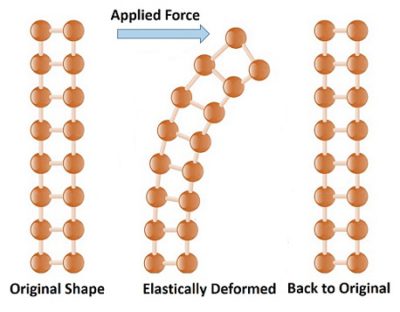
- The deformation is temporary.
- No permanent change in shape occurs.
- The material obeys Hooke’s law within this region.
Key Formula
For materials showing elastic behaviour: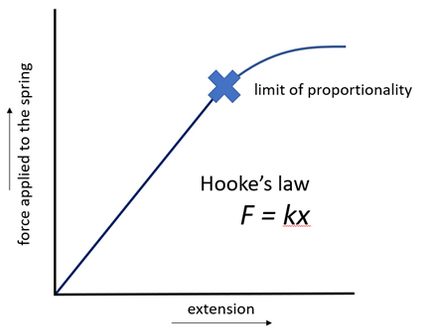
\( \mathrm{F = kx} \)
- \( \mathrm{F} \) = applied force (N)
- \( \mathrm{k} \) = spring constant (N/m)
- \( \mathrm{x} \) = extension (m)
This formula applies only while the material behaves elastically.
Elastic Limit
The elastic limit is the maximum force or extension beyond which a material will no longer return to its original shape.
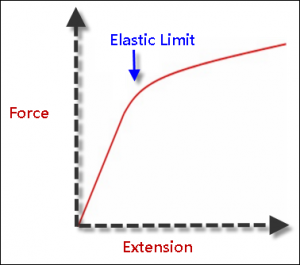
- Below the elastic limit → elastic behaviour.
- Beyond the elastic limit → permanent deformation.
Elastic vs Plastic Behaviour
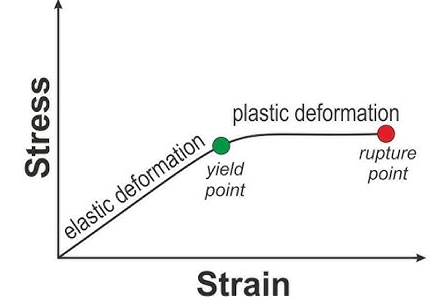
- Elastic behaviour: material returns to original shape.
- Plastic behaviour: material does not return to original shape.
Rubber bands, springs, and metal wires show elastic behaviour for small forces.
Key Idea
- Elastic behaviour is reversible deformation.
- Energy is stored during deformation.
- Elastic behaviour applies only up to the elastic limit.
Important Points to Remember
- Not all deformation is elastic.
- Exceeding the elastic limit causes permanent change.
- Elastic materials can repeatedly return to original shape.
Example
A spring is stretched by a small force and then released. Describe the behaviour of the spring.
▶️ Answer / Explanation
The spring returns to its original length.
This shows elastic behaviour.
Example
A force of \( \mathrm{5\ N} \) stretches a spring by \( \mathrm{0.025\ m} \). Calculate the spring constant.
▶️ Answer / Explanation
Use: \( \mathrm{F = kx} \)
\( \mathrm{k = \dfrac{F}{x}} \)
\( \mathrm{k = \dfrac{5}{0.025}} \)
\( \mathrm{k = 200\ N/m} \)