
Momentum, Mass and Velocity
Momentum is a quantity used to describe how difficult it is to stop a moving object. It depends on both the mass of the object and its velocity.
Momentum is especially important in situations involving motion, collisions, and safety features such as seat belts and airbags.
What Is Momentum?
- Momentum depends on how heavy an object is and how fast it is moving.
- A fast-moving or heavy object has a large momentum.
- Momentum is a vector quantity, so it has both magnitude and direction.
Key Relationship
The relationship between momentum, mass and velocity is:

\( \mathrm{momentum = mass \times velocity} \)
\( \mathrm{p = mv} \)
- \( \mathrm{p} \) = momentum (kg m/s)
- \( \mathrm{m} \) = mass (kg)
- \( \mathrm{v} \) = velocity (m/s)
Understanding the Equation
- Increasing mass increases momentum.
- Increasing velocity increases momentum.
- Changing direction changes momentum.
If velocity is zero, momentum is zero.
Rearranging the Equation
The equation can be rearranged to find mass or velocity:
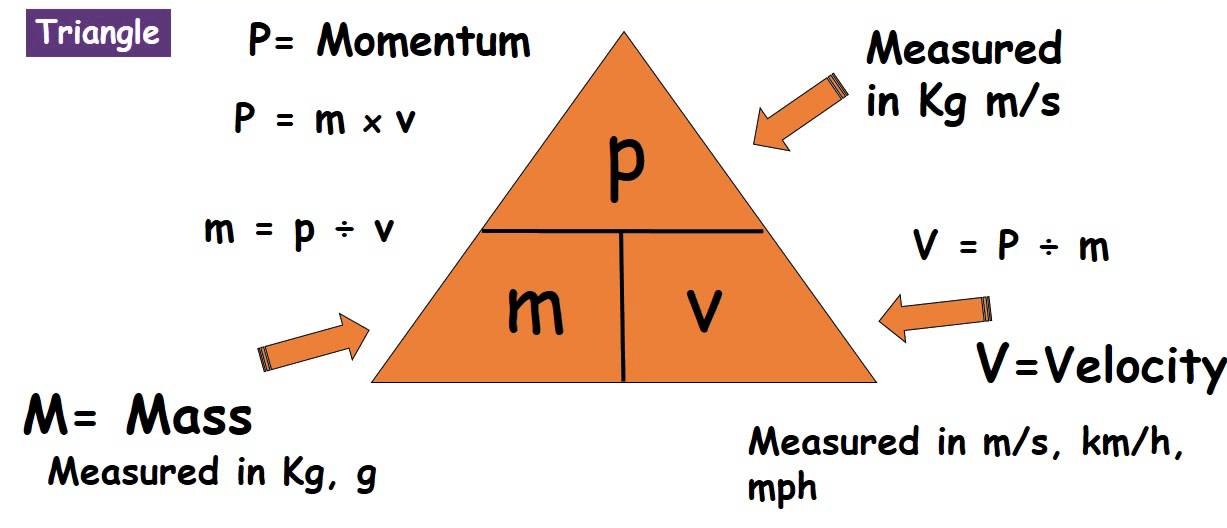
- Mass: \( \mathrm{m = \dfrac{p}{v}} \)
- Velocity: \( \mathrm{v = \dfrac{p}{m}} \)
Units
- Momentum → kilogram metre per second (kg m/s)
- Mass → kilogram (kg)
- Velocity → metre per second (m/s)
Key Idea
- Momentum combines mass and velocity.
- It describes resistance to stopping.
- Direction of motion is important.
Important Points to Remember
- Momentum is conserved in collisions (if no external forces act).
- Use velocity, not speed, in calculations.
- Always include units.
Example
A trolley of mass \( \mathrm{3\ kg} \) moves at a velocity of \( \mathrm{4\ m/s} \). Calculate the momentum of the trolley.
▶️ Answer / Explanation
Use: \( \mathrm{p = mv} \)
\( \mathrm{p = 3 \times 4} \)
\( \mathrm{p = 12\ kg\,m/s} \)
Example
An object has a momentum of \( \mathrm{20\ kg\,m/s} \) and a mass of \( \mathrm{5\ kg} \). Calculate its velocity.
▶️ Answer / Explanation
Use: \( \mathrm{p = mv} \)
\( \mathrm{v = \dfrac{p}{m}} \)
\( \mathrm{v = \dfrac{20}{5}} \)
\( \mathrm{v = 4\ m/s} \)
Momentum and Safety Features
Safety features in vehicles and protective equipment are designed using the idea of momentum. They reduce the forces experienced during collisions by increasing the time taken for momentum to change.
This helps to protect people from serious injury.
Momentum and Collisions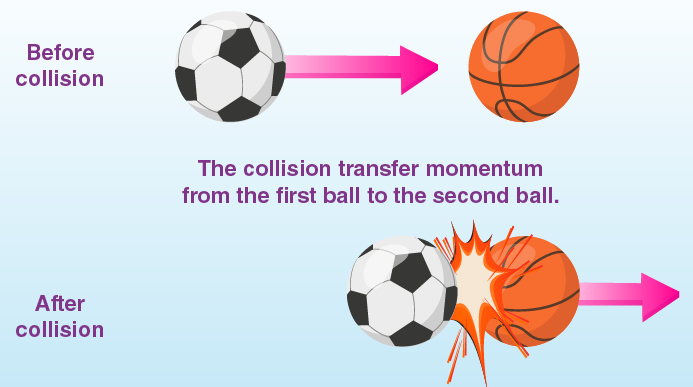
Momentum is given by:
\( \mathrm{momentum = mass \times velocity} \)
\( \mathrm{p = mv} \)
- A moving object has momentum.
- In a collision, momentum changes rapidly.
- A large change in momentum produces a large force.
Force and Change in Momentum
The force during a collision depends on how quickly momentum changes:

\( \mathrm{force = \dfrac{change\ in\ momentum}{time\ taken}} \)
\( \mathrm{F = \dfrac{\Delta p}{\Delta t}} \)
- \( \mathrm{\Delta p} \) = change in momentum (kg m/s)
- \( \mathrm{\Delta t} \) = time taken for the change (s)
For the same change in momentum, increasing the time reduces the force.
How Safety Features Reduce Injury
- They increase the time taken for momentum to change.
- This reduces the force acting on the body.
- Smaller forces mean less injury.
Examples of Safety Features
1. Seat Belts
- Hold passengers in place during a collision.

- Increase the time over which the passenger stops.
- Reduce the force acting on the body.
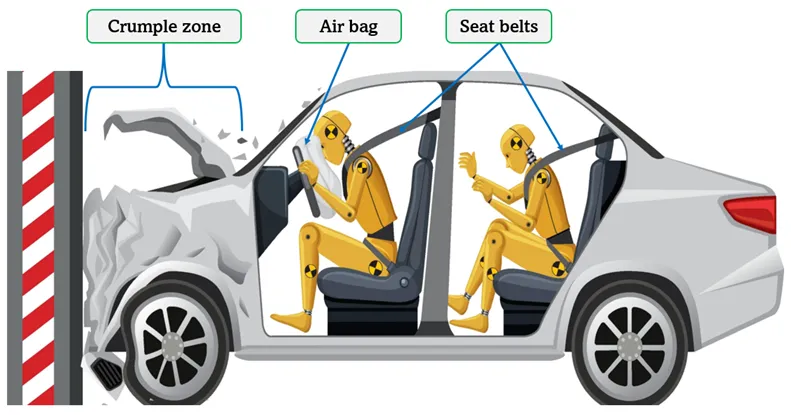
2. Airbags
- Increase stopping time of the head and chest.
- Prevent contact with hard surfaces.
- Reduce peak forces during impact.
3. Crumple Zones
- Parts of a car designed to deform in a crash.
- Increase collision time.
- Reduce the force on passengers.
Key Idea
- Safety features work by increasing stopping time.
- Increasing time reduces force.
- Momentum changes are unavoidable in collisions.
Important Points to Remember
- The change in momentum is the same with or without safety features.
- Safety features reduce force, not momentum change.
- Force depends on how quickly momentum changes.
Example
Explain how a seat belt reduces injury during a car crash using momentum.
▶️ Answer / Explanation
The seat belt increases the time taken for the passenger to stop.
This reduces the force because the change in momentum happens over a longer time.
Example
A car of mass \( \mathrm{1000\ kg} \) travelling at \( \mathrm{20\ m/s} \) comes to rest in \( \mathrm{0.5\ s} \). Calculate the average force acting on the car.
▶️ Answer / Explanation
Initial momentum:
\( \mathrm{p = mv = 1000 \times 20 = 20000\ kg\,m/s} \)
Final momentum = 0
Change in momentum:
\( \mathrm{\Delta p = 20000\ kg\,m/s} \)
Use: \( \mathrm{F = \dfrac{\Delta p}{\Delta t}} \)
\( \mathrm{F = \dfrac{20000}{0.5}} \)
\( \mathrm{F = 40000\ N} \)