
Practical: Investigating the Motion of Everyday Objects
This practical investigates the motion of everyday objects such as toy cars or tennis balls. By measuring how distance changes with time, the motion of the object can be analysed and its speed can be calculated.
This investigation helps to understand real motion and links directly to distance–time graphs and the concept of average speed.
Aim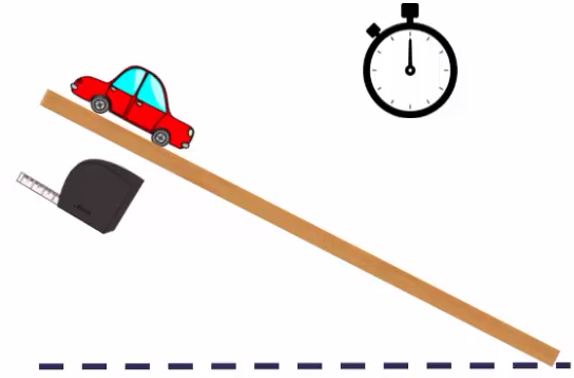
To investigate how the distance travelled by an object changes with time and to calculate its average speed.
Apparatus
- Toy car or tennis ball
- Metre ruler or measuring tape
- Stopwatch
- Smooth flat surface (floor or table)
- Masking tape or chalk (to mark distances)
Method
- Place the toy car on a smooth surface, or prepare to roll the tennis ball in a straight line.
- Mark equal distances along the surface, for example every \( \mathrm{0.5\ m} \).
- Release the object gently so that it starts moving.
- Use a stopwatch to measure the time taken to reach each distance mark.
- Record the distance and corresponding time in a table.
- Repeat the experiment at least twice and calculate average values.
Measurements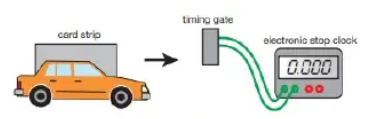
- Distance measured in metres (m).
- Time measured in seconds (s).
- Average speed calculated in metres per second (m/s).
Analysis of Results
- Plot a distance–time graph using the recorded data.
- Calculate the gradient of the graph to find the speed.
- If the graph is a straight line, the object is moving at constant speed.
- If the graph is curved, the speed is changing.
The average speed can be calculated using:
\( \mathrm{average\ speed = \dfrac{distance}{time}} \)
Safety and Accuracy
- Ensure the surface is clear of obstacles.
- Release the object gently to avoid extra forces.
- Use the same starting point for each trial.
- Repeat measurements to reduce random errors.
Conclusion
This practical shows how motion can be studied using simple everyday objects. By measuring distance and time, the motion can be described and the speed calculated. The results help to link practical observations with distance–time graphs and equations of motion.
Example
A toy car travels \( \mathrm{2.0\ m} \) in \( \mathrm{4.0\ s} \). Calculate the average speed of the car.
▶️ Answer / Explanation
Use: \( \mathrm{average\ speed = \dfrac{distance}{time}} \)
\( \mathrm{average\ speed = \dfrac{2.0}{4.0}} \)
\( \mathrm{average\ speed = 0.50\ m/s} \)
Example
A tennis ball is rolled along the floor and travels \( \mathrm{3.6\ m} \) in \( \mathrm{6.0\ s} \). Calculate the average speed of the ball.
▶️ Answer / Explanation
Use: \( \mathrm{average\ speed = \dfrac{distance}{time}} \)
\( \mathrm{average\ speed = \dfrac{3.6}{6.0}} \)
\( \mathrm{average\ speed = 0.60\ m/s} \)