
Electrical Quantities and Their Units
Electrical quantities describe how electric charge flows, how energy is transferred, and how electrical devices operate. Each quantity has a specific SI unit that must be used correctly in calculations.
Electrical Units Used in Physics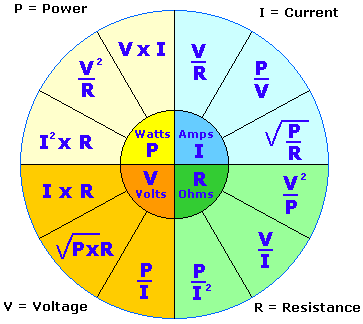
- Current → ampere (A)
- Charge → coulomb (C)
- Energy → joule (J)
- Resistance → ohm (Ω)
- Time → second (s)
- Potential difference → volt (V)
- Power → watt (W)
Electric Current (A)
Electric current is the rate of flow of charge.
\( \mathrm{current = \dfrac{charge}{time}} \)
\( \mathrm{I = \dfrac{Q}{t}} \)
- Current is measured in amperes (A).
- 1 A means 1 coulomb of charge flows each second.
Electric Charge (C)
Electric charge is the amount of electricity that flows.
\( \mathrm{charge = current \times time} \)
\( \mathrm{Q = It} \)
- Charge is measured in coulombs (C).
Potential Difference (V)
Potential difference is the energy transferred per unit charge.
\( \mathrm{potential\ difference = \dfrac{energy}{charge}} \)
\( \mathrm{V = \dfrac{E}{Q}} \)
- Measured in volts (V).
Electrical Energy (J)
Electrical energy is the energy transferred by an electric current.
\( \mathrm{energy = charge \times potential\ difference} \)
\( \mathrm{E = QV} \)
- Measured in joules (J).
Resistance (Ω)
Resistance is the opposition to the flow of current.
\( \mathrm{resistance = \dfrac{potential\ difference}{current}} \)
\( \mathrm{R = \dfrac{V}{I}} \)
- Measured in ohms (Ω).
Electrical Power (W)
Electrical power is the rate of energy transfer.
\( \mathrm{power = energy \div time} \)
\( \mathrm{P = \dfrac{E}{t}} \)
Common alternative form:
\( \mathrm{P = VI} \)
- Power is measured in watts (W).
Key Idea
- Each electrical quantity has a specific SI unit.
- Formulas link these quantities together.
- Correct units are essential in calculations.
Important Points to Remember
- Always convert values to SI units.
- Use the correct equation for the quantity required.
- Include units in final answers.
Example
A current of \( \mathrm{2\ A} \) flows for \( \mathrm{5\ s} \). Calculate the charge transferred.
▶️ Answer / Explanation
Use: \( \mathrm{Q = It} \)
\( \mathrm{Q = 2 \times 5} \)
\( \mathrm{Q = 10\ C} \)
Example
An appliance operates at \( \mathrm{230\ V} \) and draws a current of \( \mathrm{4\ A} \). Calculate the power of the appliance.
▶️ Answer / Explanation
Use: \( \mathrm{P = VI} \)
\( \mathrm{P = 230 \times 4} \)
\( \mathrm{P = 920\ W} \)