
Variation of Resistance in LDRs and Thermistors
Some electrical components are designed so that their resistance changes in response to environmental conditions. Two important examples are light-dependent resistors (LDRs) and thermistors.
These components are widely used as sensors in automatic control systems.
Key Relationship
The current in a circuit depends on resistance according to:
\( \mathrm{I = \dfrac{V}{R}} \)
This means that any change in resistance will change the current if the voltage is constant.
Light-Dependent Resistors (LDRs)
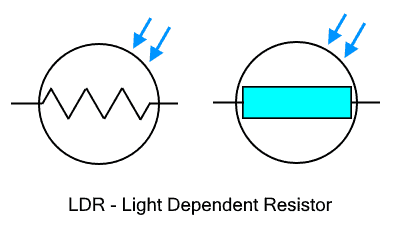
A light-dependent resistor is a resistor whose resistance depends on the intensity of light falling on it.
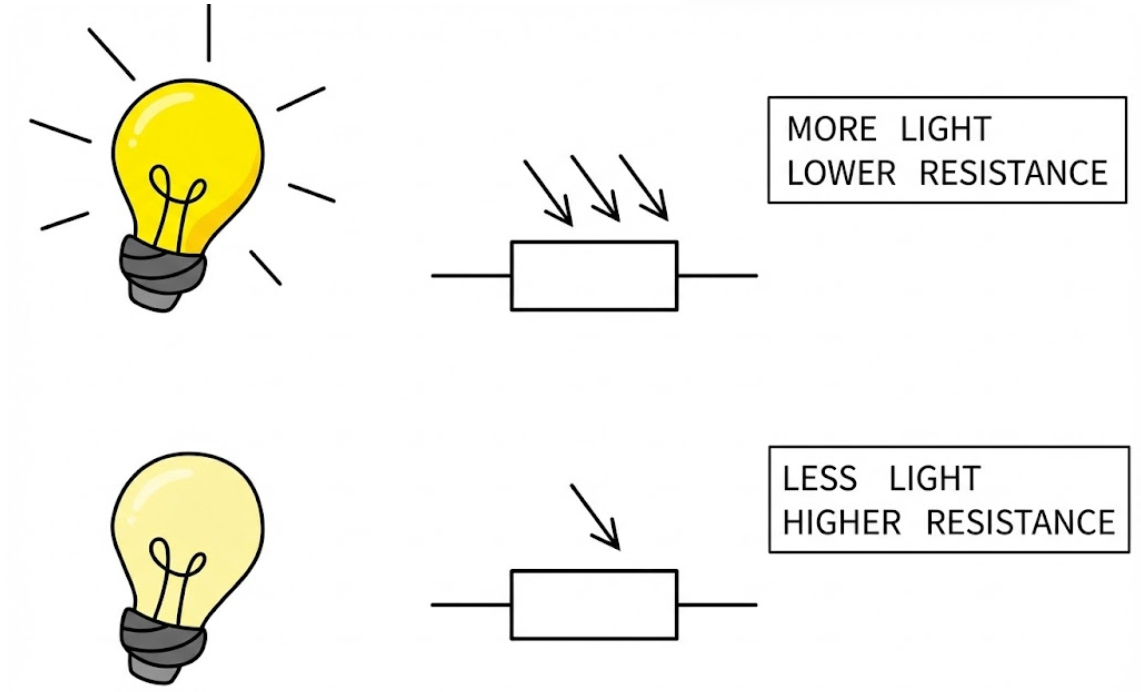
- In bright light → low resistance.
- In dim light or darkness → high resistance.
Qualitative Explanation
- Light provides energy to release charge carriers.
- More light allows more charge to flow.
- Resistance decreases as illumination increases.
Resistance–Light Graph
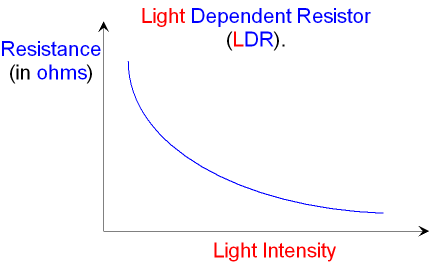
- Resistance decreases as light intensity increases.
- The graph is curved, not straight.
Uses of LDRs
- Automatic street lighting.
- Security lights.
- Camera exposure control.
Thermistors

A thermistor is a resistor whose resistance depends on temperature.
At IGCSE level, thermistors are usually NTC thermistors.

- As temperature increases → resistance decreases.
- As temperature decreases → resistance increases.
Qualitative Explanation
- Heating provides energy to charge carriers.
- More charge carriers reduce resistance.
- Resistance falls as temperature rises.
Resistance–Temperature Graph
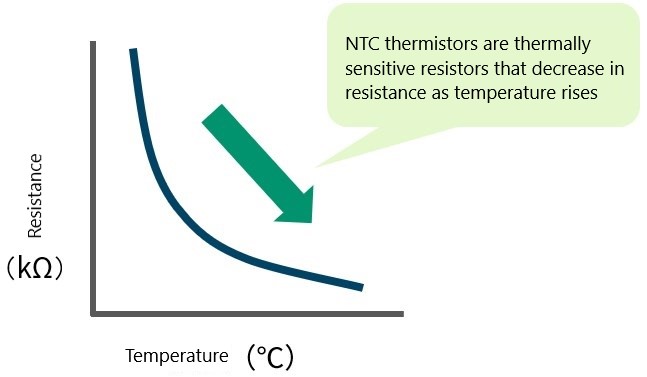
- Resistance decreases rapidly as temperature increases.
- The graph is non-linear.
Comparison of LDRs and Thermistors
- LDRs respond to light.
- Thermistors respond to temperature.
- Both are non-ohmic components.
Key Idea
- LDR resistance decreases with increasing light.
- Thermistor resistance decreases with increasing temperature.
- These changes affect current in a circuit.
Important Points to Remember
- Changes are qualitative, not linear.
- Voltage is usually kept constant.
- LDRs and thermistors are used as sensors.
Example
An LDR is used in a street light circuit. Explain what happens to the resistance of the LDR when it gets dark.
▶️ Answer / Explanation
When it gets dark, the light intensity decreases.
The resistance of the LDR increases.
Example
A thermistor is placed in hot water. Describe how its resistance changes.
▶️ Answer / Explanation
The temperature increases.
The resistance of the thermistor decreases.
Using Lamps and LEDs to Indicate Current
Lamps and light-emitting diodes (LEDs) can be used as indicators to show whether an electric current is flowing in a circuit.
If current flows, the lamp lights or the LED emits light. If no current flows, they remain off.
Why Lamps and LEDs Indicate Current
- Both lamps and LEDs emit light only when current passes through them.
- Light output provides a clear visual indication.
- This makes them useful for testing and monitoring circuits.
Lamps as Current Indicators
A lamp contains a thin metal filament.

- When current flows, the filament heats up.
- The hot filament glows, producing light.
- No light means no current.
Lamps work with both a.c. and d.c. supplies.
LEDs as Current Indicators
A light-emitting diode (LED) emits light when current flows through it in the correct direction.
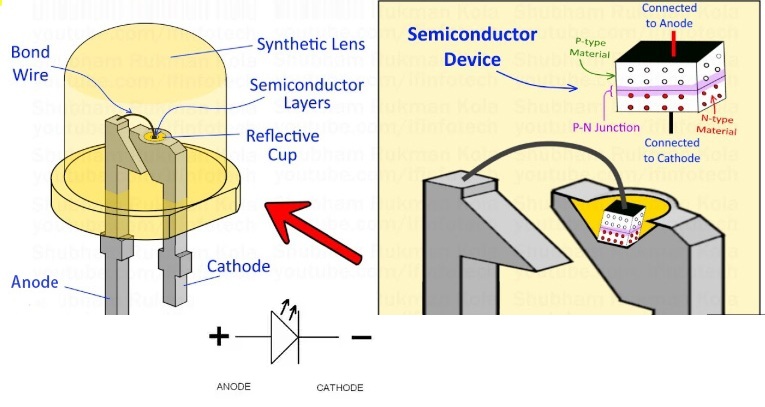
- Current flows only from anode to cathode.
- No light if connected the wrong way round.
- Produces light with very little energy loss.
LEDs are commonly used as power and status indicators.
Key Relationship
The brightness of a lamp or LED depends on the current:
\( \mathrm{I = \dfrac{V}{R}} \)
- Higher current → brighter light.
- Lower current → dimmer light.
Comparing Lamps and LEDs
- Lamps: work in either direction, but use more energy.
- LEDs: one direction only, very energy efficient.
- LEDs require a resistor to limit current.
Uses in Circuits
- Power-on indicators.
- Fault detection.
- Testing whether a circuit is complete.
Key Idea
- Light output shows that current is flowing.
- No light means no current.
- LED direction matters.
Important Points to Remember
- LEDs must be connected with correct polarity.
- LEDs require a series resistor.
- Lamps respond to current by heating.
Example
A lamp in a circuit is not glowing. State what this shows about the current.
▶️ Answer / Explanation
This shows that no current is flowing in the circuit.
Example
An LED connected to a battery does not light up. Give one possible reason.
▶️ Answer / Explanation
The LED may be connected the wrong way round.
This prevents current from flowing through it.