
Electric Current in Metallic Conductors
In solid metallic conductors, electric current is caused by the movement of negatively charged electrons.
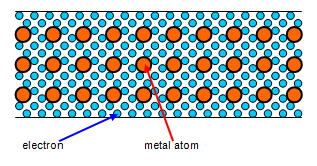
Metals conduct electricity because they contain free electrons that are able to move through the metal structure.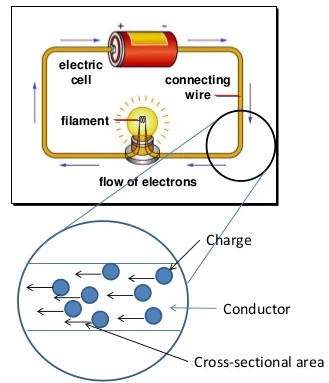
Structure of a Metal
- Metal atoms form a fixed lattice.
- Positive metal ions remain in fixed positions.
- Outer-shell electrons are free to move.
These free electrons are the charge carriers in metals.
Electron Flow
When a voltage is applied across a metal conductor:
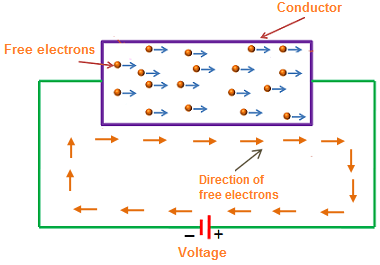
- An electric field is created in the wire.
- Free electrons drift towards the positive terminal.
- This movement of electrons produces an electric current.
Electrons move from the negative terminal to the positive terminal.
Conventional Current vs Electron Flow
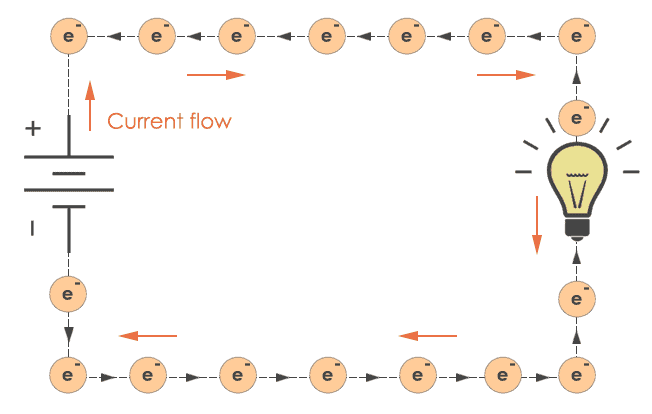
- Electron flow: negative → positive.
- Conventional current: positive → negative.
- Conventional current is used in circuit diagrams.
Although electrons move in the opposite direction, both descriptions represent the same current.
Link to Current Formula
Electric current is defined as:
\( \mathrm{I = \dfrac{Q}{t}} \)
- Moving electrons carry charge.
- More electrons per second → larger current.
Why Metals Are Good Conductors
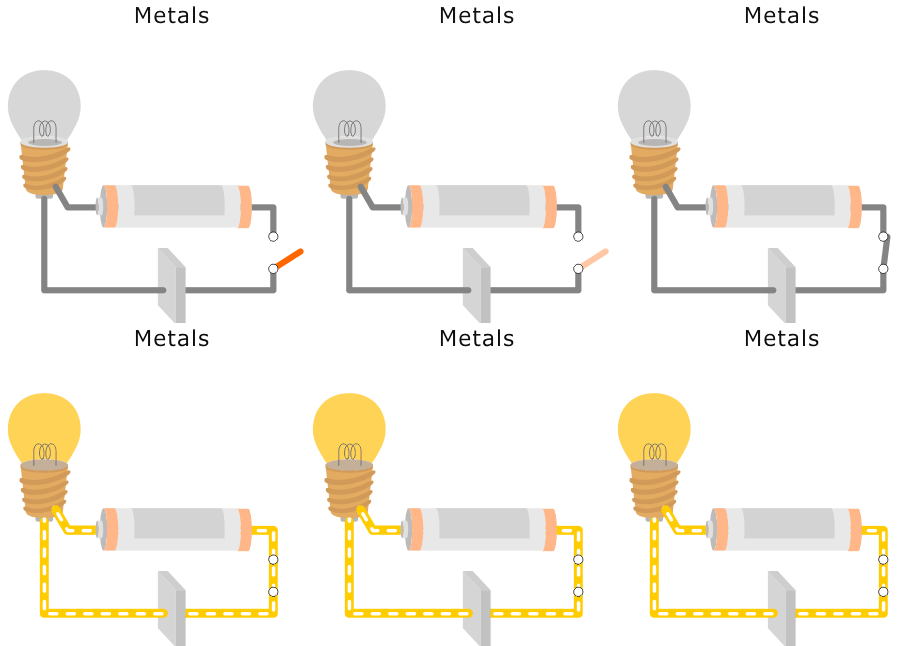
- Large number of free electrons.
- Electrons can move easily through the lattice.
- Low resistance compared to non-metals.
Key Idea
- Current in metals is due to electron flow.
- Electrons carry negative charge.
- Metal ions remain fixed.
Important Points to Remember
- Only electrons move in solid metals.
- Current requires a complete circuit.
- Electron drift speed is slow, but current is immediate.
Example
State the charge carriers responsible for electric current in a metal wire.
▶️ Answer / Explanation
Negatively charged electrons.
Example
Explain why electric current can flow in copper but not in plastic.
▶️ Answer / Explanation
Copper contains free electrons that can move.
Plastic does not have free charge carriers, so current cannot flow.
Conservation of Current at a Junction
Electric current is conserved at a junction. This means that the total current flowing into a junction is equal to the total current flowing out of the junction.
This principle applies to all electrical circuits and is especially important in parallel circuits.
Key Relationship
At any junction in a circuit:
\( \mathrm{total\ current\ in = total\ current\ out} \)
For example:
\( \mathrm{I_1 = I_2 + I_3} \)
- \( \mathrm{I_1} \) = current entering the junction (A)
- \( \mathrm{I_2, I_3} \) = currents leaving the junction (A)
Why Current Is Conserved
- Electric current is a flow of electric charge.
- Charge cannot be created or destroyed.
- Charge does not build up at a junction.
Therefore, the rate of flow of charge (current) must be the same before and after the junction.
Charge Flow Explanation
Using the definition of current:
\( \mathrm{I = \dfrac{Q}{t}} \)
- The same amount of charge per second reaches the junction.
- The same total charge per second leaves the junction.
- This ensures current conservation.
Current at Junctions in Parallel Circuits

- The current splits at a junction.
- Each branch carries part of the total current.
- The sum of branch currents equals the supply current.
Branches with lower resistance carry a larger current.
What Does Not Happen at a Junction
- Current is not “used up”.
- Charge does not disappear.
- Extra current is not created.
Key Idea
- Current is conserved at junctions.
- This is due to conservation of charge.
- Current may split, but totals remain equal.
Important Points to Remember
- Always add currents leaving the junction.
- This rule applies at every junction.
- Used when analysing parallel circuits.
Example
A current of \( \mathrm{5\ A} \) enters a junction. Two branch currents are \( \mathrm{2\ A} \) and \( \mathrm{1\ A} \). Calculate the third branch current.
▶️ Answer / Explanation
Use: total current in = total current out
\( \mathrm{5 = 2 + 1 + I} \)
\( \mathrm{I = 2\ A} \)
Example
Explain why current cannot be greater after a junction than before it.
▶️ Answer / Explanation
Current is the rate of flow of charge.
Charge is conserved and cannot be created.
Therefore, total current leaving a junction must equal total current entering.