
Voltage, Energy and Charge
Voltage, also known as potential difference, describes how much energy is transferred to or from electric charges as they move around a circuit.
It tells us how much energy each coulomb of charge gains or loses.
Meaning of Voltage
Voltage is the energy transferred per unit charge passed.
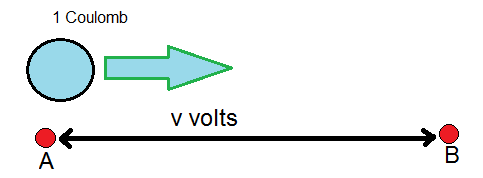
- A higher voltage means more energy is transferred to each charge.
- A lower voltage means less energy is transferred per charge.
- Voltage is not energy itself — it is energy per charge.
Key Relationship
The relationship between voltage, energy and charge is:

\( \mathrm{voltage = \dfrac{energy}{charge}} \)
\( \mathrm{V = \dfrac{E}{Q}} \)
- \( \mathrm{V} \) = voltage (V)
- \( \mathrm{E} \) = energy transferred (J)
- \( \mathrm{Q} \) = charge (C)
The Volt
The volt is defined as a joule per coulomb.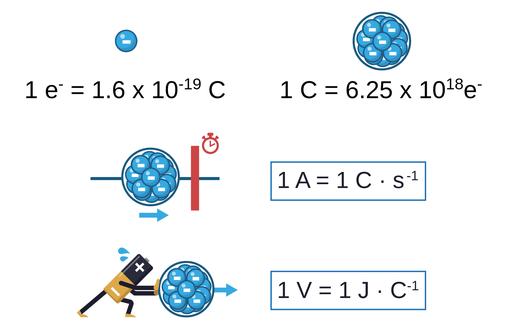
This means:
1 volt = 1 joule per coulomb
\( \mathrm{1\ V = 1\ J/C} \)
- If 1 C of charge transfers 1 J of energy, the voltage is 1 V.
Understanding Energy Transfer in a Circuit
- Cells and batteries supply energy to charges.
- Components like lamps and resistors transfer energy from charges.
- Voltage measures this energy transfer per charge.
Key Idea
- Voltage is energy per unit charge.
- The volt equals joules per coulomb.
- Voltage shows how much energy each charge carries.
Important Points to Remember
- Voltage is measured in volts (V).
- Energy is measured in joules (J).
- Charge is measured in coulombs (C).
Example
An energy of \( \mathrm{20\ J} \) is transferred when \( \mathrm{4\ C} \) of charge passes through a component. Calculate the voltage.
▶️ Answer / Explanation
Use: \( \mathrm{V = \dfrac{E}{Q}} \)
\( \mathrm{V = \dfrac{20}{4}} \)
\( \mathrm{V = 5\ V} \)
Example
A component operates at a voltage of \( \mathrm{12\ V} \). Calculate the energy transferred when \( \mathrm{3\ C} \) of charge passes through it.
▶️ Answer / Explanation
Use: \( \mathrm{E = VQ} \)
\( \mathrm{E = 12 \times 3} \)
\( \mathrm{E = 36\ J} \)
Energy Transferred, Charge and Voltage
When electric charge flows through a component in a circuit, electrical energy is transferred. The amount of energy transferred depends on the charge that flows and the voltage across the component.
This relationship explains how electrical devices use energy.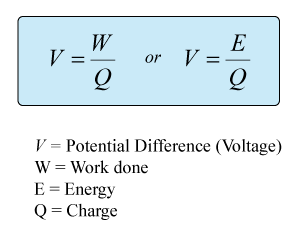
Key Relationship
The relationship between energy transferred, charge and voltage is:
\( \mathrm{energy\ transferred = charge \times voltage} \)
\( \mathrm{E = Q \times V} \)
- \( \mathrm{E} \) = energy transferred (joule, J)
- \( \mathrm{Q} \) = charge (coulomb, C)
- \( \mathrm{V} \) = voltage (volt, V)
Understanding the Equation
- Voltage tells us how much energy is transferred per unit charge.
- More charge flowing means more total energy transferred.
- Higher voltage means each coulomb transfers more energy.
If either charge or voltage increases, the energy transferred increases.
Link to the Definition of Voltage
Voltage is defined as energy transferred per unit charge:
\( \mathrm{V = \dfrac{E}{Q}} \)
Rearranging gives:
\( \mathrm{E = QV} \)
Energy Transfer in Circuits
- Cells and batteries supply electrical energy.
- Components like lamps and resistors transfer energy.
- Energy is converted into light, heat, or motion.
Key Idea
- Energy transferred depends on charge and voltage.
- The equation applies to all electrical components.
- Energy is measured in joules.
Important Points to Remember
- Use coulombs for charge and volts for voltage.
- Always include units in answers.
- This equation links electrical energy and charge flow.
Example
A charge of \( \mathrm{5\ C} \) flows through a component at a voltage of \( \mathrm{12\ V} \). Calculate the energy transferred.
▶️ Answer / Explanation
Use: \( \mathrm{E = QV} \)
\( \mathrm{E = 5 \times 12} \)
\( \mathrm{E = 60\ J} \)
Example
An electrical device transfers \( \mathrm{200\ J} \) of energy when \( \mathrm{25\ C} \) of charge passes through it. Calculate the voltage across the device.
▶️ Answer / Explanation
Use: \( \mathrm{V = \dfrac{E}{Q}} \)
\( \mathrm{V = \dfrac{200}{25}} \)
\( \mathrm{V = 8\ V} \)