
Heating Effect of an Electric Current
When an electric current flows through a resistor, electrical energy is transferred to the resistor and the temperature increases. This effect is known as the heating effect of an electric current.
This process is widely used in domestic appliances such as heaters, kettles, toasters, irons, and hairdryers.
Why a Resistor Heats Up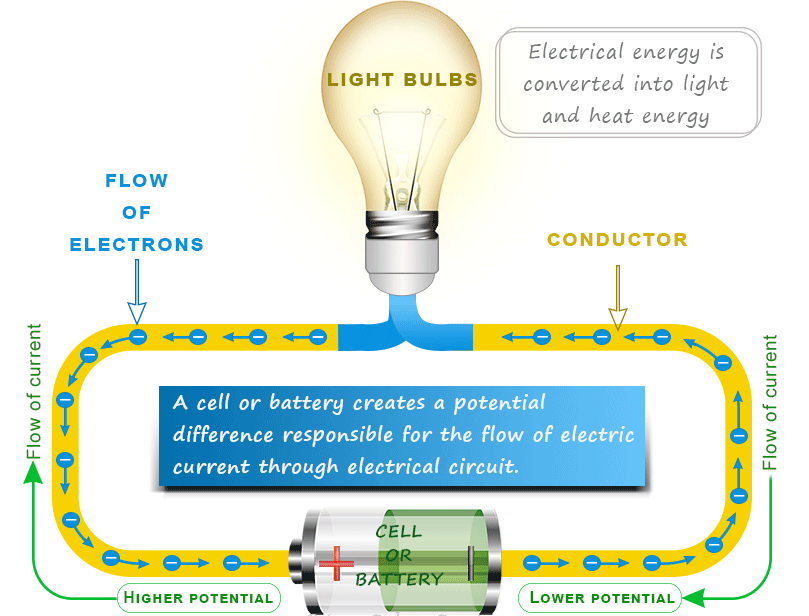
A resistor opposes the flow of electric current.
- Electrons move through the resistor.
- They collide with atoms in the metal.
- These collisions transfer energy to the atoms.
- The atoms vibrate more, increasing temperature.
Electrical energy is therefore converted into thermal (heat) energy.
Electrical Energy Transfer
The electrical energy transferred in a resistor is given by:
\( \mathrm{energy = power \times time} \)
\( \mathrm{E = Pt} \)
- \( \mathrm{E} \) = energy (J)
- \( \mathrm{P} \) = power (W)
- \( \mathrm{t} \) = time (s)
Power Dissipated in a Resistor
The power transferred in a resistor can be calculated using:
\( \mathrm{P = VI} \)
Using Ohm’s law, this can also be written as:
\( \mathrm{P = I^2R} \)
or
\( \mathrm{P = \dfrac{V^2}{R}} \)
- Higher current → more heating.
- Higher resistance → more heating.
Increase in Temperature
- As energy is transferred, the resistor’s temperature rises.
- The rate of temperature increase depends on power.
- Heat may be lost to surroundings over time.
In some devices, heating is useful; in others, it must be controlled.
Domestic Uses of the Heating Effect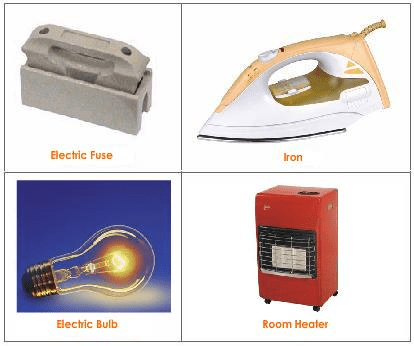
1. Electric Heaters and Kettles
- High-resistance metal elements heat up quickly.
- Electrical energy is converted to thermal energy.
- Used to warm air or heat water.
2. Toasters and Irons
- Heating elements glow due to high temperature.
- Heat is transferred to bread or fabric.
3. Fuses
- Thin wire heats up when current is too large.
- Melts and breaks the circuit.
- Prevents overheating and fire.
Key Idea
- Resistors convert electrical energy into heat.
- Heating is caused by resistance to current.
- This effect is useful in many domestic appliances.
Important Points to Remember
- Not all electrical energy is wasted as heat.
- Heating increases with current and resistance.
- Correct materials are chosen for heating elements.
Example
An electric heater operates at \( \mathrm{500\ W} \) for \( \mathrm{10\ minutes} \). Calculate the electrical energy transferred.
▶️ Answer / Explanation
Convert time to seconds:
\( \mathrm{t = 10 \times 60 = 600\ s} \)
Use: \( \mathrm{E = Pt} \)
\( \mathrm{E = 500 \times 600} \)
\( \mathrm{E = 300000\ J} \)
Example
A resistor of resistance \( \mathrm{10\ \Omega} \) carries a current of \( \mathrm{3\ A} \). Calculate the power dissipated as heat.
▶️ Answer / Explanation
Use: \( \mathrm{P = I^2R} \)
\( \mathrm{P = 3^2 \times 10} \)
\( \mathrm{P = 90\ W} \)