Edexcel iGCSE Physics -2.4–2.5 Power, Current, Voltage, and Electrical Energy Transfer- Study Notes- New Syllabus

Edexcel iGCSE Physics -2.4–2.5 Power, Current, Voltage, and Electrical Energy Transfer- Study Notes- New syllabus

Edexcel iGCSE Physics -2.4–2.5 Power, Current, Voltage, and Electrical Energy Transfer- Study Notes -Edexcel iGCSE Physics – per latest Syllabus.

Key Concepts:

2.4 know and use the relationship between power, current and voltage:
power = current × voltage
P = I × V
and apply the relationship to the selection of appropriate fuses

2.5 use the relationship between energy transferred, current, voltage and time:
energy transferred = current × voltage × time
E = I × V × t

Edexcel iGCSE Physics -Concise Summary Notes- All Topics

Power, Current and Voltage (Fuse Selection)

Electrical power describes how quickly electrical energy is transferred by a device. Power depends on both the current flowing through the device and the potential difference (voltage) across it.

This relationship is essential when choosing a correct fuse rating for domestic appliances.

Key Relationship

The relationship between power, current and voltage is:
\( \mathrm{power = current \times voltage} \)

\( \mathrm{P = I \times V} \)

  • \( \mathrm{P} \) = power (W)
  • \( \mathrm{I} \) = current (A)
  • \( \mathrm{V} \) = voltage (V)

Understanding the Equation

  • A higher voltage or current gives a higher power.
  • High-power appliances draw large currents.
  • This current must be safely controlled.

Rearranging the Equation

The equation can be rearranged to calculate current:
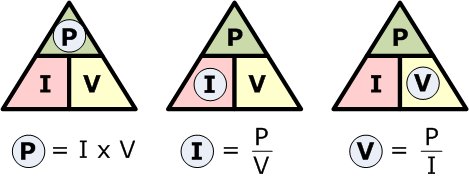
\( \mathrm{I = \dfrac{P}{V}} \)

This form is commonly used to determine the correct fuse rating.

Fuses and Electrical Safety

A fuse is a safety device that melts when the current becomes too large.
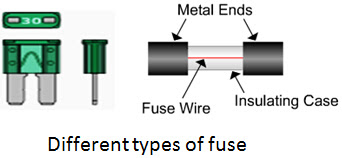
  • Connected in the live wire.
  • Protects appliances from overheating.
  • Prevents fire hazards.

The fuse rating must be slightly higher than the normal operating current.

Selecting an Appropriate Fuse

Steps:

  • Calculate the operating current using \( \mathrm{I = \dfrac{P}{V}} \).
  • Choose a fuse with a rating just above this current.
  • Common domestic fuse ratings are 3 A and 13 A.

A fuse that is too small will blow during normal use. A fuse that is too large may not protect the appliance.

Key Idea

  • Power depends on voltage and current.
  • High-power devices draw high currents.
  • Correct fuse selection is essential for safety.

Important Points to Remember

  • Always use the mains voltage in calculations.
  • Fuse rating must be higher than operating current.
  • Fuses protect appliances, not people directly.

Example

An electric lamp operates at \( \mathrm{230\ V} \) and has a power rating of \( \mathrm{460\ W} \). Calculate the current drawn by the lamp.

▶️ Answer / Explanation

Use: \( \mathrm{I = \dfrac{P}{V}} \)

\( \mathrm{I = \dfrac{460}{230}} \)

\( \mathrm{I = 2.0\ A} \)

Example

An electric kettle is rated at \( \mathrm{3000\ W} \) and operates at \( \mathrm{230\ V} \).

(a) Calculate the current drawn by the kettle. (b) State a suitable fuse rating.

▶️ Answer / Explanation

(a) Use: \( \mathrm{I = \dfrac{P}{V}} \)

\( \mathrm{I = \dfrac{3000}{230}} \)

\( \mathrm{I \approx 13.0\ A} \)

(b) A suitable fuse rating is \( \mathrm{13\ A} \).

Electrical Energy Transferred

When an electric current flows through a component, electrical energy is transferred from the power supply to the component. The amount of energy transferred depends on the current, the voltage, and the time for which the current flows.

This relationship is used to calculate the energy used by domestic appliances such as heaters, kettles, lamps, and televisions.

Key Relationship

The relationship between energy transferred, current, voltage and time is:

\( \mathrm{energy\ transferred = current \times voltage \times time} \)

\( \mathrm{E = I \times V \times t} \)

  • \( \mathrm{E} \) = energy transferred (J)
  • \( \mathrm{I} \) = current (A)
  • \( \mathrm{V} \) = voltage (V)
  • \( \mathrm{t} \) = time (s)

Understanding the Equation

  • A larger current transfers more energy each second.
  • A higher voltage transfers more energy per unit charge.
  • Longer time increases the total energy transferred.

This equation shows how electrical energy depends on both the circuit conditions and how long the device is used.

Link to Power

Electrical power is given by:

\( \mathrm{P = IV} \)

Substituting into \( \mathrm{E = Pt} \) gives:

\( \mathrm{E = IVt} \)

This confirms that energy transferred equals power multiplied by time.

Domestic Context

  • Electric heaters transfer electrical energy into thermal energy.
  • Lamps transfer electrical energy into light and heat.
  • Motors transfer electrical energy into kinetic energy.

Higher-power appliances transfer energy more quickly.

Key Idea

  • Energy transferred depends on current, voltage, and time.
  • Electrical energy is measured in joules.
  • This relationship applies to all electrical devices.

Important Points to Remember

  • Time must be in seconds.
  • Use current in amperes and voltage in volts.
  • Always include units in the final answer.

Example

A device operates at a current of \( \mathrm{2\ A} \) and a voltage of \( \mathrm{12\ V} \) for \( \mathrm{300\ s} \). Calculate the energy transferred.

▶️ Answer / Explanation

Use: \( \mathrm{E = IVt} \)

\( \mathrm{E = 2 \times 12 \times 300} \)

\( \mathrm{E = 7200\ J} \)

Example

An electric heater draws a current of \( \mathrm{5\ A} \) from a \( \mathrm{230\ V} \) supply and is switched on for \( \mathrm{10\ minutes} \). Calculate the energy transferred.

▶️ Answer / Explanation

Convert time to seconds:

\( \mathrm{t = 10 \times 60 = 600\ s} \)

Use: \( \mathrm{E = IVt} \)

\( \mathrm{E = 5 \times 230 \times 600} \)

\( \mathrm{E = 690000\ J} \)

Scroll to Top