
Series and Parallel Circuits in Applications
Electrical components can be connected in series or in parallel. The choice of circuit arrangement depends on how the components are required to operate in a particular application.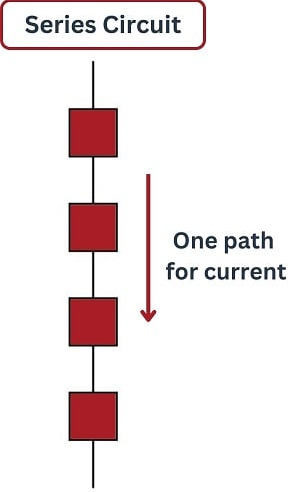
Domestic lighting systems use a specific type of circuit to ensure safety, reliability, and correct operation.
Series Circuits
In a series circuit, components are connected one after another in a single loop.
- The same current flows through all components.
- The voltage is shared between components.
- If one component fails, the entire circuit breaks.
Key Relationships (Series Circuit)
- Total resistance: \( \mathrm{R_{total} = R_1 + R_2 + R_3} \)
- Current is the same everywhere.
Uses of Series Circuits
- Simple low-power circuits.
- Decorative lights (older-style fairy lights).
- Situations where the same current is required.
However, series circuits are generally not suitable for domestic lighting.
Parallel Circuits
In a parallel circuit, components are connected on separate branches.
- Each component gets the full supply voltage.
- The current is shared between branches.
- If one component fails, others continue to work.
Key Relationships (Parallel Circuit)
- Total current: \( \mathrm{I_{total} = I_1 + I_2 + I_3} \)

- Voltage is the same across each branch.
Why Domestic Lighting Uses Parallel Circuits
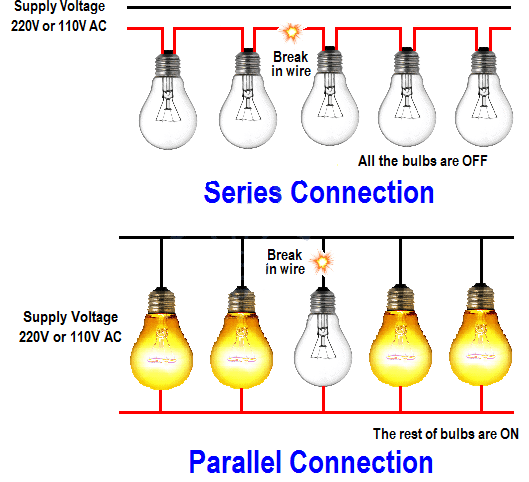
- Each light receives the full mains voltage.
- Lights can be switched on or off independently.
- If one bulb fails, others remain lit.
- Brightness of one lamp does not affect others.
This makes parallel circuits safer and more practical for homes.
Comparison of Series and Parallel Circuits
- Series: one path, same current, shared voltage.
- Parallel: multiple paths, shared current, same voltage.
- Parallel circuits are more reliable.
Key Idea
- The choice of circuit depends on the application.
- Parallel circuits allow independent operation.
- Domestic lighting must be safe and reliable.
Important Points to Remember
- Domestic lighting is wired in parallel.
- Series circuits are affected by component failure.
- Voltage behaviour differs in each type of circuit.
Example
Explain why domestic lighting circuits are connected in parallel rather than series.
▶️ Answer / Explanation
Each lamp receives the full supply voltage.
If one lamp fails, the others continue to work.
This makes the system reliable and safe.
Example
Two identical lamps are connected in series and then in parallel to the same power supply. State in which circuit the lamps will be brighter and explain why.
▶️ Answer / Explanation
The lamps are brighter in the parallel circuit.
Each lamp receives the full supply voltage.
In series, the voltage is shared, reducing brightness.
Current in a Series Circuit
In a series circuit, components are connected one after another in a single loop. The size of the current in the circuit depends on the applied voltage and the number and nature of the components in the circuit.
Key Features of a Series Circuit
- There is only one path for the current.
- The same current flows through every component.
- If one component fails, the circuit is broken.
Ohm’s Law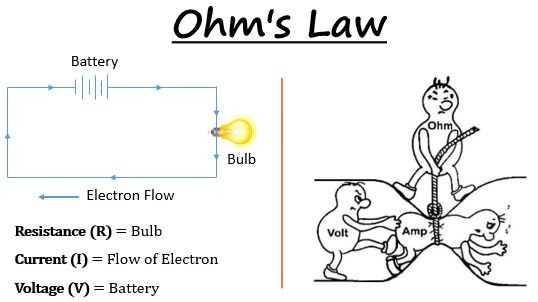
The current in a circuit is related to voltage and resistance by:
\( \mathrm{V = IR} \)
or
\( \mathrm{I = \dfrac{V}{R}} \)
- \( \mathrm{V} \) = applied voltage (V)
- \( \mathrm{I} \) = current (A)
- \( \mathrm{R} \) = resistance (Ω)
Total Resistance in a Series Circuit
In a series circuit, the total resistance is the sum of the resistances: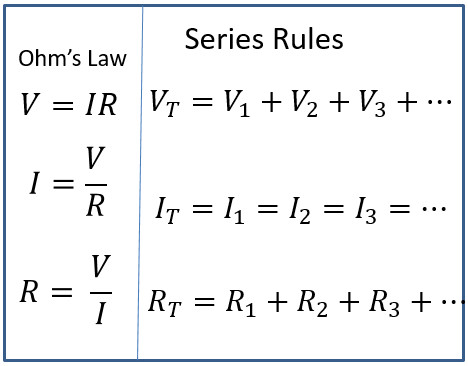
\( \mathrm{R_{total} = R_1 + R_2 + R_3} \)
- Adding more components increases total resistance.
- Increasing resistance reduces the current.
Effect of Applied Voltage
- Increasing the applied voltage increases the current.
- Decreasing the applied voltage decreases the current.
This follows directly from \( \mathrm{I = \dfrac{V}{R_{total}}} \).
Effect of Number of Components
- More components → higher total resistance.
- Higher resistance → smaller current.
- Fewer components → lower resistance → larger current.
Effect of the Nature of Components
- Fixed resistors: provide constant resistance.
- Lamps: resistance increases as temperature increases.
- Heating elements: have relatively high resistance.
Different components therefore affect the current differently.
Key Idea
- The current is the same everywhere in a series circuit.
- Current depends on applied voltage and total resistance.
- Total resistance depends on number and type of components.
Important Points to Remember
- Use total resistance when calculating current.
- Adding components always reduces current.
- Lamps do not behave like simple resistors.
Example
A \( \mathrm{12\ V} \) supply is connected to two resistors of \( \mathrm{4\ \Omega} \) and \( \mathrm{6\ \Omega} \) in series. Calculate the current in the circuit.
▶️ Answer / Explanation
Total resistance:
\( \mathrm{R_{total} = 4 + 6 = 10\ \Omega} \)
Use: \( \mathrm{I = \dfrac{V}{R}} \)
\( \mathrm{I = \dfrac{12}{10}} \)
\( \mathrm{I = 1.2\ A} \)
Example
Two identical lamps are connected in series to a power supply. Explain what happens to the current if a third identical lamp is added in series.
▶️ Answer / Explanation
Adding another lamp increases the total resistance.
The increased resistance reduces the current in the circuit.
The same smaller current flows through all lamps.