
Common Units Used in Waves and Motion
In physics, especially in the study of waves and motion, specific SI units are used to measure quantities such as distance, time, speed, frequency, and angle. Correct use of units is essential for calculations and exam answers.
Metre (m)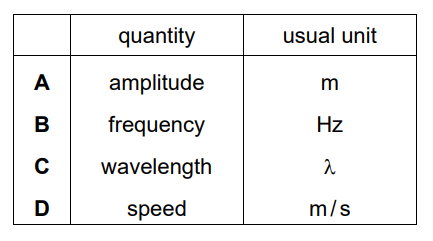
The metre (m) is the SI unit of distance.
- Used to measure wavelength.
- Used to measure distance travelled.
- Used in displacement.
Example quantities: wavelength, distance, height.
Second (s)
The second (s) is the SI unit of time.
- Used to measure time taken.
- Used to measure period of oscillation.
Example quantities: time, period.
Metre per Second (m/s)
The unit metre per second (m/s) is used to measure speed or velocity.
Key relationship:
\( \mathrm{speed = \dfrac{distance}{time}} \)
\( \mathrm{v = \dfrac{s}{t}} \)
- Wave speed is measured in m/s.
- Motion speed is measured in m/s.
Hertz (Hz)
The hertz (Hz) is the unit of frequency.
Frequency is the number of oscillations or waves passing a point each second.
Key relationship:
\( \mathrm{frequency = \dfrac{1}{time\ period}} \)
\( \mathrm{f = \dfrac{1}{T}} \)
- 1 Hz = 1 oscillation per second.
- Used for sound waves and electromagnetic waves.
Degree (°)
The degree (°) is used to measure angles.
- Used to measure direction.
- Used to describe angles in oscillations.
- Used in reflection and refraction.
Example: Angle of incidence = 30°.
Summary of Units
- Distance → metre (m)
- Time → second (s)
- Speed → metre/second (m/s)
- Frequency → hertz (Hz)
- Angle → degree (°)
Key Idea
- Each physical quantity has a specific SI unit.
- Correct units must always be used in calculations.
- Units help check whether an answer is sensible.
Important Points to Remember
- Do not mix units.
- Convert where necessary.
- Always include units in final answers.
Example
A sound wave has a wavelength of \( \mathrm{0.80\ m} \) and a frequency of \( \mathrm{400\ Hz} \). Calculate the speed of the wave.
▶️ Answer / Explanation
Use the wave equation:
\( \mathrm{v = f\lambda} \)
\( \mathrm{v = 400 \times 0.80} \)
\( \mathrm{v = 320\ m/s} \)
The correct unit for wave speed is m/s.
Example
A vibrating object completes one oscillation in \( \mathrm{0.25\ s} \).
(a) Calculate the frequency of the vibration. (b) State the unit of frequency.
▶️ Answer / Explanation
(a) Use:
\( \mathrm{f = \dfrac{1}{T}} \)
\( \mathrm{f = \dfrac{1}{0.25}} \)
\( \mathrm{f = 4\ Hz} \)
(b) The unit of frequency is hertz (Hz).