
Light as a Transverse Wave: Reflection and Refraction
Light waves are a type of electromagnetic wave. They are transverse waves and can undergo reflection and refraction when they interact with surfaces or when they pass between different media.
Light Waves as Transverse Waves
A transverse wave is a wave in which the vibrations are perpendicular to the direction of wave travel.
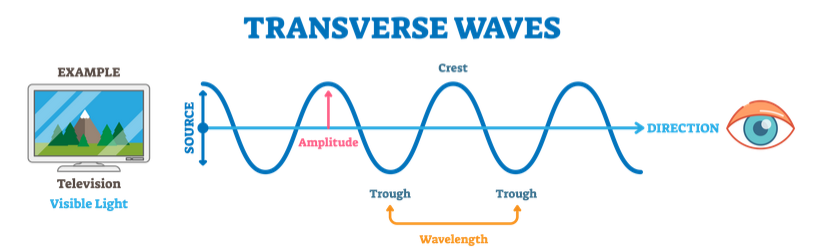
- In light waves, the electric and magnetic fields vibrate at right angles to the direction of travel.
- Energy travels forward, but vibrations occur sideways.
- This is why light can be polarised.
Key property: Transverse waves can be reflected and refracted.
Reflection of Light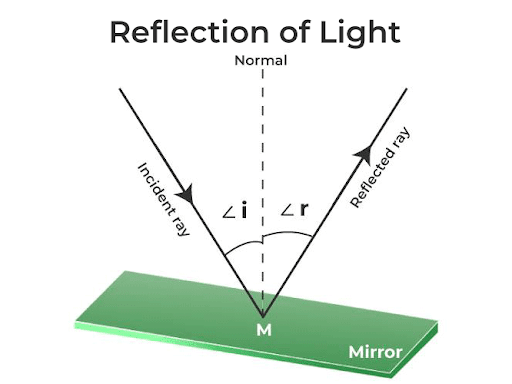
Reflection occurs when light bounces off a surface and remains in the same medium.
- Occurs at mirrors and shiny surfaces.
- The speed and frequency of light remain unchanged.
- The direction of travel changes.
Law of Reflection:
\( \mathrm{angle\ of\ incidence = angle\ of\ reflection} \)
Refraction of Light
Refraction occurs when light passes from one medium to another and its speed changes.
- Light bends at the boundary between media.

- The speed and wavelength change.
- The frequency remains constant.

Why refraction happens:
- Light travels at different speeds in different materials.
- A change in speed causes a change in direction.
Wave Relationship Used
Light obeys the wave equation:
\( \mathrm{v = f\lambda} \)
- During refraction, \( \mathrm{v} \) changes.
- \( \mathrm{f} \) remains constant.
- \( \mathrm{\lambda} \) changes.
Key Idea
- Light is a transverse wave.
- Transverse waves can be reflected and refracted.
- Reflection changes direction only.
- Refraction changes speed and direction.
Important Points to Remember
- Light does not need a medium to travel.
- Frequency of light does not change during reflection or refraction.
- Refraction only occurs when light enters a new medium.
Example
Explain why light is described as a transverse wave.
▶️ Answer / Explanation
The vibrations in a light wave are perpendicular to the direction in which the wave travels.
This is a defining property of transverse waves.
Example
A ray of light passes from air into glass at an angle.
(a) Name the wave behaviour that occurs. (b) State two properties of the light that change.
▶️ Answer / Explanation
(a) Refraction.
(b) The speed and wavelength of the light change.