
Law of Reflection
The law of reflection describes how light behaves when it reflects from a surface such as a mirror. This law applies to all waves, including light, sound, and water waves, but is most commonly used for light rays.
Key Definitions
- Incident ray: the incoming ray of light.
- Reflected ray: the ray of light that bounces off the surface.
- Normal: an imaginary line drawn at 90° to the surface at the point of incidence.
- Angle of incidence (\( \mathrm{i} \)): the angle between the incident ray and the normal.
- Angle of reflection (\( \mathrm{r} \)): the angle between the reflected ray and the normal.
Law of Reflection
The law of reflection states: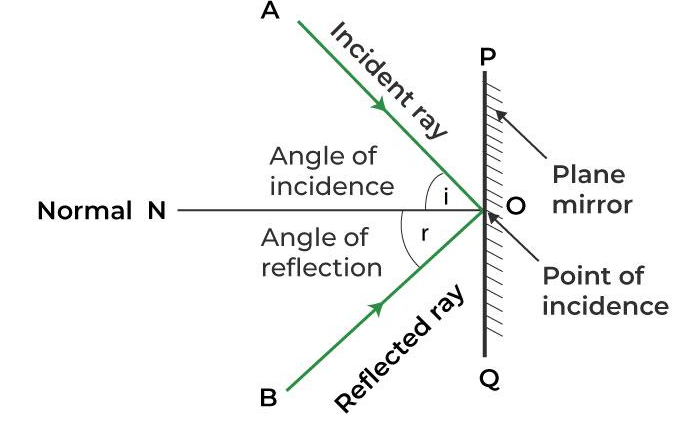
\( \mathrm{angle\ of\ incidence = angle\ of\ reflection} \)
\( \mathrm{i = r} \)
- The incident ray, reflected ray, and normal all lie in the same plane.
- The angles are always measured from the normal, not the surface.
Using the Law of Reflection
- Measure the angle between the incident ray and the normal.
- The reflected ray makes the same angle on the opposite side of the normal.
- This applies for flat mirrors and smooth reflecting surfaces.
Reflection from a Plane Mirror
- Light reflects symmetrically about the normal.
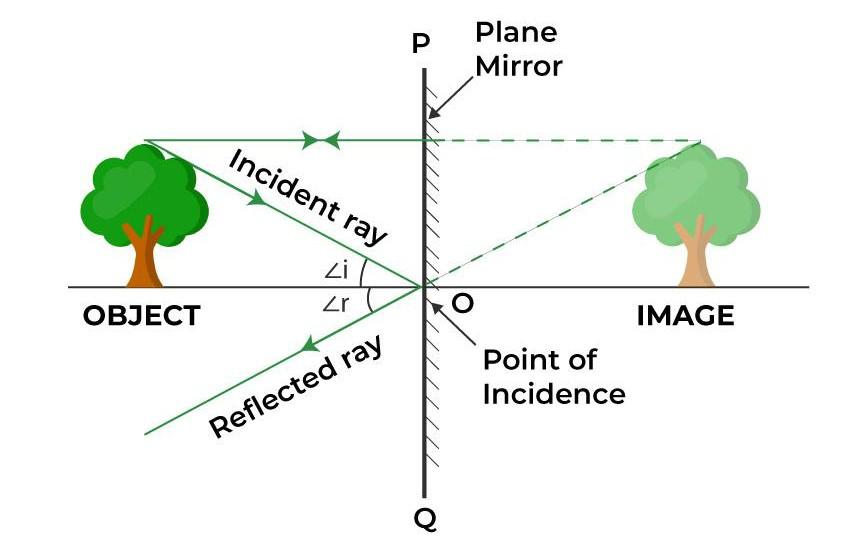
- No change in speed or frequency occurs.
- Only the direction of travel changes.
Relevant Wave Relationship
Reflection does not change the wave speed or frequency:
\( \mathrm{v = f\lambda} \)
- \( \mathrm{v} \) and \( \mathrm{f} \) remain constant.
- The wavelength does not change.
Key Idea
- Angle of incidence equals angle of reflection.
- Angles are measured from the normal.
- Applies to all reflecting surfaces.
Important Points to Remember
- Do not measure angles from the surface.
- The normal is always perpendicular to the surface.
- The law applies only to reflection, not refraction.
Example
A ray of light strikes a plane mirror at an angle of incidence of \( \mathrm{35^\circ} \).
Calculate the angle of reflection.
▶️ Answer / Explanation
According to the law of reflection:
\( \mathrm{i = r} \)
\( \mathrm{r = 35^\circ} \)
Example
A student draws a ray diagram showing light reflecting from a mirror.
The angle between the incident ray and the mirror surface is \( \mathrm{60^\circ} \).
Calculate the angle of reflection.
▶️ Answer / Explanation
The angle given is measured from the surface.
The angle of incidence is:
\( \mathrm{i = 90^\circ – 60^\circ = 30^\circ} \)
Using the law of reflection:
\( \mathrm{r = 30^\circ} \)
Ray Diagrams for Reflection and Refraction
Ray diagrams are simplified drawings that show the path taken by light rays when they are reflected from surfaces or refracted at boundaries between different media.
They are used to predict the direction of light and to explain observations in mirrors, glass blocks, and lenses.
Key Ray Diagram Rules
- Light travels in straight lines in a uniform medium.
- Rays are drawn with straight lines and arrows showing direction.
- A normal is always drawn perpendicular (90°) to the surface.
- Angles are measured from the normal.
Ray Diagram for Reflection
Reflection occurs when light bounces off a surface such as a mirror.
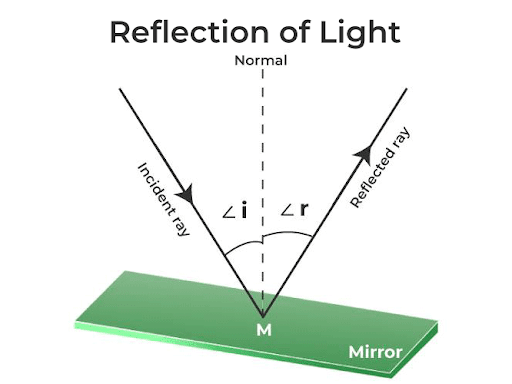
Steps to draw a reflection ray diagram:
- Draw the reflecting surface (straight line).
- Draw the incident ray approaching the surface.
- Draw the normal at the point of incidence.
- Measure the angle of incidence from the normal.
- Draw the reflected ray so that:
\( \mathrm{angle\ of\ incidence = angle\ of\ reflection} \)
\( \mathrm{i = r} \)
- The incident ray, reflected ray, and normal lie in the same plane.
Ray Diagram for Refraction
Refraction occurs when light passes from one medium to another and changes speed.

Steps to draw a refraction ray diagram:
- Draw the boundary between two media (e.g. air and glass).
- Draw the incident ray in the first medium.
- Draw the normal at the point of incidence.
- Decide whether the ray speeds up or slows down.
- Draw the refracted ray:

- Towards the normal when entering a denser medium.
- Away from the normal when entering a less dense medium.
Wave Relationship Used
Refraction is explained using the wave equation:
\( \mathrm{v = f\lambda} \)
- Frequency stays constant.
- Speed changes.
- Wavelength changes.
Key Differences in Ray Diagrams
- Reflection: ray stays in the same medium.
- Refraction: ray crosses a boundary.
- Reflection: angle in = angle out.
- Refraction: angles are different.
Key Idea
- Ray diagrams show direction, not brightness.
- Normals are essential for correct angles.
- Correct bending direction is critical in exams.
Important Exam Tips
- Always draw the normal.
- Use a ruler for straight rays.
- Label angles clearly.
- Use arrows to show ray direction.
Example
A ray of light strikes a plane mirror at an angle of incidence of \( \mathrm{40^\circ} \).
Draw a ray diagram to show the reflected ray.
▶️ Answer / Explanation
Draw the mirror as a straight line.
Draw the normal at 90° to the mirror.
Draw the incident ray making \( \mathrm{40^\circ} \) with the normal.
Draw the reflected ray on the opposite side of the normal also making \( \mathrm{40^\circ} \).
Example
A ray of light travels from air into glass at an angle.
Draw a ray diagram to show what happens to the ray at the boundary.
▶️ Answer / Explanation
Draw the boundary line between air and glass.
Draw the normal at the point of incidence.
Draw the incident ray in air.
Draw the refracted ray bending towards the normal in the glass.