
Practical: Investigating the Refraction of Light
Refraction is the change in direction of light when it passes from one medium to another due to a change in speed. This practical investigates refraction using different glass shapes to observe how light behaves at boundaries.
Aim
To investigate how light is refracted when it passes through:
- a rectangular glass block
- a semi-circular glass block
- a triangular glass prism
Apparatus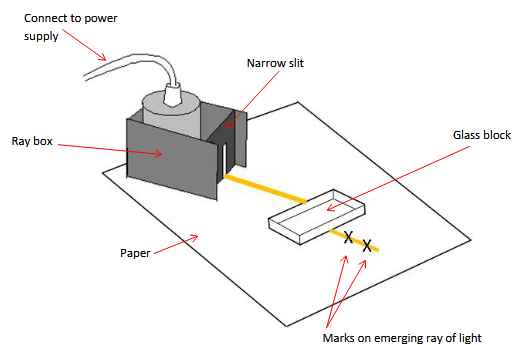
- Ray box with narrow slit
- Rectangular glass block
- Semi-circular glass block
- Triangular glass prism
- White paper
- Ruler
- Protractor
- Pencil
Relevant Formula
Refraction is explained using the wave equation:
\( \mathrm{v = f\lambda} \)
- When light enters glass, speed decreases.
- Frequency remains constant.
- Wavelength decreases.
Method A: Rectangular Glass Block
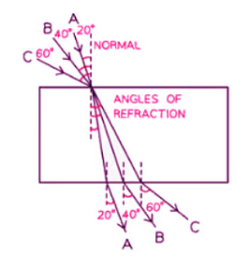
- Place the rectangular glass block on white paper and trace its outline.
- Draw a normal at one face of the block.
- Shine a narrow ray of light at an angle into the block.
- Mark the incident ray, refracted ray, and emergent ray.
- Remove the block and complete the ray paths.
- Measure the angle of incidence and angle of refraction.
Observation:
- The ray bends towards the normal on entering the block.
- The ray bends away from the normal on leaving the block.
- The emergent ray is parallel to the incident ray.
Method B: Semi-Circular Glass Block
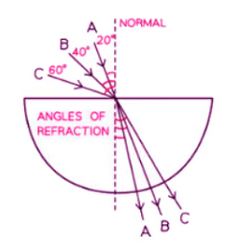
- Place the semi-circular block flat side down on paper.
- Shine the ray through the curved surface towards the flat face.
- Ensure the ray enters through the curved face along the radius.
- Trace the incident and refracted rays.
- Measure angles at the flat surface.
Observation:
- No refraction occurs at the curved surface.
- Refraction occurs only at the flat surface.
- This allows accurate measurement of refraction.
Method C: Triangular Prism
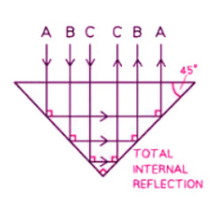
- Place the triangular prism on paper and trace around it.
- Shine a narrow ray into one face of the prism.
- Trace the ray as it enters and exits the prism.
- Observe the bending of the ray.
Observation:
- The ray is refracted at both faces of the prism.
- The overall direction of the ray changes.
- White light spreads into colours (dispersion).
Results and Conclusions
- Light bends when it enters a medium with a different optical density.
- The direction of bending depends on whether light speeds up or slows down.
- Different shapes help observe refraction more clearly.
Sources of Error
- Thick pencil lines.
- Inaccurate protractor readings.
- Misalignment of ray box.
Improvements
- Use a thinner beam of light.
- Repeat readings and take averages.
- Ensure the block does not move during tracing.
Key Idea
- Refraction occurs when light changes speed.
- Glass causes light to slow down.
- Different block shapes demonstrate refraction clearly.
Example
Why does the emergent ray from a rectangular glass block travel parallel to the incident ray?
▶️ Answer / Explanation
The ray is refracted twice, once on entering and once on leaving.
The two refractions cancel each other, making the emergent ray parallel to the incident ray.
Example
Explain why no refraction occurs when light enters a semi-circular block through the curved surface.
▶️ Answer / Explanation
The light enters along the radius, so it meets the surface at 90°.
Since there is no change in direction, refraction does not occur.