
Practical: Investigating the Speed of Sound in Air
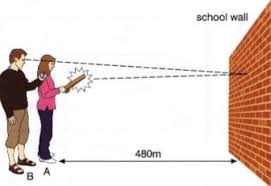
The speed of sound in air can be measured by timing how long it takes for sound to travel a known distance. In this practical, the echo method is used.
Aim
To determine the speed of sound in air by measuring the time taken for an echo to return from a large reflecting surface.
Apparatus
- Stopwatch
- Measuring tape or trundle wheel
- Large flat wall or building
- Sound source (clapping hands or wooden blocks)
- Calculator
Theory / Formula
The speed of sound is calculated using:
\( \mathrm{speed = \dfrac{distance}{time}} \)
Since sound travels to the wall and back:
\( \mathrm{v = \dfrac{2d}{t}} \)
- \( \mathrm{v} \) = speed of sound (m/s)
- \( \mathrm{d} \) = distance from wall (m)
- \( \mathrm{t} \) = time for echo (s)
Method
- Measure a straight distance \( \mathrm{d} \) from a large wall.

- Stand at the measured position facing the wall.
- Produce a sharp sound (clap or blocks).
- Start the stopwatch when the sound is made.
- Stop the stopwatch when the echo is heard.
- Record the time taken.
- Repeat the measurement several times.
- Calculate the average time.
- Use the formula to calculate the speed of sound.
Results (Sample Data)
| Distance to wall, d (m) | Time for echo, t (s) | Speed of sound, v (m/s) |
|---|---|---|
| 50 | 0.29 | 345 |
Conclusion
- The speed of sound in air is approximately 340 m/s.
- This value is consistent with the accepted value at room temperature.
- Repeating measurements improves accuracy.
Sources of Error
- Human reaction time when using a stopwatch.
- Difficulty hearing the exact echo.
- Inaccurate distance measurement.
Improvements
- Increase the distance to reduce percentage error.
- Use electronic timing equipment.
- Take more readings and calculate an average.
Safety Precautions
- Ensure the area is clear of traffic.
- Do not stand too close to the wall.
Key Idea
- Sound travels to the wall and back.
- Total distance is twice the measured distance.
- Speed is calculated using distance ÷ time.
Important Points to Remember
- Sound needs a medium to travel.
- Speed of sound depends on temperature.
- Echo method relies on reflection of sound.
Example
A student stands \( \mathrm{40\ m} \) from a wall. The time between making a sound and hearing the echo is \( \mathrm{0.24\ s} \).
Calculate the speed of sound.
▶️ Answer / Explanation
Total distance travelled by sound:
\( \mathrm{2d = 2 \times 40 = 80\ m} \)
Speed:
\( \mathrm{v = \dfrac{80}{0.24}} \)
\( \mathrm{v \approx 333\ m/s} \)
Example
Explain why increasing the distance to the wall improves the accuracy of this experiment.
▶️ Answer / Explanation
A longer time interval is measured.
This reduces the effect of reaction time errors on the final result.