
Practical: Investigating the Frequency of a Sound Wave Using an Oscilloscope
This experiment uses a microphone and an oscilloscope to display a sound wave and measure its frequency by determining the time period of the wave.
Aim
To determine the frequency of a sound wave by measuring its time period using an oscilloscope.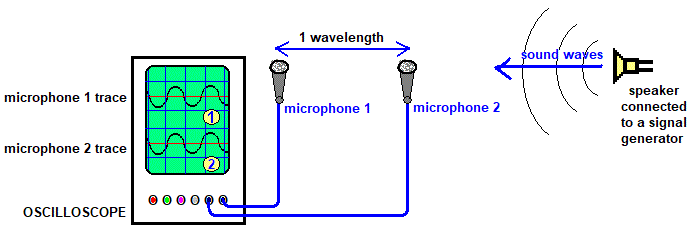
Apparatus
- Oscilloscope
- Microphone
- Signal generator or tuning fork (sound source)
- Connecting leads
- Calculator
Theory / Formula
The frequency of a wave is related to its time period by:
\( \mathrm{f = \dfrac{1}{T}} \)
- \( \mathrm{f} \) = frequency (Hz)
- \( \mathrm{T} \) = time period of one wave (s)
The time period is found from the oscilloscope trace using the time-base scale.
Method
- Connect the microphone to the input of the oscilloscope.
- Switch on the oscilloscope.
- Set the time-base to a suitable value so several waves are visible.
- Produce a steady sound using a tuning fork or signal generator.
- Observe the sound wave trace on the screen.
- Measure the time for one complete wave using the oscilloscope scale.
- Calculate the frequency using the formula.
- Repeat measurements and calculate an average value.
How the Measurement Is Taken
- Count the number of horizontal divisions for one wave.
- Multiply by the time-base setting (seconds per division).
- This gives the time period \( \mathrm{T} \).
Results (Sample)
| Time-base (s/div) | Divisions for one wave | Time period, T (s) | Frequency, f (Hz) |
|---|---|---|---|
| 0.002 | 5 | 0.010 | 100 |
Conclusion
- The oscilloscope allows the sound wave to be displayed clearly.
- The frequency is calculated from the measured time period.
- Results are consistent when repeated measurements are taken.
Sources of Error
- Difficulty identifying one complete wave.
- Unsteady sound source.
- Incorrect time-base setting.
Improvements
- Use a signal generator for a stable frequency.
- Measure several waves and divide by the number of waves.
- Adjust gain and time-base for a clearer trace.
Safety Precautions
- Keep sound levels moderate to protect hearing.
- Ensure all electrical connections are secure.
Key Idea
- The oscilloscope displays voltage variation with time.
- Sound frequency is found from the time period of the trace.
- A shorter time period means a higher frequency.
Important Points to Remember
- Horizontal axis represents time.
- Vertical axis represents voltage (related to loudness).
- Frequency depends on spacing of waves, not height.
Example
An oscilloscope trace shows one complete wave occupying 4 divisions.
The time-base setting is \( \mathrm{0.001\ s/div} \).
Calculate the frequency of the sound.
▶️ Answer / Explanation
Time period:
\( \mathrm{T = 4 \times 0.001 = 0.004\ s} \)
Frequency:
\( \mathrm{f = \dfrac{1}{0.004}} \)
\( \mathrm{f = 250\ Hz} \)
Example
Explain how the oscilloscope trace would change if the sound frequency increases.
▶️ Answer / Explanation
The waves become closer together on the screen.
This shows a shorter time period and therefore a higher frequency.