
Loudness and Amplitude of Sound
Loudness describes how loud or quiet a sound is perceived by the human ear. The loudness of a sound depends on the amplitude of vibration of the sound source.
Amplitude and Loudness
Amplitude is the maximum displacement of particles from their rest position during vibration.
- Large amplitude → loud sound
- Small amplitude → quiet sound
The greater the amplitude of vibration of the source, the louder the sound produced.
Source of Loud Sounds
- Sound is produced by vibrating objects.
- Vibrations with greater energy produce larger amplitudes.
- More energy is transferred to the surrounding air.
For example, striking a drum harder produces a louder sound.
Wave Relationship
Sound waves obey the wave equation:
\( \mathrm{v = f\lambda} \)
Although this equation does not include amplitude, amplitude affects the energy carried by the wave.
Important Distinction
- Loudness depends on amplitude.
- Pitch depends on frequency.
- Changing amplitude does not change frequency.
Representation on an Oscilloscope
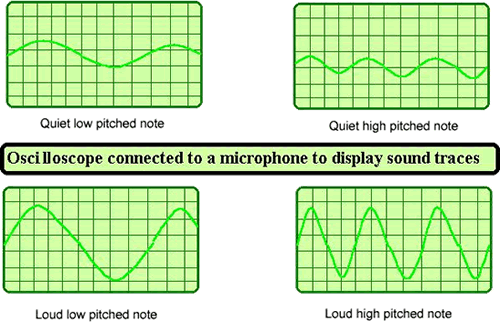
- Louder sound → taller waveform on the screen.
- Quieter sound → shorter waveform.
- Spacing between waves remains unchanged if pitch is constant.
Key Idea
- Loudness is related to energy of vibration.
- Amplitude measures the strength of vibration.
- Greater amplitude means more energy.
Important Points to Remember
- Loudness is a perception.
- Amplitude is a measurable quantity.
- Human ears detect larger amplitudes as louder sounds.
Example
A guitar string is plucked gently and then plucked harder.
Explain why the second sound is louder.
▶️ Answer / Explanation
Plucking harder makes the string vibrate with a larger amplitude.
A larger amplitude transfers more energy to the air, producing a louder sound.
Example
Two sounds have the same frequency but different amplitudes.
Describe how the sounds differ.
▶️ Answer / Explanation
The sound with the larger amplitude is louder.
The pitch of both sounds is the same because their frequencies are equal.