
Key Wave Definitions
Waves are described using specific terms that define how they move and how energy is transferred. Understanding these definitions is essential for analysing wave behaviour and solving wave problems at IGCSE level.
Amplitude
The amplitude of a wave is the maximum displacement of a point on the wave from its undisturbed (equilibrium) position.
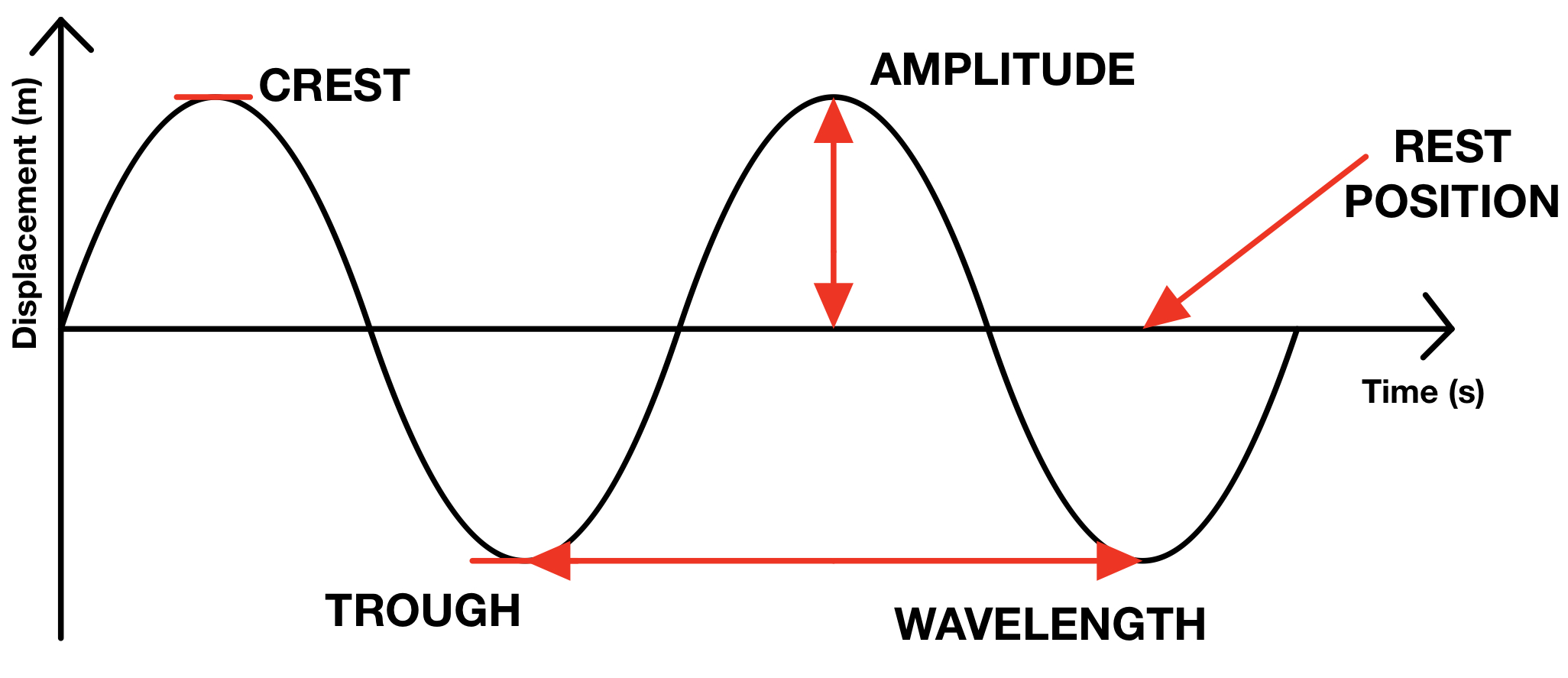
- Measured in metres (m).
- Indicates the energy carried by the wave.
- Greater amplitude → more energy.
Wavelength
The wavelength is the distance between two successive points on a wave that are in the same phase.

- Measured in metres (m).
- Crest to crest (transverse).
- Compression to compression (longitudinal).
Symbol: \( \mathrm{\lambda} \)
Frequency
The frequency of a wave is the number of complete waves (oscillations) passing a point each second.
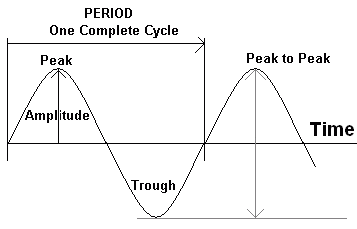
- Measured in hertz (Hz).
- 1 Hz = 1 wave per second.
Symbol: \( \mathrm{f} \)
Period
The period of a wave is the time taken for one complete wave (oscillation).

- Measured in seconds (s).
- Inverse of frequency.
Relationship:
\( \mathrm{T = \dfrac{1}{f}} \)
Wavefront
A wavefront is a line (or surface) joining points on a wave that are in the same phase of vibration.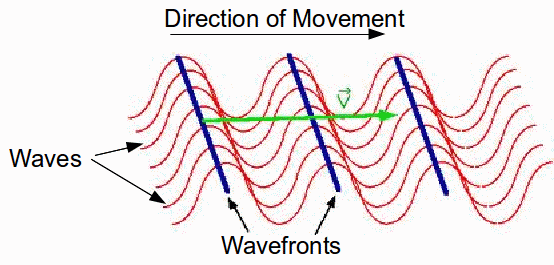
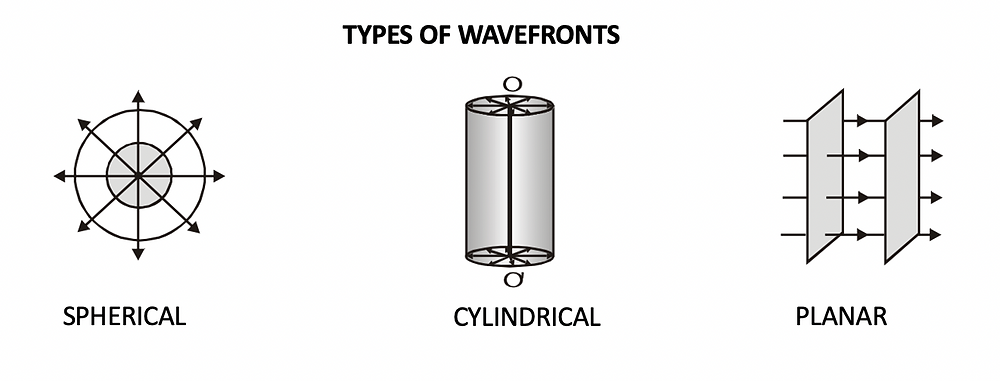
- Plane wavefronts → straight, parallel lines.
- Circular wavefronts → concentric circles.
- Direction of wave travel is perpendicular to wavefronts.
Key Wave Relationships
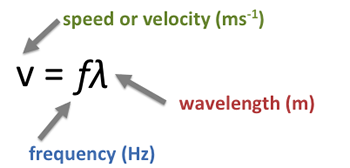
\( \mathrm{wave\ speed = frequency \times wavelength} \)
\( \mathrm{v = f\lambda} \)
- \( \mathrm{v} \) = wave speed (m/s)
- \( \mathrm{f} \) = frequency (Hz)
- \( \mathrm{\lambda} \) = wavelength (m)
Key Idea
- Wave properties describe energy transfer.
- Frequency and period are linked.
- Wavelength depends on speed and frequency.
Important Points to Remember
- Do not confuse wavelength with amplitude.
- Always include correct units.
- Wavefronts show wave direction.
Example
A wave has a frequency of \( \mathrm{5\ Hz} \).
(a) Define the period of the wave. (b) Calculate the period.
▶️ Answer / Explanation
(a) The period is the time taken for one complete wave.
(b) Use \( \mathrm{T = \dfrac{1}{f}} \):
\( \mathrm{T = \dfrac{1}{5} = 0.20\ s} \)
Example
A transverse wave has an amplitude of \( \mathrm{0.04\ m} \) and a wavelength of \( \mathrm{0.80\ m} \).
(a) State what is meant by amplitude. (b) State what is meant by wavelength.
▶️ Answer / Explanation
(a) Amplitude is the maximum displacement from the equilibrium position.
(b) Wavelength is the distance between two successive points in phase on the wave.