
Using Wave Relationships in Different Contexts
The same mathematical relationships apply to all types of waves. These relationships can be used to analyse sound waves (mechanical waves) and electromagnetic waves such as radio waves and light.
Although the nature of these waves is different, the equations linking speed, frequency, wavelength, and time period are the same.
Key Wave Relationships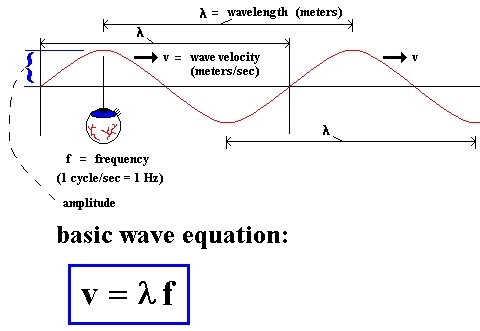
The main wave equation is:
\( \mathrm{v = f\lambda} \)
- \( \mathrm{v} \) = wave speed (m/s)
- \( \mathrm{f} \) = frequency (Hz)
- \( \mathrm{\lambda} \) = wavelength (m)
The relationship between frequency and time period is:
\( \mathrm{f = \dfrac{1}{T}} \)
\( \mathrm{T = \dfrac{1}{f}} \)
- \( \mathrm{T} \) = time period (s)
Using the Relationships for Sound Waves
Sound waves are longitudinal waves that require a medium such as air to travel.
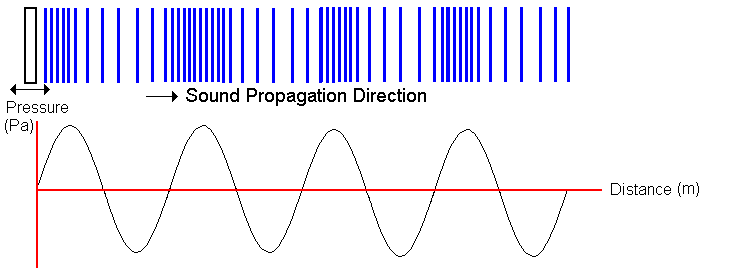
- In air, sound travels at approximately \( \mathrm{340\ m/s} \).
- Higher frequency → higher pitch.
- Wavelength changes if frequency changes but speed stays constant.
Application: Calculating wavelength of sound in air.
Using the Relationships for Electromagnetic Waves
Electromagnetic waves are transverse waves and do not require a medium.
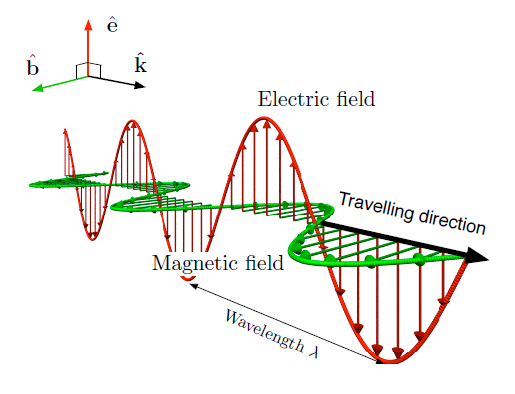
- All EM waves travel at the same speed in a vacuum.
- Speed in a vacuum: \( \mathrm{3.0 \times 10^8\ m/s} \).
- Higher frequency → shorter wavelength.
Application: Calculating wavelength of radio waves or light.
Comparing the Contexts
- The equations are identical for sound and EM waves.
- The wave speed depends on the type of wave and medium.
- Frequency and wavelength are linked through speed.
Key Idea
- One set of equations works for all waves.
- Only the wave speed changes between contexts.
- Correct units are essential.
Important Points to Remember
- Sound cannot travel in a vacuum.
- Electromagnetic waves can.
- Always check which quantity is constant.
Example
A sound wave travels through air at a speed of \( \mathrm{340\ m/s} \). The frequency of the sound is \( \mathrm{170\ Hz} \).
(a) Calculate the wavelength of the sound wave. (b) State how the wavelength would change if the frequency increased.
▶️ Answer / Explanation
(a) Use \( \mathrm{v = f\lambda} \):
\( \mathrm{\lambda = \dfrac{v}{f} = \dfrac{340}{170}} \)
\( \mathrm{\lambda = 2.0\ m} \)
(b) If frequency increases, wavelength decreases (speed remains constant).
Example
A radio wave travels at \( \mathrm{3.0 \times 10^8\ m/s} \) in a vacuum. The frequency of the wave is \( \mathrm{6.0 \times 10^7\ Hz} \).
(a) Calculate the wavelength of the radio wave. (b) State the time period of the wave.
▶️ Answer / Explanation
(a) Use \( \mathrm{v = f\lambda} \):
\( \mathrm{\lambda = \dfrac{3.0 \times 10^8}{6.0 \times 10^7}} \)
\( \mathrm{\lambda = 5.0\ m} \)
(b) Use \( \mathrm{T = \dfrac{1}{f}} \):
\( \mathrm{T = \dfrac{1}{6.0 \times 10^7}} \)
\( \mathrm{T = 1.7 \times 10^{-8}\ s} \)