
Doppler Effect
The Doppler effect is the change in observed frequency and wavelength of a wave when there is relative motion between the source of the wave and the observer.
It occurs for all types of waves, including sound waves and electromagnetic waves.
Why the Observed Frequency and Wavelength Change
- A moving source emits wavefronts while continuously changing position.
- In front of the moving source, wavefronts become compressed.
- Behind the moving source, wavefronts become spread out.
This changes the wavelength reaching the observer and therefore changes the observed frequency.
Source Moving Towards the Observer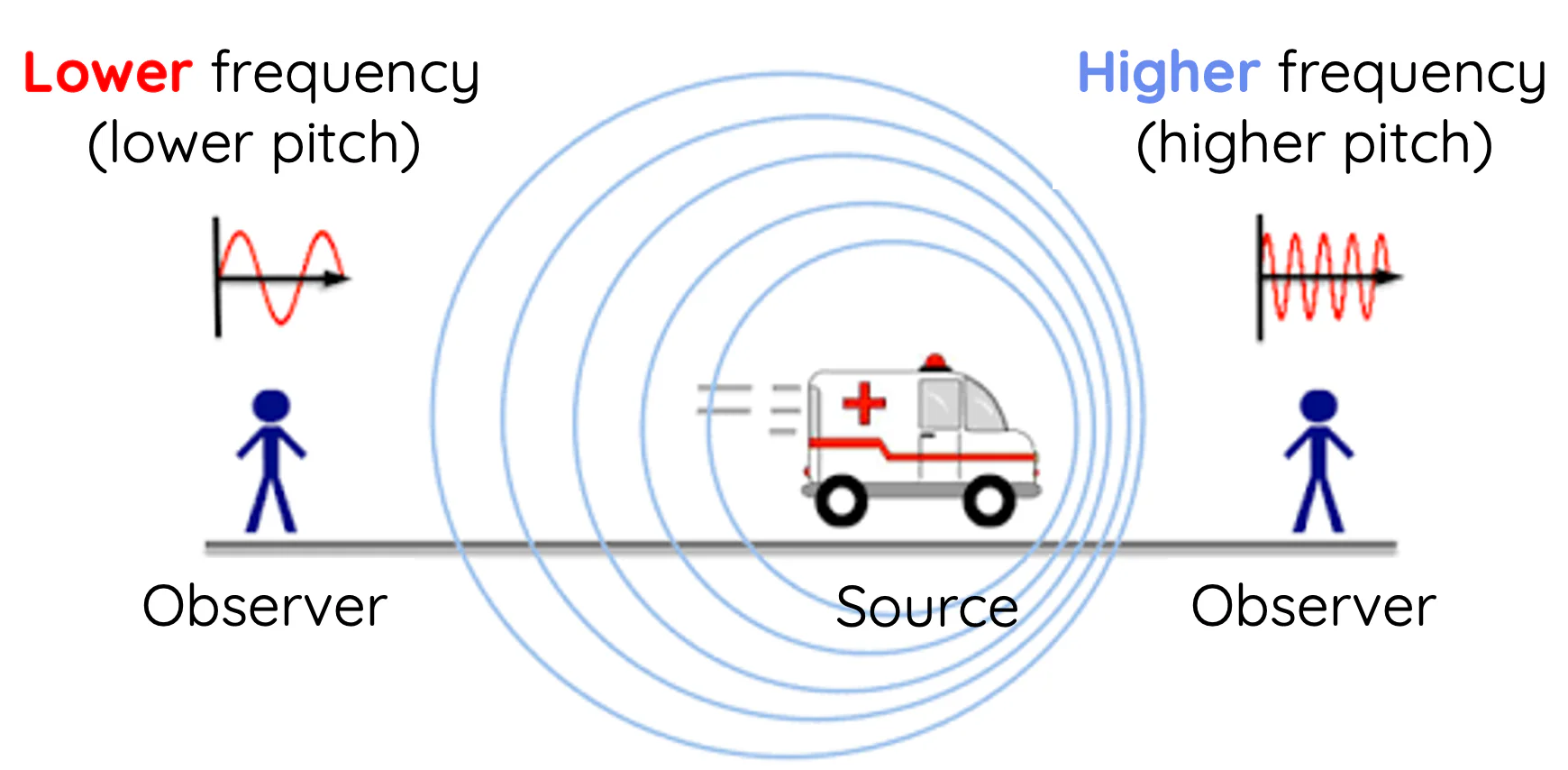
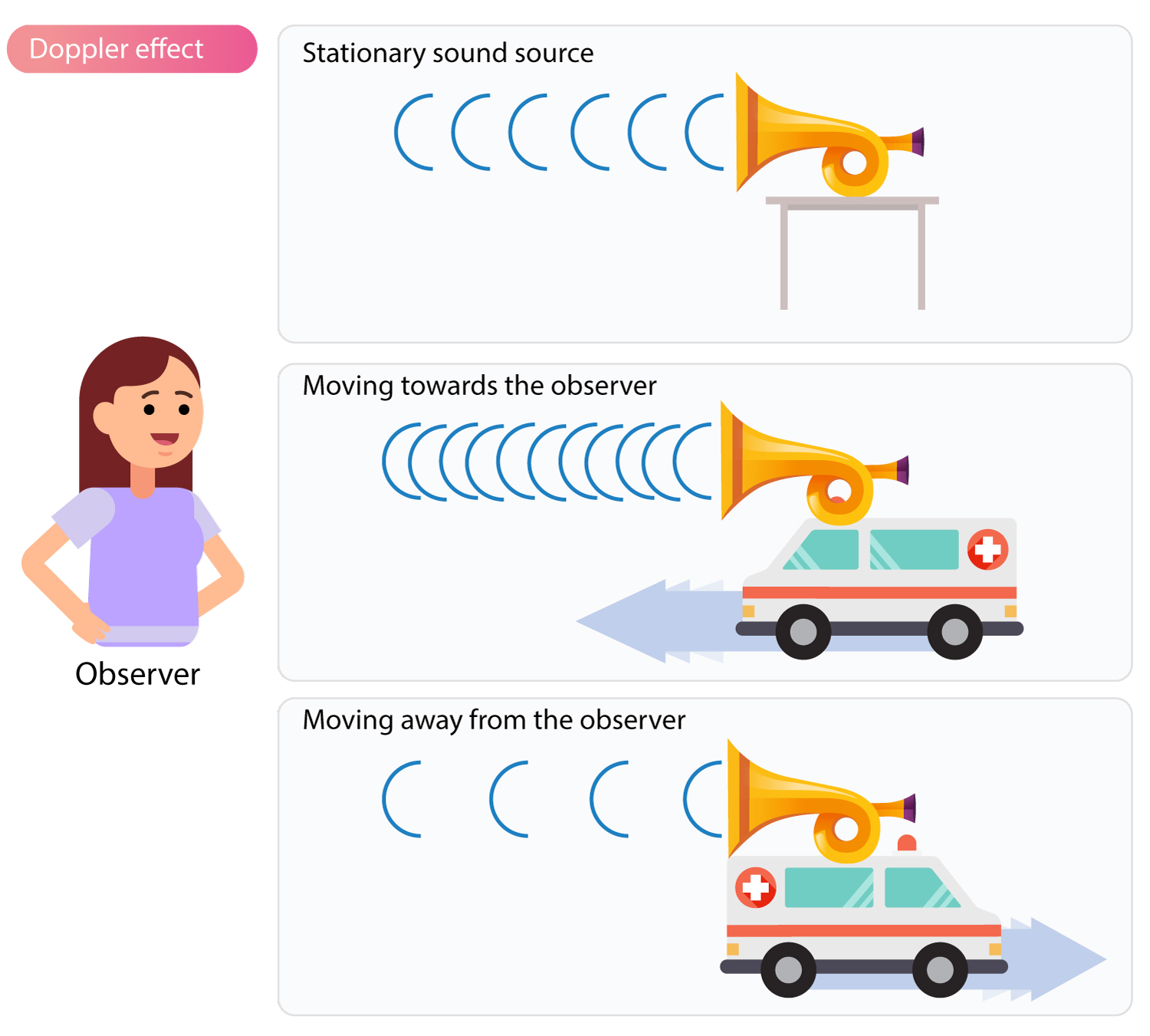
- Wavefronts are closer together.
- Observed wavelength decreases.
- Observed frequency increases.
- For sound, the pitch sounds higher.
Source Moving Away from the Observer
- Wavefronts are further apart.
- Observed wavelength increases.
- Observed frequency decreases.
- For sound, the pitch sounds lower.
Doppler Effect for Sound Waves
Sound waves are longitudinal waves and require a medium (such as air) to travel.
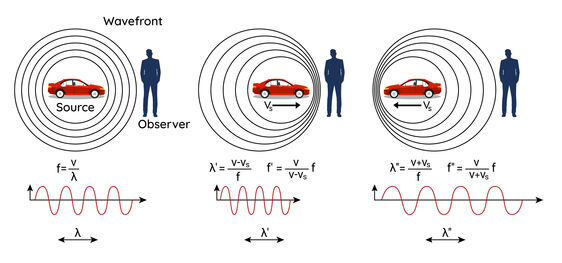
- The speed of sound in air remains constant.
- The observed pitch changes due to frequency change.
- The emitted frequency of the source does not change.
Common example: the changing pitch of an ambulance siren as it passes an observer.
Doppler Effect for Electromagnetic Waves
For electromagnetic waves (such as light):

- Source moving towards observer → blue shift.
- Source moving away from observer → red shift.
This effect is used in astronomy to determine whether stars and galaxies are moving towards or away from Earth.
Important IGCSE Note
- The wave speed in the medium remains constant.

- Only the observed frequency and wavelength change.
- The Doppler effect is caused by relative motion.
Wave Relationship Used
The Doppler effect is explained using the wave equation:
\( \mathrm{v = f\lambda} \)
- If \( \mathrm{f} \) increases, \( \mathrm{\lambda} \) decreases.
- If \( \mathrm{f} \) decreases, \( \mathrm{\lambda} \) increases.
- \( \mathrm{v} \) remains constant.
Key Idea
- Doppler effect is due to motion of the source or observer.
- Wavefront compression and expansion cause frequency change.
- Applies to sound and electromagnetic waves.
Important Points to Remember
- Observer motion can also cause the Doppler effect.
- Pitch depends on frequency.
- Colour shift depends on wavelength.
Example
An ambulance approaches a stationary observer with its siren switched on.
(a) Describe how the sound heard by the observer changes as the ambulance approaches. (b) Explain this change using wave ideas.
▶️ Answer / Explanation
(a) The sound becomes higher in pitch.
(b) The wavefronts are compressed in front of the moving ambulance, giving a shorter wavelength and higher frequency.
Example
A distant star is observed to have its light shifted towards the red end of the spectrum.
(a) Name this effect. (b) What does this tell us about the motion of the star?
▶️ Answer / Explanation
(a) This effect is called red shift.
(b) The star is moving away from the observer.
Example
A sound wave travels through air at a speed of \( \mathrm{340\ m/s} \).
When the sound source moves towards an observer, the observed wavelength becomes \( \mathrm{0.68\ m} \).
Calculate the observed frequency of the sound.
▶️ Answer / Explanation
Use the wave equation:
\( \mathrm{v = f\lambda} \)
Rearrange:
\( \mathrm{f = \dfrac{v}{\lambda}} \)
\( \mathrm{f = \dfrac{340}{0.68} = 500\ Hz} \)
The observed frequency is higher due to the Doppler effect.