
Reflection and Refraction of Waves
All waves including sound waves, water waves, and electromagnetic waves—can undergo reflection and refraction when they meet a boundary between different media.
These behaviours occur because waves change direction when they interact with surfaces or when their speed changes.
Reflection of Waves
Reflection occurs when a wave bounces off a surface and changes direction while remaining in the same medium.
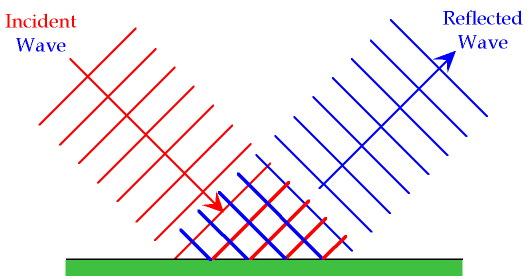
- The wave does not pass into a new medium.
- The speed and frequency remain the same.
- The direction of travel changes.
Law of Reflection (applies to all waves):
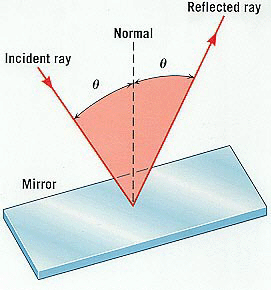
\( \mathrm{angle\ of\ incidence = angle\ of\ reflection} \)
This law applies to sound, water waves, and light waves.
Refraction of Waves
Refraction occurs when a wave enters a different medium and its speed changes, causing the wave to change direction.
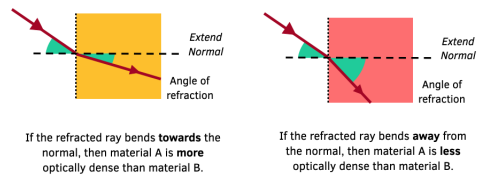
- The wave crosses a boundary.
- Wave speed changes.
- Wavelength changes.
- Frequency remains constant.
Why Refraction Occurs
- Different media affect wave speed differently.
- A change in speed causes bending of the wave.
- This bending is refraction.
Wave Relationship Used
The relationship between wave speed, frequency and wavelength is:
\( \mathrm{v = f\lambda} \)
- When a wave slows down, wavelength decreases.
- When a wave speeds up, wavelength increases.
- Frequency stays the same across boundaries.
Reflection and Refraction in Different Waves
- Water waves: reflect from barriers and refract in shallow water.
- Sound waves: reflect to form echoes and refract due to temperature changes.
- Light waves: reflect from mirrors and refract in glass or water.
Key Idea
- All waves can be reflected.
- All waves can be refracted.
- Refraction only occurs when wave speed changes.
Important Points to Remember
- Reflection does not change speed or frequency.
- Refraction changes speed and wavelength.
- Frequency never changes during refraction.
Example
A sound wave hits a large wall and an echo is heard.
(a) Name the wave behaviour involved. (b) State one property of the wave that remains unchanged.
▶️ Answer / Explanation
(a) The wave behaviour is reflection.
(b) The frequency (and speed in air) remain unchanged.
Example
A water wave travels from deep water into shallow water at an angle.
(a) Describe what happens to the direction of the wave. (b) Explain this using wave speed.
▶️ Answer / Explanation
(a) The wave changes direction (bends).
(b) The wave slows down in shallow water, causing refraction.