
Work Done and Energy Transferred
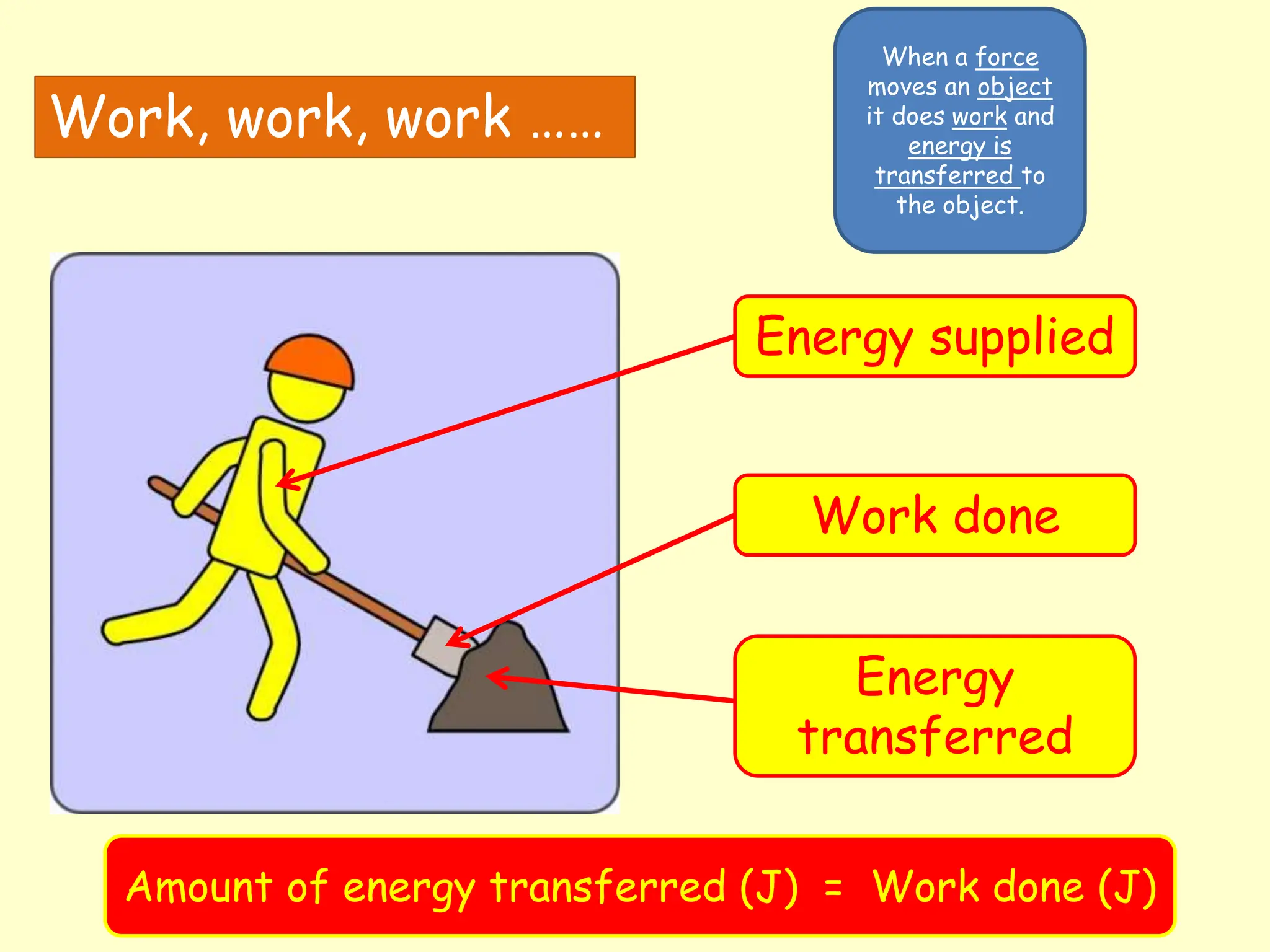
Work done is a way of describing energy transfer. Whenever a force causes an object to move, energy is transferred, and the amount of energy transferred is equal to the work done.
Key Statement
Work done = Energy transferred
This means that when work is done on an object, energy is moved from one energy store to another.
Relationship Between Work and Energy
The work done by a force is:
\( \mathrm{W = F \times s} \)
- \( \mathrm{W} \) = work done (joule, J)
- \( \mathrm{F} \) = force (newton, N)
- \( \mathrm{s} \) = distance moved in the direction of the force (metre, m)
The unit of both work done and energy is the joule (J).
Energy Stores Involved
Work done usually causes energy to be transferred between energy stores:
- Work done against gravity → gravitational potential energy increases
- Work done on a moving object → kinetic energy increases
- Work done against friction → thermal energy increases
- Work done stretching a spring → elastic potential energy increases
Examples of Work Done = Energy Transferred
- Lifting an object increases its gravitational potential energy.
- Pushing a box increases thermal energy due to friction.
- Accelerating a car increases its kinetic energy.
In each case, the energy gained equals the work done.
Key Idea
- Work done is a measure of energy transfer.
- No work done means no energy transferred.
- Energy is conserved during the process.
Important Points to Remember
- Work and energy have the same unit (J).
- Only the distance moved in the direction of the force counts.
- Work done can increase or decrease an energy store.
Example
A student lifts a book using a force of \( \mathrm{12\ N} \) through a vertical height of \( \mathrm{0.80\ m} \).
Calculate the energy transferred to the book.
▶️ Answer / Explanation
Work done equals energy transferred.
\( \mathrm{W = F \times s} \)
\( \mathrm{W = 12 \times 0.80} \)
\( \mathrm{W = 9.6\ J} \)
The book gains \( \mathrm{9.6\ J} \) of gravitational potential energy.
Example
A box is pushed along a rough floor at constant speed.
Explain where the energy transferred by the work done goes.
▶️ Answer / Explanation
The work done against friction is transferred to thermal energy.
The box and the floor both warm up.
The total energy is conserved.