
Energy Stores and Energy Transfers
Energy cannot be created or destroyed, but it can be stored in different ways and transferred between these stores. In physics, energy changes are described using the ideas of energy stores and energy transfer pathways.
Energy Stores
An energy store is a way of describing where energy is kept before and after an energy transfer.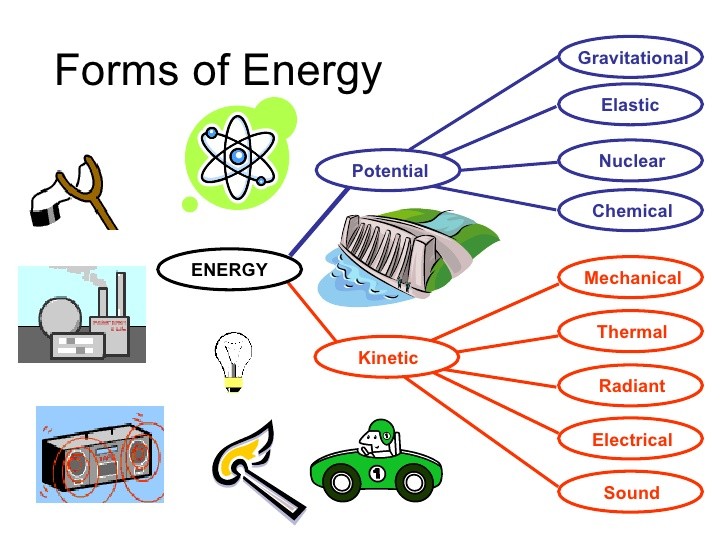
- Chemical store: energy stored in fuels, food, and batteries.
- Kinetic store: energy of a moving object.
- Gravitational potential store: energy due to an object’s height above the ground.
- Elastic potential store: energy stored when an object is stretched or compressed.
- Thermal store: energy related to the temperature of an object.
- Magnetic store: energy stored in magnetic fields.
- Electrostatic store: energy stored when electric charges are separated.
- Nuclear store: energy stored in the nucleus of atoms.
Energy Transfer Pathways
Energy is transferred between stores using specific pathways:
- Mechanically: energy transferred by forces doing work (e.g. lifting, pushing).
- Electrically: energy transferred by moving electric charges.
- By heating: energy transferred due to a temperature difference.
- By radiation: energy transferred by waves such as light and sound.
Examples of Energy Transfers
- A falling object: gravitational → kinetic (mechanically).
- An electric heater: electrical → thermal (electrically).
- A stretched spring released: elastic → kinetic (mechanically).
- A lamp: electrical → light and thermal (by radiation).
Key Distinction
- Energy stores describe where energy is held.
- Energy transfers describe how energy moves between stores.
Key Relationships (where applicable)
- Kinetic energy: \( \mathrm{E_k = \dfrac{1}{2}mv^2} \)
- Gravitational potential energy: \( \mathrm{E_p = mgh} \)
- Elastic potential energy: \( \mathrm{E_e = \dfrac{1}{2}kx^2} \)
- Electrical energy transferred: \( \mathrm{E = IVt} \)
Key Idea
- Energy always moves between stores.
- Energy transfers can be useful or wasted.
- Total energy in a closed system remains constant.
Important Points to Remember
- Energy is never “used up”.
- Wasted energy is usually transferred to the thermal store.
- Diagrams can help show energy changes clearly.
Example
A battery-powered toy car moves along the floor and then slows down.
Describe the energy stores involved and the energy transfer pathways.
▶️ Answer / Explanation
Energy is initially stored in the chemical store of the battery.
Energy is transferred electrically to the motor.
The kinetic energy store of the car increases.
As the car slows, energy is transferred to the thermal store of the surroundings by heating due to friction.
Example
A stretched bow is released and fires an arrow.
Describe the energy stores and transfers involved.
▶️ Answer / Explanation
Energy is stored in the elastic potential store of the bow.
When released, energy is transferred mechanically.
The kinetic energy store of the arrow increases.
Some energy is also transferred to the thermal store and as sound by radiation.