
Efficiency, Useful Energy Output and Total Energy Output
Efficiency is a measure of how much of the input energy is transferred usefully by a device or system. Not all input energy is converted into useful output energy — some energy is always transferred to wasted energy stores, usually as thermal energy.
Definition of Efficiency
Efficiency compares the useful energy output with the total energy input.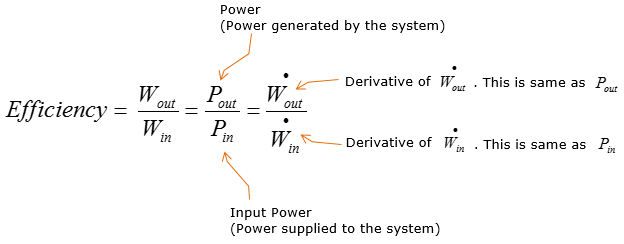
\( \mathrm{efficiency = \dfrac{useful\ energy\ output}{total\ energy\ input}} \)
Efficiency has no units.
It is often written as:
- A decimal (e.g. 0.75)
- A percentage (e.g. 75%)
\( \mathrm{efficiency(\%) = \dfrac{useful\ energy\ output}{total\ energy\ input} \times 100} \)
Understanding Energy Outputs
- Useful energy: energy transferred to the desired energy store.
- Wasted energy: energy transferred to unwanted stores (often thermal or sound).
- Total energy input = useful energy + wasted energy
Efficiency can never be greater than 1 (or 100%).
Sankey Diagrams
- Used to show energy transfers visually.
- Arrow width represents the amount of energy.
- Useful energy continues straight.
- Wasted energy branches off.
Key Idea
- Higher efficiency means less energy is wasted.
- Some energy is always wasted due to friction or resistance.
- Improving efficiency reduces energy loss.
Important Points to Remember
- Use energy values in joules (J).
- Do not confuse energy with power.
- Check whether the answer is required as a decimal or percentage.
Example
An electric motor receives \( \mathrm{800\ J} \) of electrical energy.
It transfers \( \mathrm{600\ J} \) into useful kinetic energy.
Calculate the efficiency of the motor.
▶️ Answer / Explanation
Use:
\( \mathrm{efficiency = \dfrac{useful\ energy}{total\ energy}} \)
\( \mathrm{efficiency = \dfrac{600}{800}} \)
\( \mathrm{efficiency = 0.75} \)
As a percentage:
\( \mathrm{efficiency = 75\%} \)
Example
A device has an efficiency of \( \mathrm{40\%} \).
If the total energy input is \( \mathrm{500\ J} \), calculate the useful energy output.
▶️ Answer / Explanation
Convert percentage to decimal:
\( \mathrm{40\% = 0.40} \)
Use:
\( \mathrm{useful\ energy = efficiency \times total\ energy} \)
\( \mathrm{useful\ energy = 0.40 \times 500} \)
\( \mathrm{useful\ energy = 200\ J} \)