
Practical: Investigating Thermal Energy Transfer by Conduction, Convection and Radiation
Thermal energy can be transferred by conduction, convection, and radiation. In this practical, simple experiments are used to investigate each method of heat transfer.
Aim
To investigate how thermal energy is transferred by conduction, convection and radiation.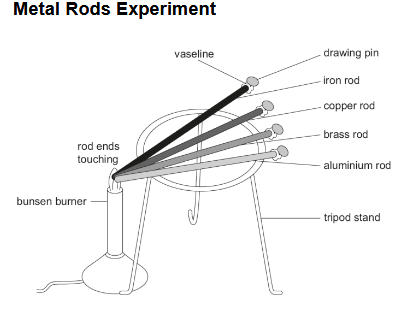
Part A: Conduction
Apparatus
- Metal rod (copper or aluminium)
- Drawing pins
- Wax
- Clamp stand
- Bunsen burner
Method
- Attach drawing pins along the metal rod using small pieces of wax.
- Clamp the rod horizontally.
- Heat one end of the rod using a Bunsen burner.
- Observe the order in which the pins fall off.
Observation
- Pins closest to the flame fall first.
- Pins further away fall later.
Conclusion
- Thermal energy is transferred through the metal by conduction.
- Metals conduct heat efficiently due to free electrons.
Part B: Convection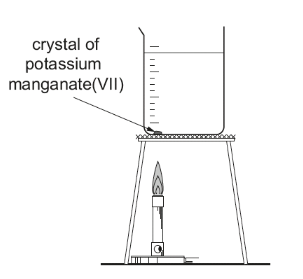
Apparatus
- Beaker of water
- Heat source
- Food colouring or potassium permanganate crystals
Method
- Place the beaker on a heat source.
- Add a small amount of dye to the bottom of the beaker.
- Heat gently from below.
- Observe the movement of the dye.
Observation
- The coloured water rises.
- Cooler water sinks.
Conclusion
- Convection currents form due to density differences.
- Thermal energy is transferred by movement of the fluid.
Part C: Radiation
Apparatus
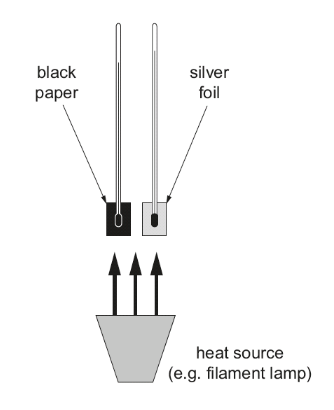
- Leslie cube or metal plates (black and shiny)

- Infrared heater or hot water
- Thermometer or temperature sensor
Method
- Heat the Leslie cube or plates equally.
- Measure temperature changes at equal distances.
- Compare radiation from different surfaces.
Observation
- Black surfaces emit more radiation.
- Shiny surfaces emit less radiation.
Conclusion
- Radiation does not require a medium.
- Black, dull surfaces are the best emitters.
Overall Conclusion
- Conduction transfers heat through solids.
- Convection transfers heat through fluids.
- Radiation transfers heat by electromagnetic waves.
Safety Precautions
- Handle hot equipment carefully.
- Wear eye protection when heating substances.
- Keep flammable materials away from flames.
Key Idea
- Different methods dominate in different materials.
- All three processes transfer thermal energy.
- Temperature differences drive heat transfer.
Important Points to Remember
- Convection does not occur in solids.
- Radiation can occur in a vacuum.
- Metals are good conductors.
Example
In the convection experiment, explain why the coloured water rises when heated.
▶️ Answer / Explanation
Heating causes the water to expand and become less dense.
The less dense water rises, setting up a convection current.
Example
Explain why the drawing pins fall off in order during the conduction experiment.
▶️ Answer / Explanation
Thermal energy is transferred along the metal rod by conduction.
Pins closer to the heat receive energy first, melting the wax earlier.