
Edexcel iGCSE Physics (4PH1) 1.3 Forces, Movement & Changing Shape Exam Style Question Paper 1B - New Syllabus
Question
The diagram shows a truck travelling along a horizontal road.
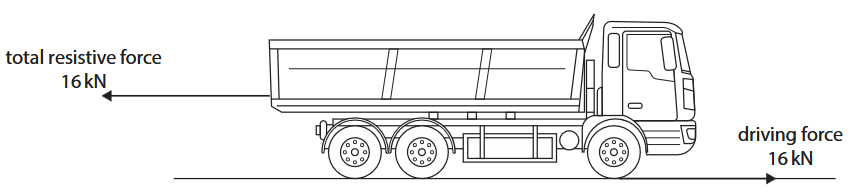
The horizontal forces acting on the truck are shown in the diagram.
(a) Give the resultant horizontal force acting on the truck. (1)
resultant horizontal force = __________________ \(\mathrm{kN}\)
(b) The driver of the truck has to stop because a tree has fallen on the road.
(i) The thinking distance of the driver is \(7\,\mathrm{m}\).
The braking distance of the truck is \(20\,\mathrm{m}\).
Calculate the stopping distance of the truck. (1)
stopping distance = __________________ \(\mathrm{m}\)
(ii) Give two factors that would affect the braking distance of the truck. (2)
1. ________________________________________________________________
2. ________________________________________________________________
(iii) Which of these factors would decrease the driver’s thinking distance? (1)
(B) the truck has old, worn tyres, rather than new tyres
(C) the driver is tired
(D) the truck is travelling at a lower speed
Syllabus Topic Codes (Edexcel International GCSE Physics 4PH1):
• 1.14–1.16: Forces, braking and friction — parts (b)(i) and (b)(ii)
• 1.3–1.4: Motion, speed and stopping distance — part (b)(iii)
▶️ Answer/Explanation
(a) Resultant horizontal force [1 mark]
The driving force is \(16\,\mathrm{kN}\) to the right and the total resistive force is \(16\,\mathrm{kN}\) to the left.
Therefore,
\(F_{\mathrm{resultant}}=16-16=0\,\mathrm{kN}\)
Final Answer: \( \boxed{0\,\mathrm{kN}} \)
(b)(i) Stopping distance [1 mark]
Stopping distance is the sum of the thinking distance and braking distance:
\(\mathrm{stopping\ distance}=\mathrm{thinking\ distance}+\mathrm{braking\ distance}\)
\(=7+20\)
\(=27\,\mathrm{m}\)
Final Answer: \( \boxed{27\,\mathrm{m}} \)
(b)(ii) Factors affecting braking distance [2 marks]
Any two valid factors, for example:
- Speed of the truck
- Mass or weight of the truck
- Condition of the brakes
- Condition of the tyres
- Condition of the road, such as whether it is wet or icy
- Whether the truck is travelling uphill or downhill
- How hard the brake pedal is pressed
Award \(1\) mark for each valid factor, up to \(2\) marks.
(b)(iii) Factor that decreases thinking distance [1 mark]
Correct Answer: \( \boxed{\mathrm{D}} \) the truck is travelling at a lower speed
Thinking distance depends on the speed of the vehicle and the driver’s reaction time. At a lower speed, the truck travels a shorter distance during the driver’s reaction time.
Final Answer: A lower speed decreases the thinking distance.
Question
Ice hockey is a team sport played on ice. Players try to hit a disc called a puck into the other team’s goal.
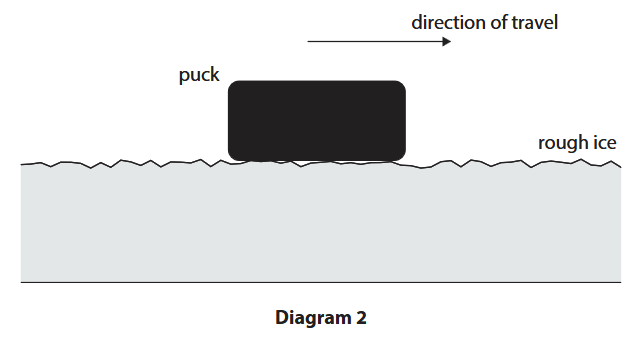
(a) Diagram 1 shows a puck travelling across some smooth ice.
(i) State the formula linking average speed, distance moved and time taken. (1)
(ii) The puck travels at a constant speed of \(2.8\,\mathrm{m\,s^{-1}}\).
Calculate the distance moved by the puck in a time of \(3.5\,\mathrm{s}\). (3)
distance moved = __________________ \(\mathrm{m}\)
(b) Diagram 2 shows a puck travelling across some rough ice.
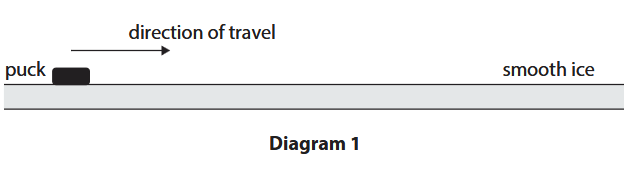
The rough ice exerts a frictional force on the puck.
(i) Draw a labelled arrow on diagram 2 to show the force of friction acting on the puck. (1)
(ii) Explain how the force of friction changes the velocity of the puck. (2)
Syllabus Topic Codes (Edexcel International GCSE Physics 4PH1):
• 1.16: Friction — parts (b)(i) and (b)(ii)
• 1.15: Resultant forces — relevant to the effect of the frictional force on the puck in part (b)(ii)
▶️ Answer/Explanation
(a)(i) Correct Answer: \( \boxed{\mathrm{speed}=\dfrac{\mathrm{distance}}{\mathrm{time}}} \) [1 mark]
Using standard symbols, this can also be written as:
\(v=\dfrac{s}{t}\)
(a)(ii) Distance moved [3 marks]
1. Use the speed equation:
\(v=\dfrac{s}{t}\)
2. Rearrange for distance:
\(s=vt\)
3. Substitute the values:
\(s=(2.8)(3.5)\)
\(s=9.8\,\mathrm{m}\)
Final Answer: \( \boxed{9.8\,\mathrm{m}} \)
(b)(i) Force of friction [1 mark]
- The frictional force acts horizontally to the left, opposite to the direction of travel of the puck.
- The arrow should therefore point from the puck towards the left and should be labelled friction or frictional force.
(b)(ii) Effect of friction on velocity [2 marks]
- The frictional force acts in the opposite direction to the velocity of the puck.
- Therefore, the puck slows down, so its speed and hence its velocity decrease.
The frictional force produces a resultant force opposite to the direction of motion, causing the puck to decelerate.
Final Answer: Friction acts opposite to the puck’s motion, causing the puck to decelerate and its velocity to decrease.
Question
A student investigates the magnetic force on a current-carrying metal rod.
The student places a U-shaped magnet on a sensitive balance.
They connect a rigid metal rod to a low-voltage power supply, and then fix the rod in place so that it passes between the poles of the magnet.
The diagram shows part of the student’s apparatus.
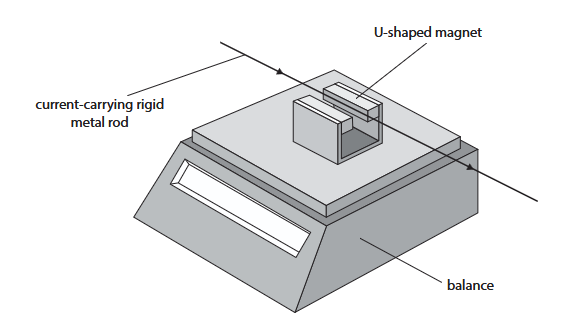
When there is a current in the metal rod, the rod experiences a force due to the magnetic field of the magnet.
The reading on the balance changes because the magnet experiences a force that is the same magnitude as the force on the rod, but in the opposite direction.
(a) The student can increase the current in the metal rod up to a maximum of \(5.0\,\mathrm{A}\).
Suggest why the student should only have the power supply switched on for short periods of time. (2)
(b) Before the power supply is switched on, the reading of the balance is \(194.95\,\mathrm{g}\).
After the power supply is switched on, the reading of the balance is \(193.80\,\mathrm{g}\).
Calculate the force exerted on the current-carrying rod by the magnet. (4)
force = __________________ \(\mathrm{N}\)
(c) The student investigates how the balance reading varies as they change the current in the metal rod.
The table shows the student’s results.
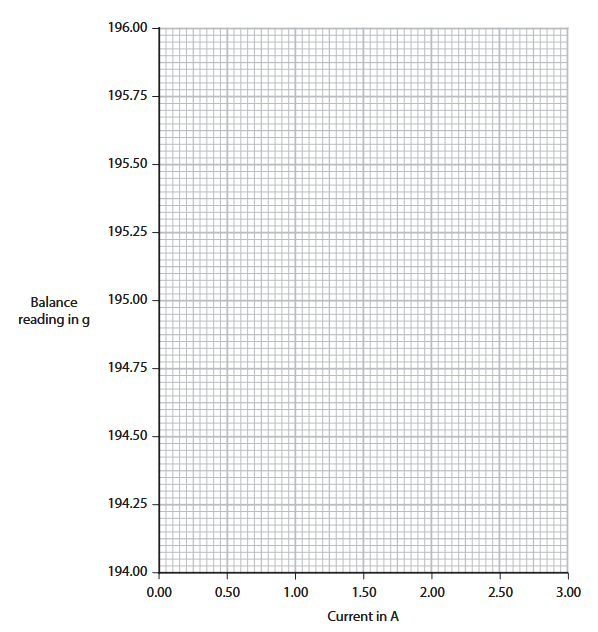
| Current in \(\mathrm{A}\) | Balance reading in \(\mathrm{g}\) |
|---|---|
| \(0.00\) | \(194.95\) |
| \(0.50\) | \(194.80\) |
| \(1.00\) | \(194.65\) |
| \(1.50\) | \(194.50\) |
| \(2.00\) | \(194.35\) |
| \(2.50\) | \(194.20\) |
| \(3.00\) | \(194.05\) |
(i) Plot the student’s results on the grid. (1)
(ii) Draw the line of best fit. (1)
(iii) The student changes the connections between the metal rod and the power supply to reverse the direction of the current.
Draw another line on the graph to show how the balance reading will vary with current after this change has been made. (3)
Syllabus Topic Codes (Edexcel International GCSE Physics 4PH1):
• 6.8–6.10P: Magnetic fields produced by magnets and current-carrying conductors — relevant to the interaction between the rod and magnet
• 4.10: Weight and gravitational force — part (b), converting the balance reading change into a force
• 1.8–1.10: Experimental data, graphs and interpretation — part (c)
▶️ Answer/Explanation
(a) Reason for switching on for short periods [2 marks]
- Current in the metal rod produces a heating effect.
- If the current flows for too long, the rod or power supply could become hot, increasing the risk of burns or overheating.
Final Answer: A large current causes heating in the rod and wires. Keeping the supply on for short periods reduces overheating and the risk of burns or fire.
(b) Force on the current-carrying rod [4 marks]
1. Calculate the change in balance reading:
\(\Delta m=194.95-193.80=1.15\,\mathrm{g}\)
2. Convert grams to kilograms:
\(\Delta m=1.15\times10^{-3}\,\mathrm{kg}=0.00115\,\mathrm{kg}\)
3. Use the weight equation:
\(W=mg\)
4. Calculate the force:
\(F=0.00115\times10\)
\(F=0.0115\,\mathrm{N}\)
The force on the magnet and the force on the rod have the same magnitude and opposite directions.
Final Answer: \( \boxed{0.0115\,\mathrm{N}} \)
(c)(i) Plotting the results [1 mark]
The seven points should be plotted correctly:
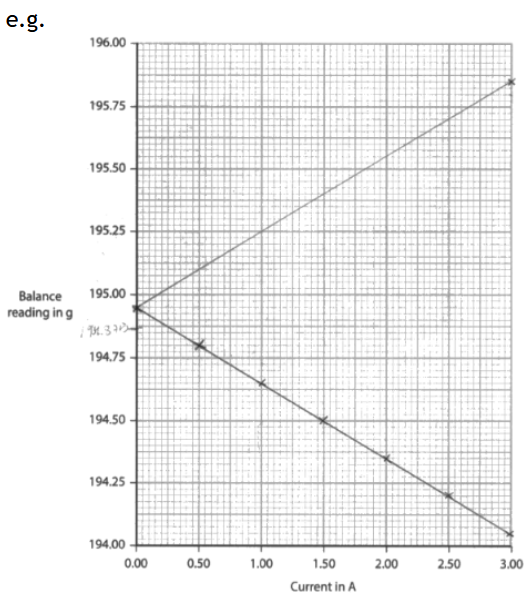
\((0.00,194.95)\), \((0.50,194.80)\), \((1.00,194.65)\), \((1.50,194.50)\), \((2.00,194.35)\), \((2.50,194.20)\), \((3.00,194.05)\).
(c)(ii) Line of best fit [1 mark]
The points form a straight-line relationship. The line of best fit should therefore be a continuous straight line through the centre of the plotted points.
(c)(iii) Reversing the current [3 marks]
- Reversing the current reverses the direction of the magnetic force.
- The force on the magnet therefore acts in the opposite direction, so the balance reading changes in the opposite direction.
- The new graph is a straight line with a positive gradient, starting from the same balance reading at \(I=0\,\mathrm{A}\).
The original results show that increasing current decreases the balance reading. Reversing the current reverses the force, so increasing the magnitude of the current now increases the balance reading.
Final Answer: Draw a straight line with a positive gradient through the point \((0,194.95)\), approximately symmetric with the original line about the \(194.95\,\mathrm{g}\) value at zero current.
Question
A car travels at a constant speed of \(14\,\mathrm{m\,s^{-1}}\) along a road.
(a) Calculate the distance travelled by the car in a time of \(30\,\mathrm{s}\). (2 marks)
Use the formula
\(\text{distance travelled}=\text{average speed}\times\text{time taken}\)
distance travelled = ____________________
(b) The driver of the car sees an obstacle in the road ahead and applies the brakes.
(i) Which of these is a description of the thinking distance of the car? (1 mark)
(B) distance travelled between seeing the obstacle and applying the brakes
(C) distance travelled between seeing the obstacle and the car coming to a stop
(D) distance travelled as the car slows down
(ii) Which of these factors would increase the braking distance of the car? (1 mark)
(B) driver being tired
(C) worn tyres on the car
(D) a dry road instead of a wet road
(iii) State the only factor that affects both the thinking distance and the braking distance of the car. (1 mark)
____________________________________________________________
Syllabus Topic Codes (Edexcel International GCSE Physics 4PH1):
• 1.19–1.20: Stopping distance and factors affecting thinking distance and braking distance — parts (b)(i), (b)(ii), (b)(iii)
▶️ Answer/Explanation and Mark Scheme
(a) Distance travelled [2 marks]
Use
\(s=vt\)
\(s=14\times30\)
\(s=420\,\mathrm{m}\)
Answer: \( \boxed{420\,\mathrm{m}} \)
(b)(i) Correct Answer: \( \boxed{\mathrm{B}} \) [1 mark]
- The thinking distance is the distance travelled between seeing the obstacle and applying the brakes.
(b)(ii) Correct Answer: \( \boxed{\mathrm{C}} \) [1 mark]
- Worn tyres reduce the friction between the tyres and the road, increasing the braking distance.
(b)(iii) Correct Answer: speed of the car [1 mark]
- The speed of the car affects both thinking distance and braking distance.
Total: \(5\) marks
Question
In 1947, the Railton Mobil Special was the first ground vehicle to achieve a speed of more than 400 miles per hour.

(a) During a test, the vehicle travelled at a speed of 403 miles per hour.
(i) Calculate a speed of 403 miles per hour in metres per second (m/s).
[1 mile = 1600m]
(ii) During the test, the vehicle travelled past two markers. The markers were placed a known distance apart. Describe how these markers could be used to determine the speed of the vehicle.
(b) The diagram shows the vehicle travelling at a constant speed.

One of the horizontal forces acting on the vehicle has been drawn. Complete the diagram by drawing a labelled arrow for the other horizontal force acting on the vehicle.
Syllabus Topic Codes (Edexcel International GCSE Physics 4PH1):
• 1.3: Velocity and acceleration — part (a)(i)
• 1.10: Forces and their effects on motion — part (b)
• 1.12: Resultant forces and equilibrium — part (b)
▶️ Answer/Explanation
Ans
(a) (i) × 1600 seen in working OR ÷ 3600 seen in working;
speed = 179 (m/s);
(ii) idea of measuring time taken (to travel between markers);
use of appropriate instrument to measure time;
use of speed = distance / time;
(b) length of arrow equal to given arrow;
arrow drawn horizontally to the left;
arrow labelled “air resistance”;
Question
(a) A student stretches a rubber band.
(a) The photographs show a rubber band before and after it has been stretched.

(i) State which energy store increases in the rubber band after it has been stretched.
(ii) State the main method of energy transfer when the rubber band is stretched.
(iii) State the source of the energy transferred to the rubber band.
(b) The diagram shows a force-extension graph for a rubber band.

(i) State how the graph shows that the rubber band does not obey Hooke’s law.
(ii) Explain how the graph shows that the rubber band is elastic.
(c) The student stretches the rubber band and then releases it. The band moves vertically upwards.
(i) The band travels with an initial speed of \(13\,\mathrm{m\,s^{-1}}\). When the band reaches its maximum height above the student’s hand, the band has a speed of \(0\,\mathrm{m\,s^{-1}}\). Calculate the maximum height that the band reaches. Give your answer to \(2\) significant figures.
[acceleration due to gravity = \(-10\,\mathrm{m\,s^{-2}}\)]
height = ____________________ \(\mathrm{m}\)
(ii) The band reaches its maximum height. Explain the motion of the band as it falls from its maximum height to the ground. Refer to forces in your answer.
You may assume
- the band does not rotate
- the band does not reach terminal velocity
________________________________________________________________
________________________________________________________________
________________________________________________________________
Syllabus Topic Codes (Edexcel International GCSE Physics 4PH1):
• 1.c: Forces and elastic behaviour — part (b)
▶️ Answer/Explanation
(a)(i) Energy store [1 mark]
The elastic potential energy store of the rubber band increases when it is stretched.
(a)(ii) Method of energy transfer [1 mark]
The main method of energy transfer is mechanical working.
(a)(iii) Source of energy [1 mark]
The energy comes from the person’s hand/fingers stretching the rubber band.
(b)(i) Rubber band and Hooke’s law [1 mark]
The graph is a curve with a variable gradient rather than a straight line.
(b)(ii) Elastic behaviour [2 marks]
- The graph returns to the origin/start point when the rubber band is unloaded.
- This shows that the rubber band returns to its original length when the force is removed.
(c)(i) Maximum height [4 marks]
Use the equation
\(v^2=u^2+2as\)
At maximum height, \(v=0\,\mathrm{m\,s^{-1}}\), \(u=13\,\mathrm{m\,s^{-1}}\), and \(a=-10\,\mathrm{m\,s^{-2}}\).
\(0^2=(13)^2+2(-10)s\)
\(0=169-20s\)
\(s=\dfrac{169}{20}=8.45\,\mathrm{m}\)
Answer: \( \boxed{8.5\,\mathrm{m}} \)
(c)(ii) Motion of the band as it falls [5 marks]
- The band has weight acting downwards.
- At the highest point, the band has zero speed, so there is no air resistance/drag.
- The resultant force is therefore downwards.
- The band accelerates downwards as it starts to fall.
- Once the band is moving, air resistance/drag acts upwards and increases as the speed increases.
- The increasing drag causes the resultant force to decrease.
- Therefore, the downward acceleration decreases as the band falls.
Key idea: The weight remains downward, while increasing air resistance acts upward, reducing the resultant force and hence the acceleration.
Questions
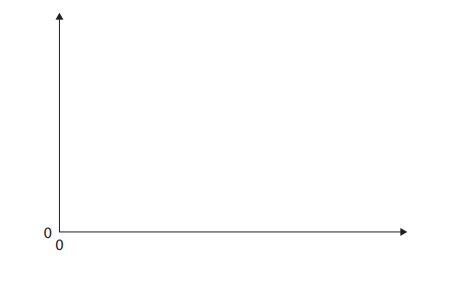
(a) A metal spring obeys Hooke’s law. Sketch a graph to show that the spring obeys Hooke’s law as it is stretched. You should label both axes with appropriate physical quantities
(b) Diagram 1 shows an object suspended from a support using a metal spring. The object is initially at rest.
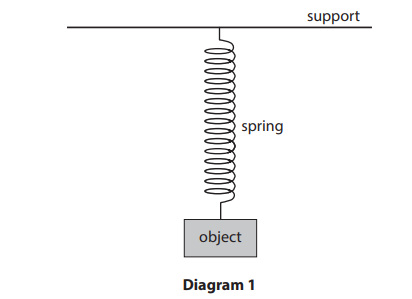
(i) The object is pulled down and then released. Diagram 2 shows the forces acting on the object at the instant it is released. 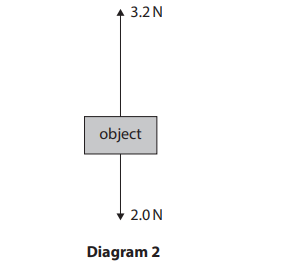
Determine the magnitude and direction of the resultant force acting on the object.
(ii) The object has a mass of 0.20kg. Calculate the acceleration of the object at the instant it is released
(iii) Explain how the magnitude of the acceleration of the object changes, from the instant the object is released until the first time the object returns to its initial resting position. You should refer to the forces acting on the object in your answer.
Syllabus Topic Codes (Edexcel International GCSE Physics 4PH1):
• 1.15: Calculation of resultant forces acting along a line — part (b)(i)
• 1.17: Relationship between unbalanced force, mass and acceleration — part (b)(ii)
• 1.15, 1.17, 1.23: Resultant force, acceleration and the changing spring force as extension changes — part (b)(iii)
▶️Answer/Explanation
Ans
(a) axes labelled “extension”/“elongation” and “load”/“force”/”weight”;
straight line of positive gradient drawn throughout;
line passes through origin;
(b) (i) magnitude = 1.2 (N);
direction = up(wards);
(ii) substitution into F = m × a;
rearrangement;
evaluation;
e.g.
1.2 = 0.20 × a
a = 1.2 / 0.20
(a =) 6.0 \(m/s^2\)
(iii) acceleration decreases (to zero);
with any two from:
• spring extension decreases;
• force from spring / elastic force / upwards force decreases;
• weight (of object) stays the same;
• resultant force decreases (to zero);
Questions
Diagram 1 shows the apparatus a student uses to investigate the bending of a wooden strip. Part of the wooden strip is clamped to a table. A load is fixed to the free end of the wooden strip, causing it to bend.
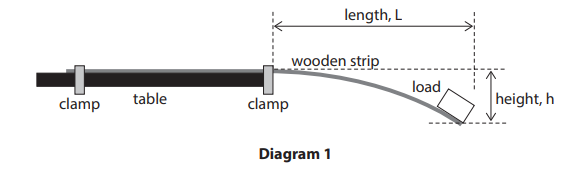
The free end of the wooden strip is positioned a length, L, beyond the edge of the table, as shown in diagram 1. The weight of the load causes the end of the wooden strip to move down through a height, h. A student investigates how the length, L, affects the height, h.
(a) The load has a mass of 250g. Calculate the weight of the load. Use the formula
weight = mass × gravitational field strength, g
(b) This is the student’s method for the investigation.
• clamp the wooden strip so that L = 20cm
• fix the load to the end of the wooden strip, as shown in diagram 1
• measure the height, h
The student repeats this method for different values of L.
(i) Give the independent and dependent variables in the investigation.
(ii) Give two control variables in the investigation.
(iii) Suggest how the student could accurately measure the height, h.
(c) The table shows the results of the investigation.
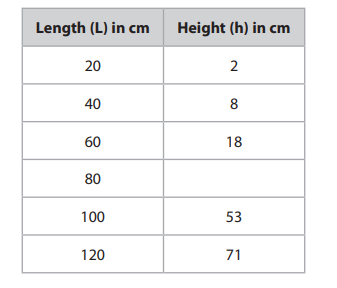
(i) Diagram 2 shows the wooden strip when L = 80 cm. 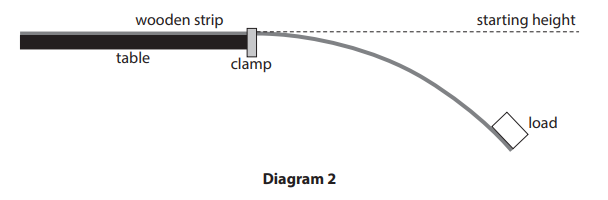
Using diagram 2, determine the height, h, in the laboratory.
[1cm on the diagram = 10cm in the laboratory]
(ii) Plot a graph of the student’s results.
(iii) Draw the curve of best fit.
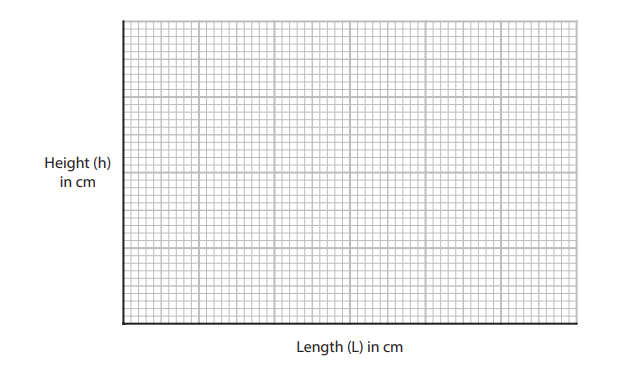
(iv) The student concludes that h is directly proportional to L. Evaluate the student’s conclusion.
Syllabus Topic Codes (Edexcel International GCSE Physics 4PH1):
• 1.11: Effects of forces between bodies, including changes in shape — parts (b)(i), (b)(ii), (b)(iii)
• 1.11: Effects of forces and deformation of materials, with analysis and interpretation of experimental data — parts (c)(i), (c)(ii), (c)(iii), (c)(iv)
▶️Answer/Explanation
Ans
(a) substitution into formula;
e.g.
weight = 250 (÷1000) × 10
(weight =) 2.5 (N)
(b) (i) independent variable = length (extending beyond table);
dependent variable = height;
(ii) any two from: 2
• mass/weight of load;
• position of load (on wooden strip);
• thickness of wood(en strip);
• material/type of wood(en strip);
(iii) any two from: 2
MP1. use of (metre) rule;
MP2. fixed in place at end of wooden strip;
MP3. 0 on rule placed at original height of wooden strip;
MP4. method to ensure measurement is vertical e.g. using a plumb line, set square etc.;
MP5. measure at eye level;
(c) (i) correct measurement from diagram = 3.1 (cm);
use of scale factor gives 31 (cm);
(ii) suitable linear scale chosen (>50% of grid used);
plotting correct to nearest half square;
(iii) acceptable curve of best fit drawn for data between 20cm and 120cm;
(iv) idea that proportionality requires a straight line (through the origin);
(graph does not show this so)
conclusion/student is incorrect;
Question
This question is about the stretching of a material.
A material is stretched by applying an increasing load. The material shows elastic behaviour as it is stretched.
(a) Describe what is meant by elastic behaviour. (2)
(b) The material obeys Hooke’s law. Sketch a graph for this material to show that it obeys Hooke’s law as it is stretched. You should label both axes with appropriate physical quantities. (3)

Syllabus Topic Codes (Edexcel International GCSE Physics 4PH1):
▶️ Answer/Explanation
(a) Elastic behaviour [2 marks]
- The material returns to its original shape or length.
- This occurs when the load or force is removed.
Therefore, a material behaves elastically if it does not have a permanent deformation when the load is removed.
(b) Hooke’s law graph [3 marks]
Axes:
- Horizontal axis: extension in metres (\(\mathrm{m}\)).
- Vertical axis: load/force in newtons (\(\mathrm{N}\)).
Shape of graph:
- A straight line with a positive gradient.
- The line passes through the origin.
This shows that the load is directly proportional to the extension, which is the condition for Hooke’s law:
\(\boxed{\mathrm{load}\propto\mathrm{extension}}\)
or
\(\boxed{F=kx}\)
where \(F\) is the force, \(x\) is the extension and \(k\) is the spring constant.
Questions
(a) The graph shows how the velocity of a ball rolling down a long ramp changes with time.

(i) Using the graph, calculate the acceleration of the ball.
(ii) State the feature of the graph that gives the distance travelled by the ball.
(iii) Calculate the distance travelled by the ball in \(2.5\,\mathrm{s}\).
(b) The table shows data for the ball after it has travelled for two different times.

A student suggests that these results obey the relationship:
\(\dfrac{\mathrm{distance}}{\mathrm{time}^2}=\mathrm{constant}\)
Use data from the table to deduce whether the results support this suggestion.
Syllabus Topic Codes (Edexcel International GCSE Physics 4PH1):
• 1.7: Velocity-Time Graphs — parts (a)(i)–(iii)
• 1.8: Acceleration from the Gradient of a Velocity-Time Graph — part (a)(i)
• 1.9: Distance Travelled from the Area Under a Velocity-Time Graph — parts (a)(ii)–(iii)
• 1.6: Relationship Between Acceleration, Change in Velocity and Time — part (b)
▶️ Answer/Explanation
(a)(i) Acceleration of the ball
The gradient of a velocity-time graph gives acceleration:
\(a=\dfrac{\Delta v}{\Delta t}\)
Using the graph:
\(a=\dfrac{3.0-0}{2.5-0}\)
\(a=1.2\,\mathrm{m\,s^{-2}}\)
\(\boxed{a=1.2\,\mathrm{m\,s^{-2}}}\)
(a)(ii) Distance travelled
The area between the velocity-time graph and the time axis gives the distance travelled.
(a)(iii) Distance travelled in \(2.5\,\mathrm{s}\)
The area under the graph is a triangle.
\(\mathrm{distance}=\dfrac{1}{2}\times\mathrm{base}\times\mathrm{height}\)
\(\mathrm{distance}=\dfrac{1}{2}\times2.5\times3.0\)
\(\mathrm{distance}=3.75\,\mathrm{m}\)
\(\boxed{\mathrm{distance}=3.8\,\mathrm{m}}\)
(b) Testing the suggested relationship
Calculate \(\dfrac{\mathrm{distance}}{\mathrm{time}^2}\) for each set of data.
For \(t=5\,\mathrm{s}\) and \(s=15\,\mathrm{m}\):
\(\dfrac{s}{t^2}=\dfrac{15}{5^2}=\dfrac{15}{25}=0.60\,\mathrm{m\,s^{-2}}\)
For \(t=10\,\mathrm{s}\) and \(s=60\,\mathrm{m}\):
\(\dfrac{s}{t^2}=\dfrac{60}{10^2}=\dfrac{60}{100}=0.60\,\mathrm{m\,s^{-2}}\)
The two values are equal, so the results support the suggested relationship.
\(\boxed{\dfrac{\mathrm{distance}}{\mathrm{time}^2}=\mathrm{constant}}\)
Question
The diagram shows a balloon with a mass attached held at rest just below the surface of a deep pool of water.

(a) The balloon and mass are released. The graph shows the velocity-time graph for the balloon and mass as they fall through the water.

(i) Use information from the graph to determine the terminal velocity of the balloon and mass.
(ii) Explain how the balloon reaches terminal velocity. You should use ideas about forces acting on the balloon in your answer.
(b)(i) State the formula linking pressure difference, height, density and gravitational field strength.
(ii) Calculate the increase in pressure on the balloon when it has reached a depth of \(25\,\mathrm{m}\) in the water.
[for water, density = \(1000\,\mathrm{kg\,m^{-3}}\)]
(iii) At the surface, the atmospheric pressure on the balloon is \(1.0\times10^5\,\mathrm{Pa}\). Show that the total pressure on the balloon at a depth of \(25\,\mathrm{m}\) is \(3.5\times10^5\,\mathrm{Pa}\).
(iv) At the surface, where the pressure is \(1.0\times10^5\,\mathrm{Pa}\), the balloon has a volume of \(0.46\,\mathrm{m^3}\). Calculate the volume of the balloon at a depth of \(25\,\mathrm{m}\).
Syllabus Topic Codes (Edexcel International GCSE Physics 4PH1):
• 5.5–5.7: Pressure, Force, and Area; Pressure in Fluids at Rest and Pressure Difference — parts (b)(i)–(iii)
• 5.20–5.22: Gas Pressure Relationships (Pressure–Temperature and Pressure–Volume) — part (b)(iv)
▶️ Answer/Explanation
(a)(i) Terminal velocity [1 mark]
Terminal velocity is the constant velocity reached when the velocity-time graph becomes horizontal.
From the graph:
\(\boxed{v=8.2\,\mathrm{m\,s^{-1}}}\)
(a)(ii) Reaching terminal velocity [4 marks]
- The main forces acting are weight downwards and drag upwards.
- Initially, the weight is greater than the drag, so there is a resultant downward force and the balloon accelerates.
- As the speed increases, the drag force increases.
- Eventually, the drag becomes equal to the weight, so the resultant force is zero and the balloon continues at a constant velocity called terminal velocity.
At terminal velocity:
\(\boxed{\mathrm{weight}=\mathrm{drag}}\)
(b)(i) Pressure difference formula [1 mark]
The pressure difference in a liquid is given by:
\(\boxed{\Delta p=h\rho g}\)
(b)(ii) Increase in pressure [2 marks]
Use:
\(\Delta p=h\rho g\)
Taking \(h=25\,\mathrm{m}\), \(\rho=1000\,\mathrm{kg\,m^{-3}}\), and \(g=10\,\mathrm{N\,kg^{-1}}\):
\(\Delta p=25\times1000\times10\)
\(\Delta p=250\,000\,\mathrm{Pa}\)
Therefore: \(\boxed{\Delta p=2.5\times10^5\,\mathrm{Pa}}\)
(b)(iii) Total pressure [2 marks]
The total pressure is the atmospheric pressure at the surface plus the increase in pressure due to the water.
\(p=1.0\times10^5+2.5\times10^5\)
\(p=3.5\times10^5\,\mathrm{Pa}\)
Therefore: \(\boxed{p=3.5\times10^5\,\mathrm{Pa}}\)
(b)(iv) Volume of the balloon [3 marks]
At constant temperature, pressure and volume are inversely proportional, so:
\(p_1V_1=p_2V_2\)
Substitute \(p_1=1.0\times10^5\,\mathrm{Pa}\), \(V_1=0.46\,\mathrm{m^3}\), and \(p_2=3.5\times10^5\,\mathrm{Pa}\):
\(1.0\times10^5\times0.46=3.5\times10^5\times V_2\)
Rearranging:
\(V_2=\dfrac{1.0\times10^5\times0.46}{3.5\times10^5}\)
\(V_2=0.1314\,\mathrm{m^3}\)
Therefore: \(\boxed{V_2\approx0.13\,\mathrm{m^3}}\)
Question
The diagram shows the forces acting on a firework at take-off.

(a)(i) Calculate the magnitude of the resultant force on the firework.
(ii) State the formula linking resultant force, mass and acceleration.
(iii) The mass of the firework is \(160\,\mathrm{g}\). Calculate the acceleration of the firework.
(iv) Explain how the acceleration of the firework changes between take-off and running out of fuel. You can assume that the thrust force stays the same as the firework burns the fuel.
(b) The firework makes a sound with constant frequency. As the firework moves upwards, people on the ground notice that the frequency of the sound they hear changes. This is called the Doppler effect. Explain how the Doppler effect causes the observed frequency of sound to change for the people on the ground.
Syllabus Topic Codes (Edexcel International GCSE Physics 4PH1):
• 1.6: Acceleration — parts (a)(ii)–(iii)
• 1.17–1.18: Force, Mass, Weight, and Gravitational Field Strength — part (a)(iv)
• 1.21: Forces on Falling Objects and Terminal Velocity — part (a)(iv), considering changing forces and acceleration
• 3.8: Doppler Effect — part (b)
▶️ Answer/Explanation
(a)(i) Resultant force [1 mark]
The resultant force is found by subtracting the downward force from the upward thrust force shown in the diagram.
\(\boxed{F_{\mathrm{resultant}}=26.4\,\mathrm{N}}\)
(a)(ii) Resultant force equation [1 mark]
The formula linking resultant force, mass and acceleration is:
\(\boxed{F=ma}\)
(a)(iii) Acceleration of the firework [3 marks]
First convert the mass into kilograms:
\(160\,\mathrm{g}=0.16\,\mathrm{kg}\)
Rearrange \(F=ma\) to give:
\(a=\dfrac{F}{m}\)
Substitute \(F=26.4\,\mathrm{N}\) and \(m=0.16\,\mathrm{kg}\):
\(a=\dfrac{26.4}{0.16}\)
\(a=165\,\mathrm{m\,s^{-2}}\)
Therefore: \(\boxed{a=165\,\mathrm{m\,s^{-2}}}\)
(a)(iv) Change in acceleration [3 marks]
- As the firework burns fuel, its mass decreases, so its weight decreases.
- As the firework moves faster, air resistance increases.
- Therefore, the resultant force changes, causing the acceleration to change.
Since the thrust remains constant, the changing mass and increasing air resistance affect the resultant force and therefore the acceleration.
(b) Doppler effect [4 marks]
- The observed frequency decreases as the firework moves away from the people on the ground.
- The speed of the sound waves through the air remains approximately constant.
- As the firework moves away, the wavefronts behind the firework become more spread out.
- This causes the wavelength reaching the observers to increase.
Using the wave equation:
\(f=\dfrac{v}{\lambda}\)
Since \(v\) remains constant while \(\lambda\) increases, the observed frequency \(f\) decreases.
Question
A model electric motor is used to lift a load through a vertical height.

(a) The load has a mass of \(400\,\mathrm{g}\) and gains \(3.2\,\mathrm{J}\) of energy in its gravitational store when lifted.
(i) State the formula linking gravitational potential energy, mass, gravitational field strength (\(g\)) and height.
(ii) Calculate the height the load is lifted.
(iii) State the amount of useful work done on the load by the motor when the load is lifted through this height.
(b) The load is lifted at a constant speed. Diagram 1 shows the lifting force acting on the load as it is lifted. Draw a labelled arrow on diagram 1 to show the other force acting on the load. Ignore the effects of air resistance.

(c) A joulemeter measures the amount of energy transferred electrically to the motor as the motor lifts the load. The joulemeter displays a reading of \(11.0\,\mathrm{J}\) when the load has gained \(3.2\,\mathrm{J}\) of energy in its gravitational store.
(i) Calculate the efficiency of the motor.
(ii) Justify why \(7.8\,\mathrm{J}\) of energy must be dissipated into the thermal store of the surroundings as the load is lifted.
(iii) Diagram 2 is an incomplete Sankey diagram. Complete the Sankey diagram to show the energy transferred by the motor.

Syllabus Topic Codes (Edexcel International GCSE Physics 4PH1):
• 4.12: Work Done and Energy Transfer — part (a)(iii)
• 1.17–1.18: Force, Mass, Weight, and Gravitational Field Strength — part (b)
• 4.4: Efficiency — part (c)(i)
• 4.3: Conservation of Energy — part (c)(ii)
• 4.5: Energy Transfers in Devices and Sankey Diagrams — part (c)(iii)
▶️ Answer/Explanation
(a)(i) Gravitational potential energy formula [1 mark]
The formula linking gravitational potential energy, mass, gravitational field strength and height is:
\(\boxed{E_{\mathrm{p}}=mgh}\)
(a)(ii) Height lifted [3 marks]
Convert the mass into kilograms:
\(400\,\mathrm{g}=0.40\,\mathrm{kg}\)
Use:
\(E_{\mathrm{p}}=mgh\)
Substitute \(E_{\mathrm{p}}=3.2\,\mathrm{J}\), \(m=0.40\,\mathrm{kg}\), and \(g=10\,\mathrm{N\,kg^{-1}}\):
\(3.2=0.40\times10\times h\)
\(h=\dfrac{3.2}{0.40\times10}\)
\(h=0.80\,\mathrm{m}\)
Therefore: \(\boxed{h=0.80\,\mathrm{m}}\)
(a)(iii) Useful work done [1 mark]
The useful work done is equal to the increase in the gravitational potential energy store.
Therefore: \(\boxed{W=3.2\,\mathrm{J}}\)
(b) Other force acting on the load [2 marks]
Since the load is moving at a constant speed, the resultant force is zero. Therefore, the upward lifting force must be balanced by the downward weight of the load.
Draw a vertically downward arrow labelled weight, \(W\), or \(mg\). The arrow should be equal in length to the lifting-force arrow.
(c)(i) Efficiency of the motor [3 marks]
Use:
\(\mathrm{efficiency}=\dfrac{\mathrm{useful\ energy\ output}}{\mathrm{total\ energy\ input}}\times100\%\)
Substitute the useful energy output \(3.2\,\mathrm{J}\) and total energy input \(11.0\,\mathrm{J}\):
\(\mathrm{efficiency}=\dfrac{3.2}{11.0}\times100\%\)
\(\mathrm{efficiency}\approx29\%\)
Therefore: \(\boxed{\mathrm{efficiency}=29\%}\)
(c)(ii) Dissipated energy [2 marks]
Energy must be conserved. The electrical energy supplied is \(11.0\,\mathrm{J}\), while \(3.2\,\mathrm{J}\) is transferred usefully to the gravitational store.
Therefore, the remaining energy is:
\(11.0-3.2=7.8\,\mathrm{J}\)
This energy is dissipated mainly into the thermal store of the surroundings.
Therefore: \(\boxed{7.8\,\mathrm{J}}\)
(c)(iii) Sankey diagram [2 marks]
The Sankey diagram should show:
- An input of \(11.0\,\mathrm{J}\).
- A useful output of \(3.2\,\mathrm{J}\) directed to the right and labelled useful output (energy).
- A dissipated output of \(7.8\,\mathrm{J}\) directed downwards and transferred to the thermal store of the surroundings.
The useful output arrow should have a width corresponding to 8 small squares, as shown by the mark scheme.
Question
Diagram 1 shows a set of masses attached to a spring, which is suspended from a support.

(a) After the masses are added, the length of the spring is \(14.6\,\mathrm{cm}\). The student measures the extension of the spring as \(11.5\,\mathrm{cm}\).
(i) Calculate the original length of the spring.
(ii) The student removes the masses and notices that the spring does not show elastic behaviour. Predict a value for the new length of the spring after the masses have been removed.
(b) The student puts the masses back on the spring. The student then pulls the masses down and releases them. The masses vibrate up and down in a vertical direction, as shown in diagram 2.

The distance–time graph shows how the distance between the top of the masses and the support changes with time as the masses vibrate.

(i) Explain how the gradient of the graph shows that the masses accelerate as they vibrate.
(ii) Add crosses (X) to the distance–time graph to show all the times when the masses are not moving.
Syllabus Topic Codes (Edexcel International GCSE Physics 4PH1):
• 1.23: Hooke’s law and the initial linear region of a force-extension graph — part (a)(ii)
• 1.24: Elastic behaviour and recovery of original shape after deformation — part (a)(ii)
• 1.3: Plot and explain distance–time graphs — part (b)
• 1.4: Average speed, distance moved and time taken — part (b)(i)
• 1.6: Acceleration, velocity and time taken — part (b)(i)
▶️ Answer/Explanation
(a)(i) Original length of the spring [1 mark]
The extension is the difference between the new length and the original length:
\(\mathrm{extension}=\mathrm{new\ length}-\mathrm{original\ length}\)
Therefore:
\(\mathrm{original\ length}=14.6-11.5\)
\(\boxed{\mathrm{original\ length}=3.1\,\mathrm{cm}}\)
(a)(ii) New length after removing the masses [1 mark]
The spring does not show elastic behaviour, so it does not return to its original length after the masses are removed.
Therefore, the new length must be greater than \(3.1\,\mathrm{cm}\), but it cannot be greater than the stretched length of \(14.6\,\mathrm{cm}\).
Any suitable value in this range is acceptable, for example:
\(\boxed{10.0\,\mathrm{cm}}\)
(b)(i) Gradient and acceleration [3 marks]
The gradient of a distance–time graph represents speed.
The graph has a changing gradient, so the speed of the masses is not constant.
Since the velocity changes with time, the masses are accelerating during their vibration.
Therefore, the changing gradient of the graph provides evidence that the masses are accelerating.
(b)(ii) Times when the masses are not moving [2 marks]
The masses are momentarily stationary when their speed is zero.
On a distance–time graph, speed is the gradient. Therefore, the masses are not moving where the graph has a zero gradient, which occurs at the peaks and troughs.
Place crosses at all three peaks and all three troughs of the graph.
Question
The driver of a racing car makes a pit stop during a race to change the tyres on the racing car. The area where the tyres are changed is called the pit lane.

(a) Before entering the pit lane, the speed of the car must decrease for safety reasons.
(i) The mass of the racing car is \(830\,\mathrm{kg}\). The maximum braking force is \(41000\,\mathrm{N}\). Show that the maximum deceleration of the racing car is approximately \(50\,\mathrm{m\,s^{-2}}\).
(ii) The racing car is travelling at an initial speed of \(72\,\mathrm{m\,s^{-1}}\). Calculate the minimum distance needed to decrease the speed of the racing car from \(72\,\mathrm{m\,s^{-1}}\) to \(26\,\mathrm{m\,s^{-1}}\).
(b) The racing car slows down using its brakes. The brakes work using friction. The brakes become very hot when the racing car slows down. Using ideas about energy, explain why the brakes become hot.
(c) The tyres of the racing car also get very hot during a race. A mechanic has to handle the hot tyres during the pit stop. They wear protective gloves which have several layers of insulating materials. Explain how the layers of insulating materials in the gloves reduce the risk of the mechanic burning their hands on the hot tyres.
Syllabus Topic Codes (Edexcel International GCSE Physics 4PH1):
• 1.17–1.18: Force, Mass, Weight, and Gravitational Field Strength — part (a)(i)
• 1.9–1.10: Motion Equations — part (a)(ii)
• 1.16: Friction — part (b)
• 4.2–4.3: Energy Stores, Energy Transfer Pathways, and Conservation of Energy — part (b)
• 4.6–4.7: Thermal Energy Transfer and Convection — part (c)
• 4.10: Reducing Unwanted Energy Transfer — part (c)
▶️ Answer/Explanation
(a)(i) Maximum deceleration [3 marks]
Use Newton’s second law:
\(F=ma\)
Rearrange to find acceleration:
\(a=\dfrac{F}{m}\)
Substitute \(F=41000\,\mathrm{N}\) and \(m=830\,\mathrm{kg}\):
\(a=\dfrac{41000}{830}\)
\(a\approx49.4\,\mathrm{m\,s^{-2}}\)
Therefore: \(\boxed{a\approx50\,\mathrm{m\,s^{-2}}}\)
(a)(ii) Minimum braking distance [3 marks]
Use the motion equation:
\(v^2=u^2+2as\)
For braking, the acceleration is negative:
\(26^2=72^2+2(-50)s\)
\(676=5184-100s\)
\(100s=5184-676\)
\(s=45.08\,\mathrm{m}\)
Therefore: \(\boxed{s\approx45\,\mathrm{m}}\)
(b) Why the brakes become hot [3 marks]
- The kinetic energy store of the racing car decreases as the car slows down.
- Friction between the brake components causes energy to be transferred to the thermal energy store of the brakes.
- Therefore, the temperature of the brakes increases and they become hot.
This is an example of conservation of energy: the decrease in the car’s kinetic energy is transferred mainly into thermal energy.
(c) Insulating gloves [4 marks]
- The insulating materials are poor conductors of thermal energy.
- The layers trap pockets of air between them.
- Air is also a poor conductor and therefore acts as a good insulator.
- The multiple layers increase the thickness of the insulating material, reducing the rate of thermal conduction from the hot tyres to the mechanic’s hands.
Therefore, less thermal energy is transferred to the hands in a given time, reducing the risk of burns.