
Edexcel iGCSE Physics (4PH1) 1.4 Momentum Exam Style Question Paper 2B - New Syllabus
Question
The diagram shows some of the parts of a hydroelectric power station.
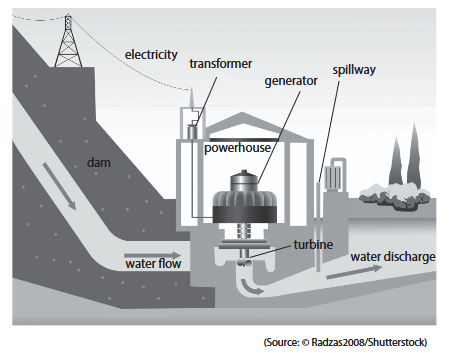
Water is discharged from the turbine, and a spillway is also shown.
(a) Water enters the turbine with a momentum of \(120\,000\,\mathrm{kg\,m\,s^{-1}}\).
(i) State the formula linking momentum, mass and velocity. (1)
(ii) A mass of \(14\,000\,\mathrm{kg}\) of water enters the turbine.
Calculate the velocity of the water as it enters the turbine. (2)
velocity = __________________ \(\mathrm{m\,s^{-1}}\)
(iii) The \(14\,000\,\mathrm{kg}\) of water leaves the turbine.
This water has a momentum of \(63\,000\,\mathrm{kg\,m\,s^{-1}}\) after it leaves the turbine.
The turbine exerts a force of \(6100\,\mathrm{N}\) on the water.
Calculate the time taken for the water to pass through the turbine. (3)
time = __________________ \(\mathrm{s}\)
(b) As the water passes through the turbine, energy is lost from the water’s kinetic energy store.
Explain what happens to the energy lost from the water’s kinetic energy store. (3)
(c) Hydroelectric power is an example of a renewable resource for the generation of electricity.
Give two examples of non-renewable resources for the generation of electricity. (2)
1. __________________________________________
2. __________________________________________
Syllabus Topic Codes (Edexcel International GCSE Physics 4PH1):
• 1.28P: Force, Momentum, and Time — part (a)(iii)
• 4.2–4.5: Energy Stores, Energy Transfer Pathways, Conservation of Energy, Efficiency, and Energy Transfers in Devices — part (b)
• 4.18–4.19P: Electricity Generation from Energy Resources; Advantages and Disadvantages — part (c)
▶️ Answer/Explanation
(a)(i) Momentum formula [1 mark]
The relationship between momentum, mass and velocity is:
\(p=mv\)
Final Answer: \( \boxed{p=mv} \)
(a)(ii) Velocity of the water [2 marks]
1. Start with the momentum equation:
\(p=mv\)
2. Rearrange for velocity:
\(v=\dfrac{p}{m}\)
3. Substitute the values:
\(v=\dfrac{120\,000}{14\,000}\)
\(v=8.57\,\mathrm{m\,s^{-1}}\)
To 2 significant figures:
\(v=8.6\,\mathrm{m\,s^{-1}}\)
Final Answer: \( \boxed{8.6\,\mathrm{m\,s^{-1}}} \)
(a)(iii) Time taken for the water to pass through the turbine [3 marks]
1. Calculate the change in momentum:
\(\mathrm{change\ in\ momentum}=120\,000-63\,000\)
\(\mathrm{change\ in\ momentum}=57\,000\,\mathrm{kg\,m\,s^{-1}}\)
2. Use the relationship between force, momentum change and time:
\(F=\dfrac{\Delta p}{t}\)
Therefore:
\(t=\dfrac{\Delta p}{F}\)
3. Substitute the values:
\(t=\dfrac{57\,000}{6100}\)
\(t=9.34\,\mathrm{s}\)
To an appropriate number of significant figures:
\(t=9.3\,\mathrm{s}\)
Final Answer: \( \boxed{9.3\,\mathrm{s}} \)
(b) Energy transfer from the water [3 marks]
- Energy is transferred mechanically from the water to the turbine.
- The kinetic energy store of the turbine increases as the turbine rotates.
- Some energy is also transferred to the thermal energy stores of the turbine and its surroundings, for example because of friction and other unwanted energy transfers.
Final Answer: The energy lost from the water’s kinetic energy store is mainly transferred mechanically to the turbine, increasing its kinetic energy store. Some energy is dissipated to the thermal energy stores of the turbine and surroundings.
(c) Non-renewable energy resources [2 marks]
Any two suitable examples include:
- coal
- gas
- oil
- petrol
- diesel
- kerosene
- uranium
- plutonium
- nuclear fuel
- fossil fuels
Final Answer: \( \boxed{\mathrm{coal\ and\ gas}} \)
Question
A tennis ball is dropped from a height above the ground.
(a) Diagram 1 shows the tennis ball at the instant it is released.
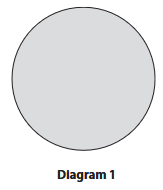
On diagram 1, draw a labelled arrow to show the force acting on the tennis ball at the instant it is released.
(b) Diagram 2 shows the tennis ball at the instant it hits the ground.
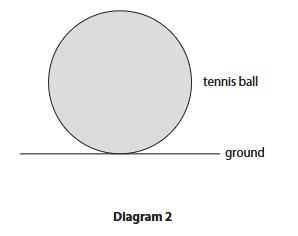
Just before hitting the ground, the tennis ball is moving downwards at a velocity of \(2.5\,\mathrm{m\,s^{-1}}\).
Just after hitting the ground, the tennis ball is moving upwards at a speed of \(1.9\,\mathrm{m\,s^{-1}}\).
(i) The mass of the tennis ball is \(0.057\,\mathrm{kg}\).
Calculate the change in momentum of the tennis ball when it hits the ground.
Give the unit. (4)
change in momentum = __________________ unit = __________________
(ii) The ball is in contact with the ground for a time of \(6.0\,\mathrm{ms}\).
Calculate the force exerted on the ball by the ground.
Give the direction of this force. (3)
force = __________________ \(\mathrm{N}\)
direction = __________________
(c) The coefficient of restitution can be used to determine how high a ball will bounce. The higher the value of the coefficient of restitution, the higher the ball will bounce.
Diagram 3 shows a ball being dropped from a height \((h_1)\) above the ground.
The ball hits the ground and bounces.
At the top of its bounce, the ball reaches a height \((h_2)\) above the ground.
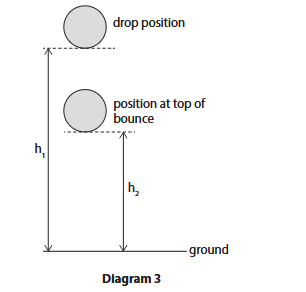
The coefficient of restitution can be determined using the formula
\(\mathrm{coefficient\ of\ restitution}=\sqrt{\dfrac{h_2}{h_1}}\)
A student decides to do an investigation to compare the coefficient of restitution for different types of ball.
Design a method for the student’s investigation.
Your answer should include details of:
- the variables in the investigation
- how to obtain accurate measurements
- how to obtain reliable results
You may add to diagram 3 or draw an additional diagram to help your answer. (6)
Syllabus Topic Codes (Edexcel International GCSE Physics 4PH1):
• 1.25P: Momentum, \(p=mv\), part (b)(i)
• 1.26P: Change in momentum, part (b)(i)
• 1.28P: Force, change in momentum and time, part (b)(ii)
• 1.5: Investigating motion experimentally, including identifying variables, making accurate measurements and obtaining reliable results, part (c)
▶️ Answer/Explanation
(a) Force acting on the ball [2 marks]
The force acting on the ball when it is released is its weight.
- Draw an arrow vertically downwards through the centre of the ball.
- Label the arrow weight or gravitational force.
Final Answer: A downward arrow through the centre of the ball labelled weight.
(b)(i) Change in momentum [4 marks]
1. Calculate the initial momentum:
\(p=mv\)
\(p_\mathrm{initial}=(0.057)(2.5)\)
\(p_\mathrm{initial}=0.1425\,\mathrm{kg\,m\,s^{-1}}\)
2. Calculate the final momentum:
\(p_\mathrm{final}=(0.057)(1.9)\)
\(p_\mathrm{final}=0.1083\,\mathrm{kg\,m\,s^{-1}}\)
The two velocities are in opposite directions, so the change in momentum is the sum of the two momentum magnitudes.
\(\Delta p=0.1425+0.1083\)
\(\Delta p=0.2508\,\mathrm{kg\,m\,s^{-1}}\)
Final Answer: \(\boxed{0.25\,\mathrm{kg\,m\,s^{-1}}}\)
(b)(ii) Force exerted by the ground [3 marks]
1. Use the relationship between force, change in momentum and time:
\(F=\dfrac{\Delta p}{\Delta t}\)
2. Convert the contact time:
\(6.0\,\mathrm{ms}=0.0060\,\mathrm{s}\)
3. Substitute:
\(F=\dfrac{0.25}{0.0060}\)
\(F\approx41.7\,\mathrm{N}\)
The ground pushes the ball upwards, causing the ball to reverse its direction of motion.
Final Answer: \(\boxed{42\,\mathrm{N}}\), upwards
(c) Investigation of coefficient of restitution [6 marks]
Variables:
- Independent variable: type of ball.
- Dependent variable: height of the bounce, \(h_2\), or the calculated coefficient of restitution.
- Control variables: initial drop height \(h_1\), surface on which the ball bounces, and conditions of release.
Method for accurate measurements:
- Use a metre rule or tape measure positioned vertically and perpendicular to the ground.
- Use a set square to help ensure that the measurements are vertical.
- Release each ball from the same measured height \(h_1\), without pushing it.
- Measure the maximum height \(h_2\) reached by the ball after the bounce.
- A slow-motion camera can be used to identify the maximum height accurately.
Calculation:
For each ball, calculate
\(\mathrm{coefficient\ of\ restitution}=\sqrt{\dfrac{h_2}{h_1}}\)
Reliable results:
- Repeat the experiment several times for each type of ball.
- Identify any anomalous results and repeat the measurement if necessary.
- Calculate a mean value for the coefficient of restitution for each type of ball.
Final Answer: Compare the mean coefficient of restitution values for the different balls. The ball with the highest mean coefficient of restitution has the greatest bounce.
Question
A crumple zone is a safety feature in a car. It is a part of the car that is designed to collapse during a collision. A student investigates the effectiveness of crumple zones. The student rolls two model cars down a ramp. Each car comes to rest when it hits a large metal block. A data logger measures the mean force applied to the car during the collision with the block. The diagram shows the equipment used in the investigation.

Car 1 has a paper crumple zone at the front.
Car 2 has no paper crumple zone.
The table shows the student’s results.

(a) The mass of each car is \(0.074\,\mathrm{kg}\). Calculate the time taken for the velocity of car 1 to decrease from \(3.0\,\mathrm{m\,s^{-1}}\) to \(0.0\,\mathrm{m\,s^{-1}}\).
(b) State the magnitude and direction of the force on the metal block, when car 2 collides with the block.
(c) Explain why the mean force from the block on car 1 is smaller than the mean force on car 2.
Syllabus Topic Codes (Edexcel International GCSE Physics 4PH1):
• 1.28P: Force, Momentum, and Time — parts (a) and (c)
• 1.29P: Newton’s Third Law — part (b)
▶️ Answer/Explanation
(a) Time taken to stop [3 marks]
Use the relationship between force, momentum and time:
\(F=\dfrac{mv-mu}{t}\)
Rearrange to make \(t\) the subject:
\(t=\dfrac{mv-mu}{F}\)
For car 1, \(m=0.074\,\mathrm{kg}\), \(u=3.0\,\mathrm{m\,s^{-1}}\), \(v=0.0\,\mathrm{m\,s^{-1}}\), and the mean force is \(2.5\,\mathrm{N}\).
\(t=\dfrac{(0.074\times0.0)-(0.074\times3.0)}{2.5}\)
Taking the magnitude of the change in momentum:
\(t=\dfrac{0.074\times3.0}{2.5}\)
\(t=0.0888\,\mathrm{s}\)
Therefore:
\(\boxed{t=0.089\,\mathrm{s}}\)
(b) Force on the metal block [2 marks]
The force exerted by the car on the metal block is \(4.9\,\mathrm{N}\). By Newton’s third law, the force on the metal block has the same magnitude but acts in the opposite direction to the force on the car.
Therefore:
\(\boxed{4.9\,\mathrm{N}}\), acting to the right, opposite to the direction of motion of the car.
(c) Effect of the crumple zone [3 marks]
- The crumple zone increases the time taken for the car to stop.
- Both cars undergo the same overall change in momentum because both are brought to rest from the same initial velocity.
- For the same change in momentum, increasing the stopping time reduces the rate of change of momentum and therefore reduces the mean force.
This follows from:
\(F=\dfrac{\Delta p}{\Delta t}\)
Therefore, the paper crumple zone makes the collision last longer and reduces the mean force acting on car 1.
Question
The diagram shows two birds, just before bird X catches the smaller bird Y. Both birds are travelling horizontally at constant velocity.

(a) Show that the momentum of bird X is about \(5\,\mathrm{kg\,m\,s^{-1}}\).
(b) The momentum of bird Y just before it is caught is \(0.15\,\mathrm{kg\,m\,s^{-1}}\). Calculate the total momentum of the birds just before bird X catches bird Y.
(c) State the total momentum of the birds just after bird X has caught bird Y.
(d) Bird Y has a mass of \(0.17\,\mathrm{kg}\). Calculate the velocity of the birds just after bird X has caught bird Y.
Syllabus Topic Codes (Edexcel International GCSE Physics 4PH1):
• 1.27P: Conservation of Momentum — parts (b), (c), and (d)
• 1.17–1.18: Force, Mass, Weight, and Gravitational Field Strength — part (d), for total mass
▶️ Answer/Explanation
(a) Momentum of bird X [2 marks]
Use the momentum equation:
\(p=mv\)
From the diagram, the mass of bird X is \(0.41\,\mathrm{kg}\) and its velocity is \(13\,\mathrm{m\,s^{-1}}\).
\(p=0.41\times13\)
\(p=5.33\,\mathrm{kg\,m\,s^{-1}}\)
Therefore:
\(\boxed{p\approx5\,\mathrm{kg\,m\,s^{-1}}}\)
(b) Total momentum before the collision [1 mark]
The momentum of bird X is approximately \(5.33\,\mathrm{kg\,m\,s^{-1}}\), and the momentum of bird Y is \(0.15\,\mathrm{kg\,m\,s^{-1}}\).
Since both birds are travelling in the same direction, their momenta are added:
\(p_\mathrm{total}=5.33+0.15\)
\(p_\mathrm{total}=5.48\,\mathrm{kg\,m\,s^{-1}}\)
\(\boxed{p_\mathrm{total}=5.48\,\mathrm{kg\,m\,s^{-1}}}\)
(c) Total momentum after the collision [1 mark]
Momentum is conserved provided there is no resultant external force acting on the system.
Therefore, the total momentum after bird X catches bird Y is equal to the total momentum before the collision.
\(\boxed{p_\mathrm{total}=5.48\,\mathrm{kg\,m\,s^{-1}}}\)
(d) Velocity after the collision [3 marks]
After bird X catches bird Y, the two birds move together, so their combined mass is:
\(m_\mathrm{total}=0.41+0.17\)
\(m_\mathrm{total}=0.58\,\mathrm{kg}\)
Using \(p=mv\):
\(5.48=0.58v\)
Rearranging:
\(v=\dfrac{5.48}{0.58}\)
\(v=9.45\,\mathrm{m\,s^{-1}}\)
Therefore:
\(\boxed{v\approx9.4\,\mathrm{m\,s^{-1}}}\)
The velocity is in the same direction as the original motion of the birds because the total momentum was in that direction before the collision.
Question
This question is about momentum and forces.
(a) State the principle of conservation of momentum.
(b) The diagram shows an air track that can be used to investigate motion without friction. Air comes out through a series of small holes in the air track. The air lifts the glider slightly above the track. A small spacecraft engine floats at rest on a cushion of air.

(i) State the momentum of the spacecraft engine when it is at rest.
(ii) The spacecraft engine ejects large numbers of xenon ions to the left. A mass of \(2.6\times10^{-8}\,\mathrm{kg}\) of xenon ions leaves the engine with a mean speed of \(26\,\mathrm{km\,s^{-1}}\). Calculate the momentum of all the ejected xenon ions.
(iii) State the magnitude and direction of the spacecraft engine’s momentum after these xenon ions leave the engine.
(iv) The ions exert a force of \(2.6\,\mathrm{mN}\) on the spacecraft engine. The spacecraft engine has a mass of \(1.2\,\mathrm{kg}\). Calculate the acceleration of the engine. Give your answer to 2 significant figures.
(c) The engine is designed to accelerate a spacecraft while the spacecraft is travelling through space. The spacecraft carries a mass of \(0.75\,\mathrm{kg}\) of xenon ions for the engine. When the engine is used, \(9.9\times10^{-8}\,\mathrm{kg}\) of xenon ions leave the engine each second. A student suggests that this small spacecraft engine would not be useful because the acceleration it produces is very small. Evaluate the student’s suggestion.
Syllabus Topic Codes (Edexcel International GCSE Physics 4PH1):
• 1.27P: Conservation of Momentum — parts (a) and (b)(iii)
• 1.28P: Force, Momentum, and Time — parts (b)(iv) and (c)
• 1.17–1.18: Force, Mass, Weight, and Gravitational Field Strength — part (b)(iv)
▶️ Answer/Explanation
(a) Conservation of momentum [1 mark]
The total momentum of a system remains constant, provided there is no resultant external force acting on the system.
Therefore:
\(\boxed{\text{total momentum before}=\text{total momentum after}}\)
(b)(i) Momentum when at rest [1 mark]
Momentum is given by:
\(p=mv\)
The spacecraft engine is at rest, so \(v=0\).
Therefore:
\(\boxed{p=0\,\mathrm{kg\,m\,s^{-1}}}\)
(b)(ii) Momentum of the xenon ions [3 marks]
Use:
\(p=mv\)
Convert the speed into \(\mathrm{m\,s^{-1}}\):
\(26\,\mathrm{km\,s^{-1}}=26000\,\mathrm{m\,s^{-1}}\)
Substitute:
\(p=(2.6\times10^{-8})(26000)\)
\(p=6.76\times10^{-4}\,\mathrm{kg\,m\,s^{-1}}\)
Therefore:
\(\boxed{p\approx6.8\times10^{-4}\,\mathrm{kg\,m\,s^{-1}}}\)
(b)(iii) Momentum of the spacecraft engine [2 marks]
Initially, the total momentum is zero. Therefore, by conservation of momentum, the momentum of the engine must be equal in magnitude and opposite in direction to the momentum of the ejected ions.
The ions move to the left, so the spacecraft engine moves to the right.
Therefore:
\(\boxed{p=6.8\times10^{-4}\,\mathrm{kg\,m\,s^{-1}}\text{ to the right}}\)
(b)(iv) Acceleration of the engine [4 marks]
Use Newton’s second law:
\(F=ma\)
Convert the force into newtons:
\(2.6\,\mathrm{mN}=2.6\times10^{-3}\,\mathrm{N}\)
Rearrange:
\(a=\dfrac{F}{m}\)
\(a=\dfrac{2.6\times10^{-3}}{1.2}\)
\(a=2.16\times10^{-3}\,\mathrm{m\,s^{-2}}\)
To 2 significant figures:
\(\boxed{a=2.2\times10^{-3}\,\mathrm{m\,s^{-2}}}\)
(c) Evaluating the student’s suggestion [6 marks]
The student is not necessarily correct. Although the acceleration at any instant is small, the engine can operate for a long time.
The mass of xenon carried is \(0.75\,\mathrm{kg}\), while \(9.9\times10^{-8}\,\mathrm{kg}\) is used each second.
The approximate operating time is:
\(\displaystyle t=\frac{0.75}{9.9\times10^{-8}}\)
\(t\approx7.6\times10^6\,\mathrm{s}\)
This is a very long operating time. A small acceleration acting continuously for a long period can produce a significant change in velocity.
Using:
\(\Delta v=a t\)
shows that even a small acceleration can produce a large change in velocity when it acts for a sufficiently long time.
Therefore, the engine can still be useful for gradually accelerating a spacecraft over a long period.
Conclusion: the student’s suggestion is not justified.