
Edexcel iGCSE Physics (4PH1) 1.5 Moments Exam Style Question Paper 2B - New Syllabus
Question
The diagram shows the apparatus used to investigate electric charge.
The equipment is viewed from above.
- ball 1 and ball 2 have a positive charge
- ball 1 is fixed in place
- ball 2 is attached to a rod that can rotate about point P
- ball 2 does not move
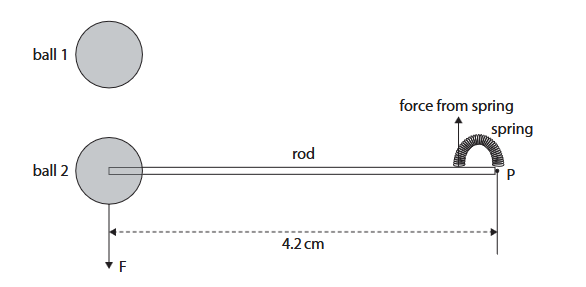
(a) State, in terms of charged particles, how the balls have become positively charged. (1)
(b) Ball 1 exerts a force, \(F\), of \(0.57\,\mathrm{N}\) on ball 2.
(i) State the value of the force exerted on ball 1 from ball 2. (1)
force = __________________ \(\mathrm{N}\)
(ii) Calculate the moment on the rod from force \(F\) about point P. (2)
moment = __________________ \(\mathrm{N\,cm}\)
(iii) State the magnitude of the moment about point P due to the force from the spring. (1)
magnitude of moment = __________________ \(\mathrm{N\,cm}\)
(iv) Draw an arrow on the diagram to show the direction of the force that the rod exerts on the spring. (1)
Syllabus Topic Codes (Edexcel International GCSE Physics 4PH1):
• 1.29P: Newton’s Third Law — part (b)(i) and relevant to part (b)(iv)
• 1.30P–1.33P: Moments, Principle of Moments and Moments on a Beam — parts (b)(ii) and (b)(iii)
▶️ Answer/Explanation
(a) Positive charge [1 mark]
The balls have become positively charged because they have lost electrons.
Final Answer: \( \boxed{\mathrm{loss\ of\ electrons}} \)
(b)(i) Force on ball 1 [1 mark]
By Newton’s Third Law, the force exerted on ball 1 by ball 2 has the same magnitude as the force exerted on ball 2 by ball 1, but acts in the opposite direction.
Therefore:
\(F=0.57\,\mathrm{N}\)
Final Answer: \( \boxed{0.57\,\mathrm{N}} \)
(b)(ii) Moment about point P [2 marks]
1. Use the moment equation:
\(\mathrm{moment}=\mathrm{force}\times\mathrm{perpendicular\ distance}\)
2. Substitute the values:
\(\mathrm{moment}=0.57\times4.2\)
\(\mathrm{moment}=2.394\,\mathrm{N\,cm}\)
To an appropriate number of significant figures:
\(\mathrm{moment}\approx2.4\,\mathrm{N\,cm}\)
Final Answer: \( \boxed{2.4\,\mathrm{N\,cm}} \)
(b)(iii) Moment due to the spring [1 mark]
Ball 2 does not move, so the rod is in rotational equilibrium. Therefore, the clockwise and anticlockwise moments about point P must be equal in magnitude.
Hence, the magnitude of the moment due to the spring is equal to the moment calculated in part (b)(ii).
\(\mathrm{moment}=2.4\,\mathrm{N\,cm}\)
Final Answer: \( \boxed{2.4\,\mathrm{N\,cm}} \)
(b)(iv) Direction of the force from the rod on the spring [1 mark]
- The spring exerts an upward force on the rod.
- By Newton’s Third Law, the rod exerts an equal and opposite force on the spring.
- Therefore, the force exerted by the rod on the spring acts downwards.
Final Answer: Draw a downward arrow on the spring.
Question
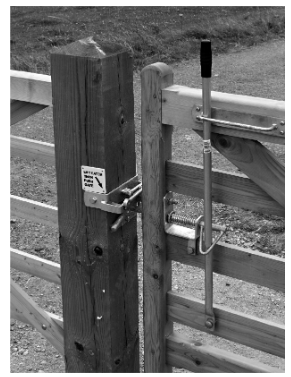
The photograph shows a mechanism that can be used to open a gate.
The diagram shows the gate mechanism when the handle is being pulled to the right.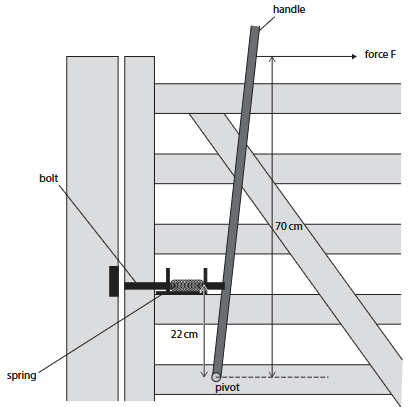
The bolt is connected to the handle. When the handle is pulled to the right, the bolt also moves to the right and the gate can be opened.
The spring is compressed when the bolt moves to the right. When the handle is released, the spring pushes the bolt back to its original position
(a) When the handle is pulled to the right, the spring applies a force on the handle to the left.
The vertical distance between the spring and the pivot point of the handle is \(22\,\mathrm{cm}\).
The force from the spring is \(5.2\,\mathrm{N}\).
(i) Show that the force from the spring produces a moment of approximately \(1\,\mathrm{N\,m}\). (3)
(ii) State what is meant by the term principle of moments. (1)
(iii) Force \(F\) acts on the handle to keep the handle stationary so that the gate can be opened.
Force \(F\) acts at a vertical distance of \(70\,\mathrm{cm}\) from the pivot point of the handle.
Calculate the magnitude of force \(F\). (3)
(b) Give two changes to this gate mechanism that would make it easier to open the gate. (2)
1. ________________________________________________
2. ________________________________________________
Syllabus Topic Codes (Edexcel International GCSE Physics 4PH1):
• 2.15: Principle of Moments and Factors Affecting Moments — part (b)
▶️ Answer/Explanation
(a)(i) Moment produced by the spring [3 marks]
1. Use the moment equation:
\(\mathrm{moment}=\mathrm{force}\times\mathrm{perpendicular\ distance}\)
2. Convert the distance into metres:
\(22\,\mathrm{cm}=0.22\,\mathrm{m}\)
3. Substitute the values:
\(\mathrm{moment}=5.2\times0.22\)
\(\mathrm{moment}=1.144\,\mathrm{N\,m}\)
Therefore, the moment is approximately \(1\,\mathrm{N\,m}\).
Final Answer: \( \boxed{1.14\,\mathrm{N\,m}\approx1\,\mathrm{N\,m}} \)
(a)(ii) Principle of moments [1 mark]
For an object in equilibrium, the sum of the clockwise moments about a pivot equals the sum of the anticlockwise moments about the same pivot.
Final Answer: Sum of clockwise moments = sum of anticlockwise moments.
(a)(iii) Magnitude of force \(F\) [3 marks]
1. Apply the principle of moments:
\(\mathrm{clockwise\ moment}=\mathrm{anticlockwise\ moment}\)
2. Use the moment from part (i):
\(F\times0.70=1.14\)
3. Rearrange and calculate:
\(F=\dfrac{1.14}{0.70}\)
\(F=1.63\,\mathrm{N}\)
To an appropriate number of significant figures:
\(F\approx1.6\,\mathrm{N}\)
Final Answer: \( \boxed{1.6\,\mathrm{N}} \)
(b) Changes to make the gate easier to open [2 marks]
Any two suitable changes:
- Use a longer handle.
- Use a weaker spring.
- Place the spring closer to the pivot point.
- Lubricate the pivot or lubricate the spring.
Final Answer: For example, use a longer handle and a weaker spring.
Question
A wrench is used to turn a nut.

(a) The force applied to the wrench is \(28\,\mathrm{N}\). Calculate the moment applied by the wrench on the nut. Give a suitable unit.
(b) State two changes that could be made to increase the size of the moment applied to the nut.
(c) Diagram 2 shows the wrench as it is turned through \(90^\circ\).

(i) The force is applied over a distance that is equal to a quarter of the circumference of a circle. The circle has a radius of \(15\,\mathrm{cm}\). Calculate the distance over which the force is applied.
[circumference of circle \(=2\times\pi\times\mathrm{radius}\)]
(ii) Calculate the work done by the force as the wrench is turned through a quarter of the circumference of the circle.
Syllabus Topic Codes (Edexcel International GCSE Physics 4PH1):
• 4.11: Work Done by a Force — part (c)(ii)
• 4.12: Work Done and Energy Transfer — part (c)(ii)
▶️ Answer/Explanation
(a) Moment applied to the nut [3 marks]
Use the equation:
\( \mathrm{moment}=\mathrm{force}\times\mathrm{perpendicular\ distance} \)
From the diagram, the perpendicular distance from the nut is \(15\,\mathrm{cm}=0.15\,\mathrm{m}\).
Therefore:
\( \mathrm{moment}=28\times0.15 \)
\( \mathrm{moment}=4.2\,\mathrm{N\,m} \)
\(\boxed{4.2\,\mathrm{N\,m}}\)
(b) Increasing the moment [2 marks]
Two suitable changes are:
- Apply a larger force.
- Apply the force further from the nut, increasing the perpendicular distance.
This follows from \( \mathrm{moment}=\mathrm{force}\times\mathrm{perpendicular\ distance} \).
(c)(i) Distance travelled by the end of the wrench [2 marks]
The circumference of the circle is:
\(C=2\pi r\)
\(C=2\times\pi\times15\)
\(C\approx94.2\,\mathrm{cm}\)
The wrench is turned through a quarter of the circle, so:
\(d=\dfrac{94.2}{4}\)
\(d\approx23.6\,\mathrm{cm}\)
Therefore, to a suitable value:
\(\boxed{d\approx24\,\mathrm{cm}}\)
(c)(ii) Work done by the force [3 marks]
Convert the distance into metres:
\(24\,\mathrm{cm}=0.24\,\mathrm{m}\)
Use:
\(W=Fd\)
Therefore:
\(W=28\times0.24\)
\(W=6.72\,\mathrm{J}\)
So the work done is approximately \(6.7\,\mathrm{J}\).
Question
This question is about moments.
Diagram 1 shows the raised lower leg of a person.

(a) (i) The moment of the weight of the lower leg about the pivot is \(19\,\mathrm{N\,m}\). A vertical force, \(F\), is applied to the person’s foot to keep the lower leg raised. The lower leg does not move.
Calculate the magnitude of force \(F\), using the formula
moment = force × perpendicular distance from pivot
(ii) Which distance is used to calculate the moment of the weight of the lower leg about the pivot?
A \(0.25\,\mathrm{m}\)
B \(0.28\,\mathrm{m}\)
C \(0.30\,\mathrm{m}\)
D \(0.55\,\mathrm{m}\)
(b) Diagram 2 shows the person resting their lower leg on two supports.

(i) The centre of gravity of the lower leg is \(0.25\,\mathrm{m}\) away from support A and \(0.35\,\mathrm{m}\) away from support B. Explain whether force \(X\) or force \(Y\) is larger. Ignore the weight of the upper leg.
(ii) A bag of ice is placed on the lower leg, vertically above the centre of gravity. This causes force \(X\) and force \(Y\) to increase. The bag is then moved towards the person’s foot.
Describe how force \(X\) and force \(Y\) change as the bag is moved towards the person’s foot.
Syllabus Topic Codes (Edexcel International GCSE Physics 4PH1):
• 1.31P: Centre of Gravity — parts (b)(i)–(ii)
▶️ Answer/Explanation
(a)(i) Calculating the force \(F\) [2 marks]
Since the lower leg does not move, it is in rotational equilibrium. Therefore, the moment produced by force \(F\) must balance the moment of the weight.
Use:
\(\mathrm{moment}=\mathrm{force}\times\mathrm{perpendicular\ distance}\)
The perpendicular distance from the pivot to the line of action of \(F\) is \(0.55\,\mathrm{m}\).
\(19=F\times0.55\)
\(F=\dfrac{19}{0.55}\)
\(F=34.5\,\mathrm{N}\)
\(\boxed{F=35\,\mathrm{N}}\)
(a)(ii) Perpendicular distance [1 mark]
The moment of a force is calculated using the perpendicular distance from the pivot to the line of action of the force.
Correct answer: A, \(0.25\,\mathrm{m}\)
(b)(i) Comparing forces \(X\) and \(Y\) [3 marks]

The centre of gravity is \(0.25\,\mathrm{m}\) from support A and \(0.35\,\mathrm{m}\) from support B.
For the lower leg to remain in rotational equilibrium, the clockwise and anticlockwise moments must be equal.
The force acting at the support with the shorter moment arm must therefore be larger.
Since force \(X\) has the shorter distance to the centre of gravity:
\(\boxed{X>Y}\)
Therefore, force \(X\) is larger than force \(Y\).
(b)(ii) Moving the bag of ice [3 marks]
- Force \(X\) decreases.
- Force \(Y\) increases.
- The forces change by the same amount, so the total upward force remains equal to the total downward force.
Moving the bag towards the foot changes the moments about the two supports, so the load is redistributed between \(X\) and \(Y\).
The total upward force must still balance the total downward force because the lower leg remains in equilibrium.